
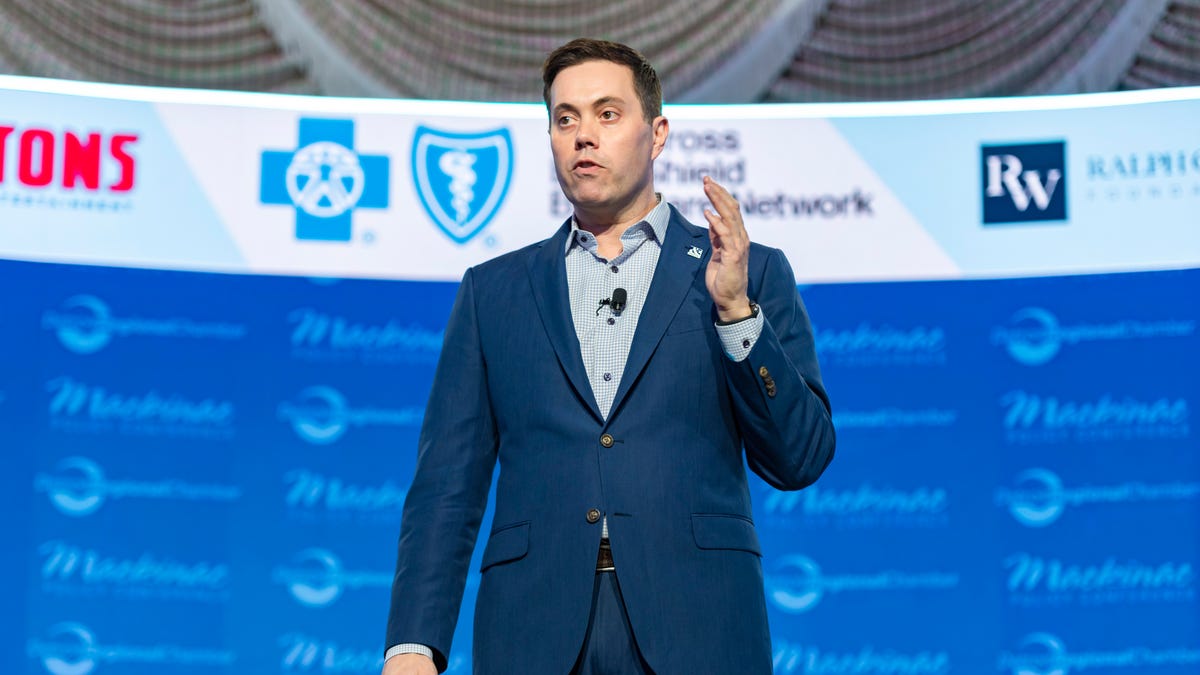
Business Leaders for Michigan on Monday called for a comprehensive strategy on education, business growth and talent retention to help the Great Lakes states compete with rivals amid technological, economic and demographic shifts.
The nonpartisan organization driven by CEOs of the largest employers in the state seeks to make Michigan a top 10 state for jobs, workforce and economy. Highlighting poor comparative performance of income gains, growth in professional service jobs, fourth-grade reading and student absenteeism, the group’s “Michigan in a New Era” proposal calls for setting politics aside to develop a plan that will strengthen Michigan through changes in gubernatorial administrations and legislatures.
“Michigan’s challenge isn’t ideas or effort — it’s consistency and follow-through,” Jeff Donofrio, CEO of Business Leaders for Michigan, said in a statement. “When priorities shift, progress stalls. We need a long-term strategy that endures beyond election cycles. Other states have shown what’s possible when that happens.”
Meanwhile, artificial intelligence and other technology disruptions, inflation and tariffs, demographic shifts and again population, and populism and distrust of institutions are creating new challenges and opportunities.
In education, the report calls for a stronger stance from Michigan’s governor to unify educators, parents, legislators and administrators around establishing clear priorities, ensuring reforms are systemic and enduring, and implementing shared accountability for results. And to move toward every third grader being able to read, the plan recommends adopting nonprofit Launch Michigan’s Every Child READS framework: right curriculum, every educator trained, assessment, data and system.
Also, one in four Michigan students are chronically absent from school. The group recommends a statewide early warning system and home visits to help address the problem. It’s also recommending a Michigan Education Guarantee standard for graduation to ensure students are ready for post-high school endeavors, expanding career and technical education, and reforming funding to encourage dual enrollment and apprenticeships instead of penalizing them.
Half of the jobs in Michigan that pay more than $60,000 per year are professional positions not in science, technology, engineering and mathematics and are managerial jobs that require a Bachelor of Arts, according to a report from Ann Arbor nonprofit Michigan Future Inc. The other half are blue-collar workers, STEM jobs and other roles.
To encourage entrepreneurship and business growth, the Business Leaders’ plan suggests a fast-track approval process for low-risk reviews, a one-stop permitting portal and reducing licensing requirements and increasing reciprocation with other states. It recommends harmonizing construction standards between communities and expanding allowable and by-right developments that don’t require discretionary approvals. Communities that simplify processes in adherence to state standards also should be recognized and rewarded, the group said.
Another goal is to take advantage of Michigan’s economic-driving resources. The plan emphasizes reforms to the Michigan Economic Development Corp. It calls for a unifying economic development vision, leveraging regional strengths and dedicating multiyear funding to offer consistency less susceptible to changes in appropriations and economic swings.
Retaining and attracting also is a core goal. The plan encourages linking students with in-state employers, targeted campaigns marketing Michigan and tailoring outreach to the state’s alumni. The plan also highlights actions undertaken by other states and cities in Michigan that could be adopted here or at a larger scale.
“Michigan’s future will continue to be defined by our ability to come together around a common vision for growth,” said Gary Torgow, Business Leaders For Michigan chair and chairman of Huntington National Bank. “If we continue to stay focused and work together, Michigan can endeavor to lead the nation in creating opportunity and prosperity for all.”
The Business Leaders for Michigan plan comes as Business Roundtable, a nonprofit association of leading CEOs in the United States, also released a report on how policymakers can strengthen U.S. research and development, including investments for securing supply chains, upgrading infrastructure, creating frameworks for technology like AI and developing a robust workforce.
“To remain the global leader in innovation,” Adena Friedman, CEO of Nasdaq and chair of the Business Roundtable Technology Committee, said in a statement, “the United States must continue to foster an environment where bold ideas can flourish.”
bnoble@detroitnews.com
X: @BreanaCNoble