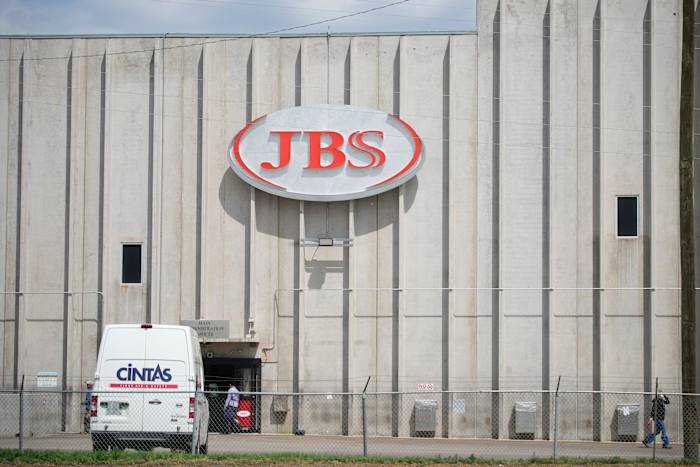
GREELEY, Colo. – Workers at one of the nation’s largest meatpacking plants have agreed to return to work and halt a three-week strike after plant owner JBS USA agreed to resume negotiations, labor union representatives announced Saturday.
The strike by thousands of workers at the Swift Beef Co. plant in Greeley, Colorado, began on March 16 in coordination with the United Food and Commercial Workers Local 7 union in a bid for higher wages and better health care.
The strike came as U.S. cattle numbers hit a 75-year-old low this year, a decline driven in part by drought and low prices offered to ranchers. Meanwhile, beef prices have soared to record levels, adding to economic anxiety in the U.S.
The union said in a statement that workers will return to work Tuesday morning after plant owner JBS USA agreed to reopen talks later in the week.
“Workers remain united and will continue to fight,” said local union president Kim Cordova in a statement.
JBS USA spokesperson Nikki Richardson said the company is “preparing to resume and ramp up operations at the Greeley plant next week.”
“Our Last, Best and Final offer remains on the table,” Richardson said in an email that did not include terms. “We hope employees will have the opportunity to review and vote on it soon.”
The strike at Greeley is the first strike at a U.S. slaughterhouse since workers walked out at a Hormel plant in Minnesota in 1985. That strike lasted more than a year and included violent confrontations between police and protesters.
JBS is the world’s largest meatpacking company with a market capitalization of $17 billion. It is the top employer in Greeley, a city 50 miles (80 kilometers) northeast of Denver with a population of about 114,000 people.
The strike at Greeley was launched on accusations by union officials that management at Swift Beef Co. retaliated against workers and committed other unfair labor practices.
The union said the company had offered less than 2% more a year in wages, which is less than inflation in Colorado. JBS USA has denied any labor law violations and said its contract offer was fair.
The Greeley plant has about 6% of the total U.S. beef slaughterhouse capacity, said Abby Greiman, a livestock market adviser for industry consultant Ever.Ag.
An extended strike threatened to disrupt the industry, which could ultimately drive up prices, said Jennifer Martin at Colorado State University’s animal sciences department.
The price for 100% ground chuck beef more than doubled over the past two decades from $2.55 to $6.07 per pound, according to the Bureau of Labor Statistics.
The Colorado walkout followed the January closure of a meatpacking plant in Lexington, Nebraska, which was expected to ripple through the local economy and community. Tyson Foods cited the smaller herd and millions of dollars in expected losses this year.
JBS shares were approved for trading on the New York Stock Exchange last May despite environmental opposition and a federal probe that led to its guilty plea in October to bribing Brazilian officials for the financing it used for its U.S. expansion.
At the Greeley plant, union officials said the company tried to intimidate workers to quit the union in one-on-one meetings, union general counsel Matt Shechter said.
Copyright 2026 The Associated Press. All rights reserved. This material may not be published, broadcast, rewritten or redistributed without permission.