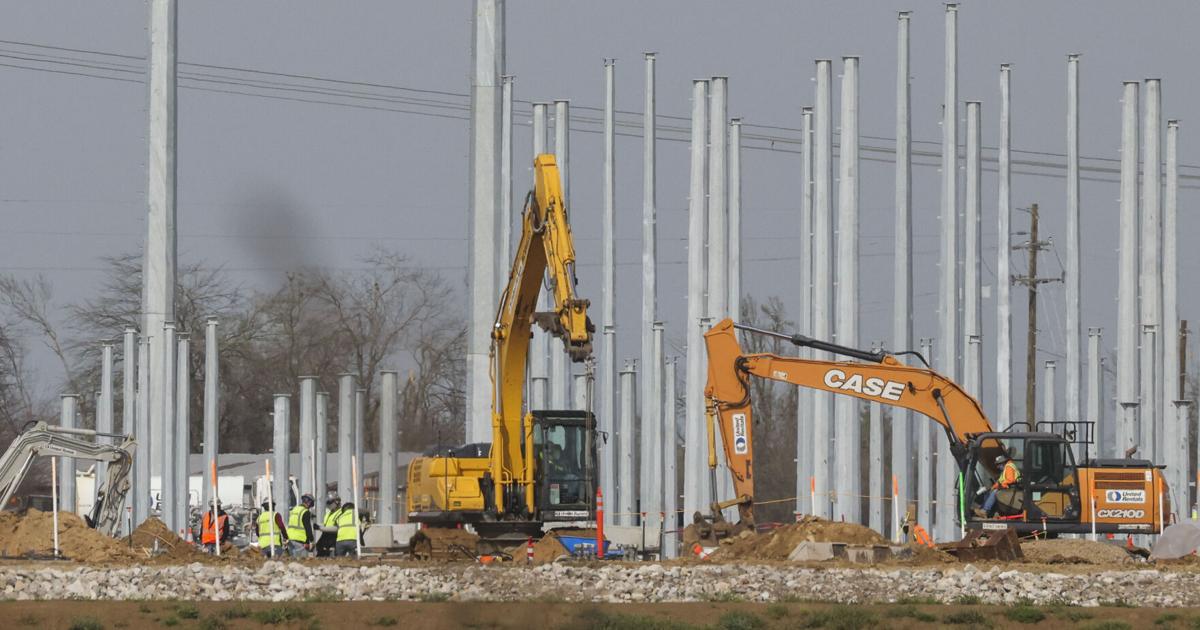
Entergy Louisiana plans to dramatically boost the amount of electricity it can generate and transmit in Richland Parish where it is already building power plants for Meta’s massive AI data center, the clearest sign yet that the Facebook parent is moving forward on a significantly larger project than first announced.
In a news release Friday, Entergy said it plans to build seven new natural gas-powered plants, upgrade its existing nuclear plants, build 2,500 megawatts of solar farms and install batteries to store solar power. The gas plants alone will total 5,200 megawatts, about five times what the entire city of New Orleans uses on a given day.
The new power capacity Entergy is seeking to generate in Richland comes on top of two natural gas turbines it is already building for Meta at the site as well as a third power plant for the project under construction near Baton Rouge. Together, those three plants will generate 2,262 megawatts of power.
The plans also come amid questions nationally about how data centers are affecting residents’ electric bills, which are rising along with a host of other everyday costs. President Donald Trump had tech companies sign a “ratepayer protection pledge” in early March.
Entergy said in its news release that Meta committed to paying for some of the infrastructure costs up front and sending millions to its charitable program for low-income customers and for energy efficiency. The company claimed customers will see $2 billion in savings because of the new deal, details of which weren’t immediately provided.
If approved by the Public Service Commission and built, the new gas and solar plants would enable Entergy to generate and transmit more than 7,700 megawatts of electricity for Meta — the equivalent of more than half of all the power Entergy currently generates for the state of Louisiana.
In its release Friday, Entergy Louisiana CEO Phillip May said the deal will help keep electricity rates affordable.
The PSC, which regulates Entergy Louisiana, has already approved a deal with Entergy to build several new gas-fired power plants, a deal that would see Meta pay for some up-front infrastructure and past hurricane costs. Still, the power plans have created some controversy amid a widening public outcry over electric bills.
Rachel Peterson, Meta’s vice president of data centers, said the boost in power plants “demonstrates the business-friendly environment in Louisiana that makes projects like this possible and aligns with the principles in the recently signed White House Ratepayer Protection Plans.”
Size of Manhattan?
Friday’s announcement was not entirely unexpected. For months, Meta has made clear that it saw the footprint of its Richland Parish project growing beyond what was originally announced.
In late 2024, Meta said the project would be a 4-million square-foot data center, the size of 70 football fields, and sit on some 2,000 acres of former farmland in the tiny community of Holly Ridge. The total price tag was pegged at $10 billion.
Last summer, Mark Zuckerberg disclosed plans to potentially increase the size of the facility, which he dubbed “Hyperion” and said it would be the company’s largest data center yet, with a footprint the size of Manhattan.
A few weeks later, Trump praised the planned size of the facility, boosting its price tag to $50 billion, though that dollar figure was never confirmed.
Then, while announcing a new financing arrangement for the project in the fall, Meta officially boosted the cost to $27 billion. In the October announcement, the company said the larger price tag included “the buildings and long-lived power, cooling, and connectivity infrastructure at the campus.”
“We are proud to be part of the Richland Parish community, and we look forward to continuing to strengthen our partnership for years to come,” Peterson, the Meta executive, said at the time.
The company declined to provide additional information about the expanded size of the project, additional costs or the number of construction and permanent jobs it could create.
Also unclear is what additional incentives Meta may have secured from the state in order to move forward with its expansion. Meta is already receiving a sales tax exemption on a wide range of spending as well as local property tax breaks. Together the tax breaks could be worth billions of dollars.
Last fall, Louisiana Economic Development Secretary Susan Bourgeois said if Meta moved ahead with plans for a larger project, it would have to negotiate a separate deal with the state for any additional tax breaks.
LED declined to comment Friday.
In a statement included in the release, Gov. Jeff Landry praised Meta CEO Mark Zuckerberg and Entergy for “prioritizing consumer interests.”
“Their policy has set a precedent that should be the norm, not the exception,” he said.
Pros and cons
Meta’s Hyperion data center is one of about 20 the tech giant is building around the country. Local and state officials have welcomed the project and the profound economic impact it is having on a poor, rural corner of the state that has suffered from decades of disinvestment.
Since breaking ground 15 months ago, northeast Louisiana has seen an influx in new investment from developers seeking to house and feed thousands of construction workers, whose numbers are eventually expected to exceed 5,000.
Companies from around the region are serving as subcontractors to Meta and its three main builders. They are also setting up shop and signing long-term leases for warehouse and office space, a boost of activity that local economic development officials hope they can turn into long-term growth.
But the project is also raising red flags from environmental advocates and others, who point to other places around the country where AI data centers have driven up utility rates and pulled massive amounts of water from local supplies.
Other critics have questioned the company’s complicated financing arrangement, which they argue could enable Meta to walk away form the project after just a few years should market conditions change drastically, and the huge tax breaks the company and its developers are getting.
Fenceline communities, meanwhile, have changed dramatically.
Local and state economic development officials say the project is worth it to an area that been dying a long, slow death, as the traditional economic engines of farming and manufacturing no longer provide a sustainable living.