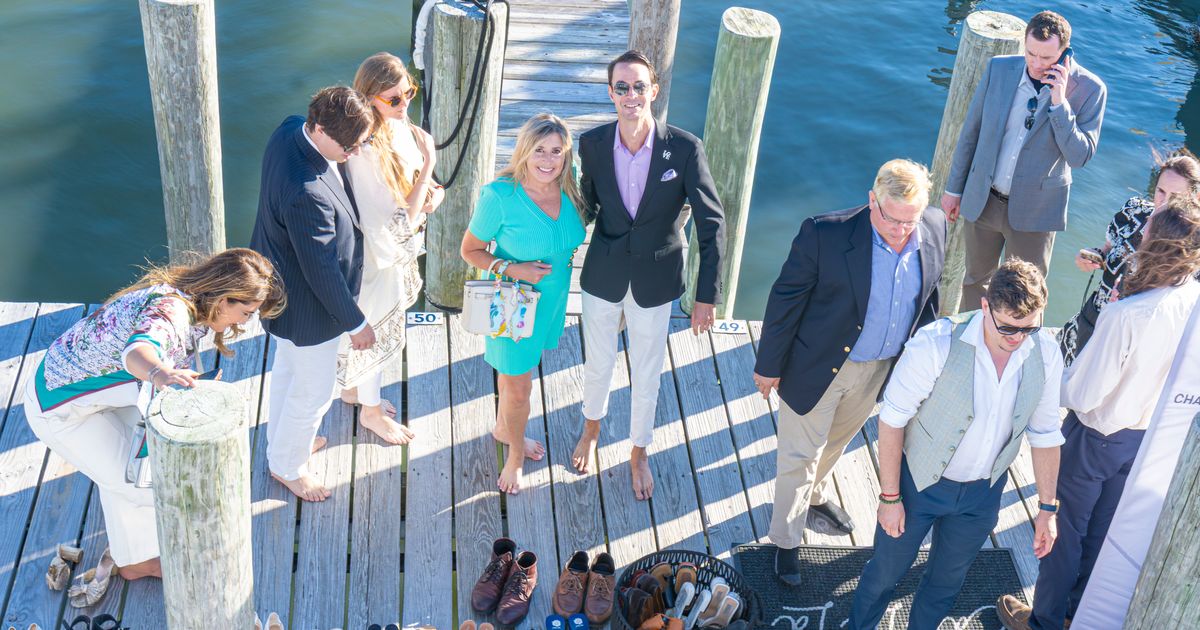
Andrea Bartzen and Matthew Rockefeller hosted the Global Passion Projects Hamptons VIP Yacht Party in Sag Harbor last August.
Photo: David Warren/Sipa USA/AP Photo
When Andrea Bartzen moved to New York in the late 1990s, it may have looked like she was living out a season of HBO’s then-new Sex and the City. She was a single 33-year-old from Ohio, and within a few years, she had moved in with a boyfriend who worked in finance, briefly sharing an apartment near — if not quite in — the West Village. She spoke of spending a summer hanging out with Gary Lutnick, the brother of Howard Lutnick (who is now Commerce secretary in the Trump administration), and claimed to work in pharmaceutical advertising at houses like Publicis and McCann. By the mid-2010s, she looked the part of a corporate-ad girlie of the era: bubbly with a perennial blond dye job and a closet full of short work dresses. She would commute from the office to drinks on the Upper East Side or the occasional socialite-studded charity benefit. She said she went to MIT and worked in biotech. “She was on top of the world,” said an acquaintance who met Bartzen at one of those uptown events and has continued to see her at parties over the years. “Buying people drinks and cigars and being very generous, always had groups of people around, and very smiley and happy.”
What her party friends didn’t know was that Bartzen couldn’t keep a job and couldn’t afford to be picking up the tab. By 2014, Bartzen was so desperate for money that she took a housekeeping job from Anna Rothschild, a celebrity publicist she’d met through a mutual friend. Rothschild paid Bartzen about $20 an hour to unpack boxes and tidy up her new apartment. “Ever since the day that I met her, she was broke,” said Rothschild.
Rothschild lost touch with Bartzen soon after, other than spotting her occasionally at a party. But around 2019, Bartzen — who by then owed the State of New York nearly $20,000 in unpaid income taxes — came to Rothschild for help. “She begged me,” said Rothschild. “She was legitimately homeless — she had no money, no job, and no place to live.” Rothschild had an empty apartment in London, located on Charles Street in Mayfair, that she was trying to sell. She told Bartzen she could stay there for free so long as she cleared out for showings.
A few weeks later, Rothschild received a call from her real-estate agent: “Your friend is in your sitting room with her legs open while I’m trying to show the flat.” Bartzen, according to what the Realtor told Rothschild, was not wearing any underwear. “She didn’t want it to sell,” Rothschild said. Four months later, Bartzen was still in the apartment. Finally, Rothschild returned to London and personally kicked her out. “I was fuming when I came back,” said Rothschild. “The place was filthy. Everything was just trashed.” She told Bartzen she had to go. “I would have thrown her stuff out the window,” said Rothschild.
By then, Rothschild had begun to question Bartzen’s story. She asked Bartzen if she’d really graduated from MIT; Bartzen then claimed she’d just taken a class there. “She said she’s like 20 years younger than she is,” said Rothschild. (Bartzen is 59, but on Facebook, she had listed a birth date in 1980, which would make her 45.) “Everything that I have found that has come out of her mouth has been totally fabricated.”
Rothschild cut ties with Bartzen and was surprised to see that, despite the lack of a home or a car, Bartzen soon popped back up in the Hamptons. By the summer of 2021, she was a regular at yacht and cocktail parties, typically wearing short, body-hugging dresses with skin-revealing cutouts.
As Hamptons summer ended, Bartzen followed the leisure-class migration to Florida. In February 2022, a woman who worked as a Pilates instructor for wealthy clients agreed to rent a studio apartment in the Roney Palace in Miami Beach from Bartzen, who told her she was the owner. Things quickly got weird. Bartzen kept dropping by unexpectedly. One night, the Pilates instructor came home to find Bartzen asleep in the other bed, a candle burning in the closet. “Don’t blow it out. I’m doing a spell,” Bartzen told her. The next morning, she went down to the management office to ask why her landlord seemed determined to be her roommate. “She?” the manager said, confused by the pronoun. The owner was an Italian man named Andrea whose surname also started with B. Bartzen, the tenant learned, had briefly sublet the apartment in the past and had apparently exploited her knowledge of the door code and the similarity of her name to impersonate the owner.
The real owner was livid. “Andrea, this is an additional crime to the already long list you have already committed,” he wrote to Bartzen after learning she’d been renting out the unit. “We will move full force with the law against you.” The Pilates instructor was also considering her legal options. In early March, she went to court to take out a restraining order against Bartzen, but it was never served. “It was hard to find her because she didn’t really have a home,” she said. “I call her ‘the poor man’s Anna Delvey.’”

Bartzen in the Hamptons in September 2021.
Photo: Rob Rich/Society Allure
Delvey, who posed as a German heiress to fool New York’s elite, had become a household name among many of the people Bartzen was trying to hang out with. They were on high alert to watch out for Delvey’s type. Yet Bartzen, who was older, and decidedly less cool, slipped past their defenses.
Bartzen, however, was developing a reputation. Back in New York after Miami, she seemed to show up everywhere — charity galas, restaurants, designer-boutique events — without an invitation. Often, she would come in late, after the organizers had stopped checking people in, or wait outside until she saw someone she knew. Tickets for these events can cost hundreds or thousands of dollars. Bartzen rarely paid her way, according to many event organizers, publicists, and staff I spoke with. “She’s been around for years. She’s like a major party crasher in the Hamptons,” said a society-party regular who has seen Bartzen at events for at least a decade. But these are genteel affairs, where, once you are in the room, no one is going to second-guess your presence. More often than not, even event hosts who knew what she was doing let her stay. “She turns on this syrupy kind of nice,” said a person who has interacted with her over the years. “You can’t really be nasty to her.” The more Bartzen showed up, the more she seemed to belong.
“She’s one of those ladies that plans out a spreadsheet — like, she has to be at an event at 9, 11, 1, 2, 3,” said the acquaintance, who also spent time with Bartzen in Palm Beach. “Almost like it was air to breathe.” Sometimes Bartzen was inexplicably at the Colony, the trendy, and famously pink, Palm Beach hotel. “She basically came to my table and ate the rest of my lunch I hadn’t finished,” said a person who ran into her there. In July 2024, Rothschild spotted Bartzen pacing in front of the VIP entrance to the annual Polo Hamptons. Then suddenly she was inside. “She was just walking around by herself,” said Rothschild. “Nobody goes to polo by themselves.”
Not every host turned a blind eye to her party crashing. That summer, she was kicked out of at least two Hamptons galas: an animal-charity fundraiser she snuck into and a cancer benefit to which she pretended to have bought a ticket. Later that summer, Bartzen attempted to sit down at real-estate executive Dottie Herman’s table at a private dinner at Le Bilboquet in Sag Harbor, leading to a tense standoff with Herman until Bartzen finally agreed to leave.
It didn’t seem to matter to Bartzen whether she was invited or not. Once inside, she would make the rounds, posing for party photographs with the most noteworthy people there. “The only reason that Andrea Bartzen is in those pictures is because she jumped into them,” said the Hamptons society-party regular. By the time Bartzen set about planning the first big event of her own that summer, which she called the Global Passion Project, it looked like she already knew everyone who mattered. That perception was important as Bartzen targeted her new audience: the immensely lucrative — if often naïve and opaque — world of family offices.
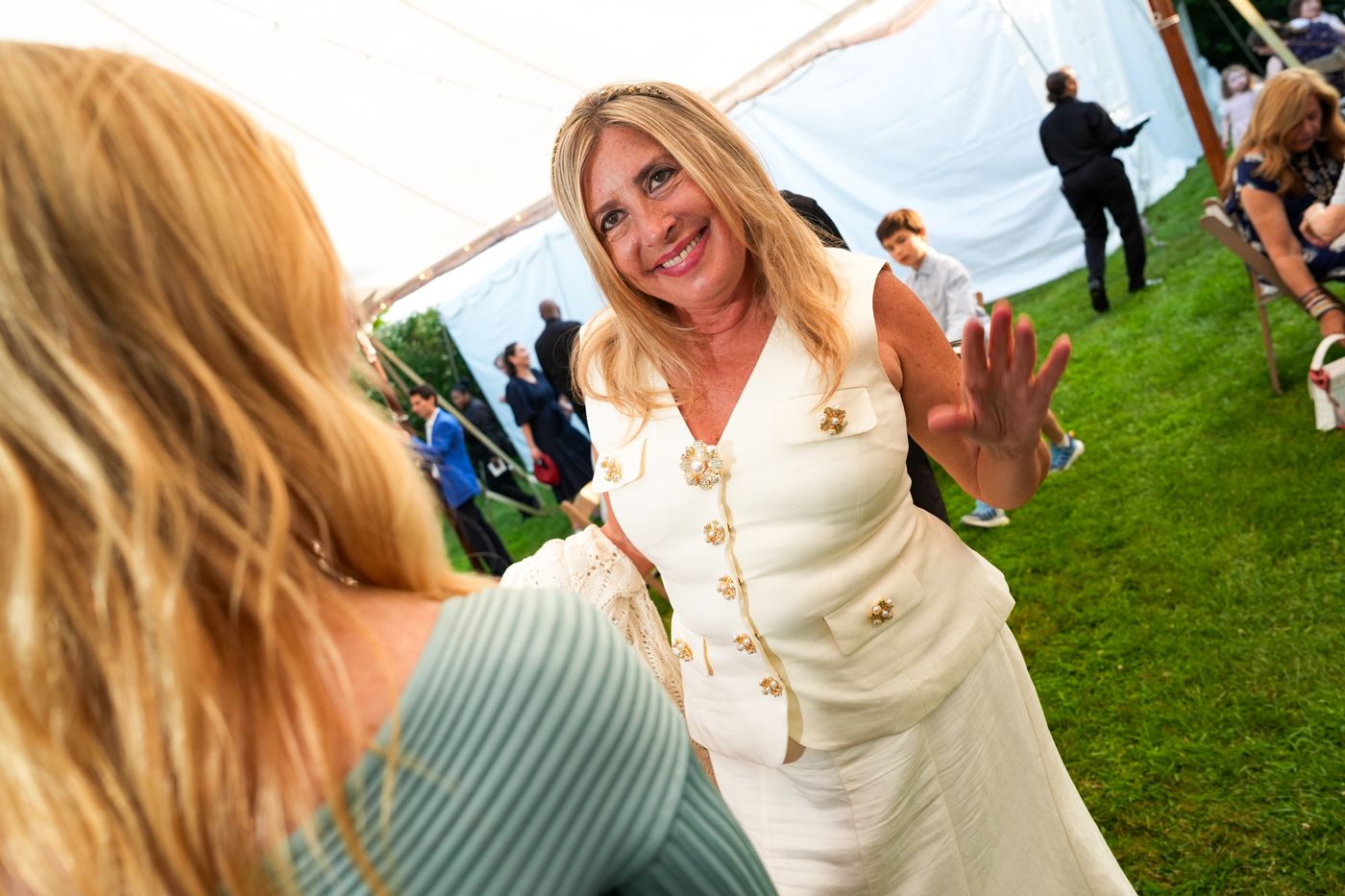
Bartzen at an event in Southampton in July.
Photo: Sean Zanni/Patrick McMullan/Getty Images
On the society circuit, family-office events are their own subgenre of party. Family offices are essentially private wealth-management firms where the rich run their personal fortunes — something that becomes a practical option when a family’s assets reach the scale of a small hedge fund. Generally, family offices are considered legitimate when they manage upwards of $100 million.
In the Hamptons, the family-office circuit features attendees ranging from your average self-made .01 percenter (tech, finance, and so on) to the children, grandchildren, and great-grandchildren of someone who built a fortune in the past. These are “next gens,” and among their number are many self-proclaimed socialites, influencers, heirs, and heiresses. But it’s a murky world. When you talk to someone who calls herself an heiress, it will often be impossible to figure out (via the media or public records or family obituaries) who their rich relative is or how they got rich. Some of these next gens will have built ostensibly successful businesses of their own (no doubt with a bit of family funding); others may be trying to use a recognizable last name to network and find opportunities. In this crowd, a name is money, and a counterfeit is not only a scandal but a threat to the overall order.
Bartzen planned to debut her Global Passion Project as an event for family offices in late August 2024 in East Hampton. The idea was to bring together family-office investors with a range of executives, doctors, and philanthropists representing various health-care entities — in theory, pairing people running ambitious health initiatives with potential funders. (Bartzen had by then become enamored of Robert F. Kennedy Jr.’s “Make America Healthy Again” movement, and she showcased a variety of eccentrics, some of whom aligned squarely with a MAHA concept of wellness and alternative treatments.)
Bartzen teamed up with Rolise Rachel, who had been producing family-office events for years and had become something of a socialite herself. Rachel, 53, was born in Southampton and said she was raised by a “Waspy” grandmother who took her on trips to Scotland, where they would sit for daily tea at 4 p.m. (“That type of upbringing,” she said.) She kept her cherished Palm Beaches Blue Book — essentially a privately published society register and a who’s who of the area’s old-money heirs and debutantes — on top of the antique organ in her dining room. Over the summer, while they worked on planning the event, Rachel had agreed to rent Bartzen a room. Rachel said they planned to split the event proceeds 50-50, after giving a cut to three health-care charities that would supply speakers.
“If you think about it, the family office rules the world,” said Rachel. “They are our most generous benefactors — they’re the ones who support funding for biotech or robotics.” Family offices control an estimated $5.5 trillion of capital, ranking them with Wall Street’s biggest banks. But in the financial world, they’re often the butt of jokes. There are notable exceptions, yet overall, family offices have a reputation for being somewhat unsophisticated — a sort of dumber money. Many of them make investments based on the whims of one very rich dude or, worse, the whims of his children who have no business experience or financial acumen of their own.
A joke among family offices goes, “You have a family, you have an office, you have a family office.” In other words, there are few specific qualifications or regulatory requirements for setting one up, making them both a potentially easy target for cons as well as ripe for fakers. When I spoke with people in the industry, many wanted to warn me about a roster of unscrupulous characters they believed to be scamming family offices.
As Bartzen worked on the event, she seemed unusually on edge. “She was a ball of stress, hammering the phone, like 16-hour days calling people. The type of behavior suggested that maybe she was having a tough time paying rent,” said the acquaintance, having run into her that summer. “She said, ‘I need to make money.’” Her dad had died without leaving her anything, she explained, and her mom was middle class and retired. “She told me no one can help her, and she’s on her own.” Soon Rachel began noticing a rotation of unexpected guests in her home. It turned out Bartzen had been renting out the other side of her own rented bed.
Rachel started to question Bartzen’s background. Bartzen cursed a lot, and she spoke with a raspiness not typical of the wealthy ladies with whom she was rubbing shoulders. “The frequency of her voice is off. You can tell she wasn’t brought up with money,” said Rachel. “She just doesn’t have the vernacular.”
Bartzen had promised caviar, oysters, and sushi, along with dishes from two private chefs, for the six-hour event, held at the home of Scott Weissman, CEO of fashion label Grey/Ven. She was charging sponsors between $7,000 and $30,000, ostensibly to cover an impressive spread. But when the day came, attendees arrived to find there was tequila but no food; one speaker compared it to the Fyre Festival. Guests milled around, audibly complaining about their hunger. Modest platters of sandwiches and sushi eventually showed up and were devoured almost instantly. “It was scavenged through because people hadn’t had food all day,” the speaker said. Utensils were hard to find. “People just had to kind of grab the sushi with their hands.”
But to Rachel, who said she’d planned for a much smaller number of guests than Bartzen had invited, the biggest problem was what Bartzen did — or didn’t do — with the money they’d brought in. Based on what sponsors paid, Rachel believes Bartzen made about $100,000, but the charities the event was supposed to benefit received nothing. “We didn’t make any money at the event, so there’s nothing to donate,” Bartzen told one. Rachel said Bartzen never paid her half of the supposed profits either.
Three days after the event, over Labor Day weekend, when Rachel was out for the afternoon, Bartzen packed up and left. “Her moving out of my house is like skipping town with the money,” said Rachel. After Bartzen left, Rachel noticed the Blue Book was gone too.
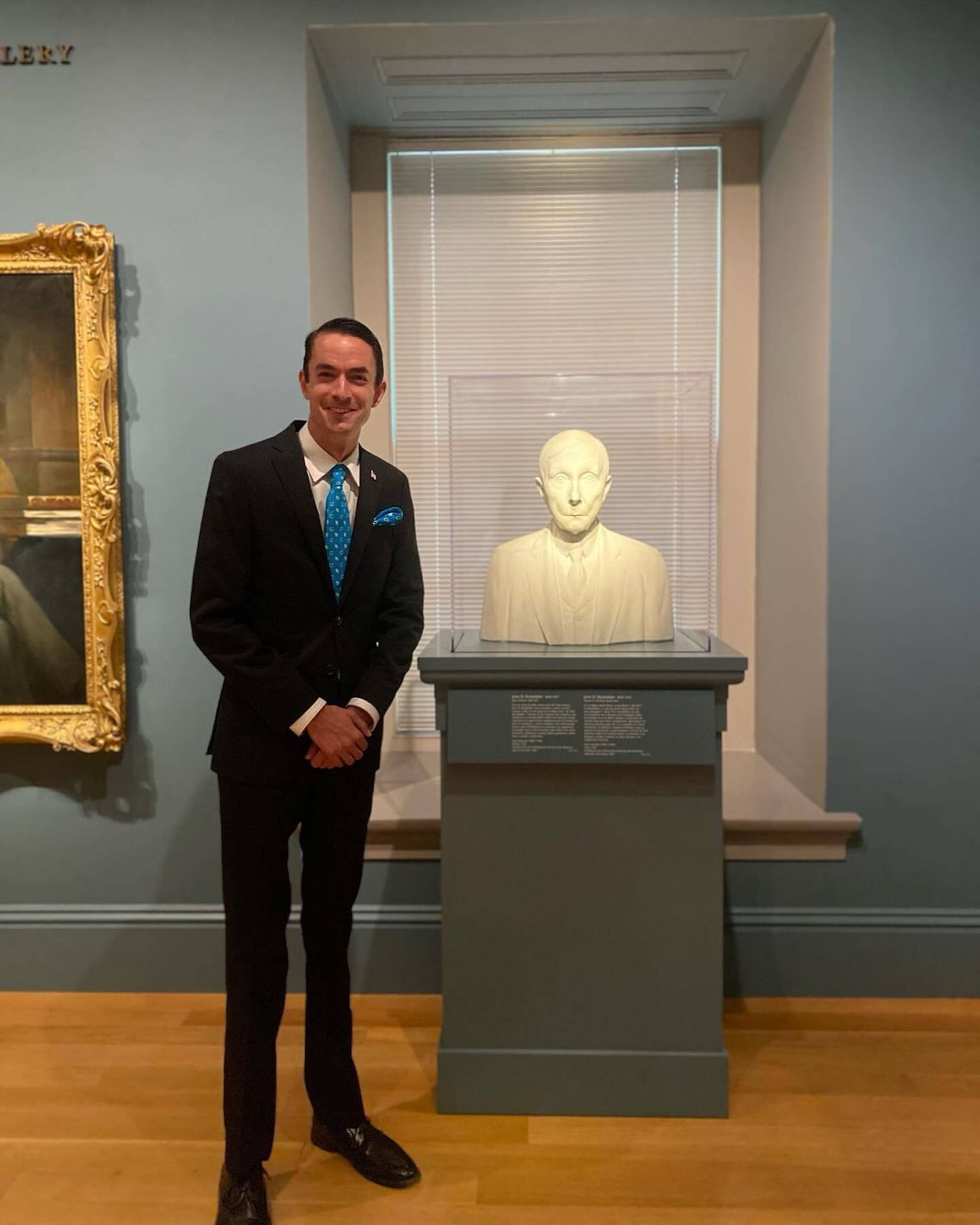
Matthew Rockefeller next to a bust of John D. Rockefeller at the National Portrait Gallery in October 2023.
Photo: @mattwrockefeller/Instagram
That fall, with her sights set on even bigger targets, Bartzen headed to Palm Beach and began hanging around with someone who appeared to be a genuine member of the scion class: a much younger man who introduced himself as Matthew Rockefeller. “From the minute they met, they were inseparable,” said someone who saw them in Palm Beach and Miami. Before long, Rockefeller was telling people he wanted to marry Bartzen.
Suddenly, Bartzen and Global Passion Projects, to which Rockefeller signed on, took on a new gloss. Rockefeller, who is 39, told potential event partners that he ran the philanthropy arm of the oil baron’s family. In late 2024, the two invited a pair of entrepreneurs to Rockefeller Center to discuss partnering for a Global Passion Projects event on a yacht at Miami Hedge Fund week. The entrepreneurs showed up to the meeting expecting to be whisked upstairs to a conference room at the offices of Rockefeller Capital Management. Instead, Rockefeller, in a full suit, ushered them into the Equinox at the base of the building. He took a seat in the gym’s café area. “He couldn’t have invited us into one of the buildings? Why are we meeting at the Equinox at the Rockefeller Center if we’re meeting with a Rockefeller?” one of the entrepreneurs said he wondered. Still, it wasn’t a deal-breaker; children from ultrarich families did all sorts of odd things to project normalcy.
For fees of up to $12,000, Bartzen and Rockefeller promised event sponsors access to a network of 50,000 investors, according to emails and promotional documents. The entrepreneurs agreed to co-host the event, which was scheduled for late January, on the condition that they would not be responsible for any costs. The party was to be held at the Mansion Yacht House, a new waterborne private club.
Trouble started as soon as guests showed up to the yacht. They were initially unable to board. The venue’s owners had agreed to host about 30 investors aboard the yacht for free but balked when Bartzen showed up with some 300; an event that size would typically cost $40,000. “It’s like, ‘All right, there’s no way in hell we’re doing this for free,’” said a manager of the Mansion Yacht House. “‘It’s not gonna happen here.’ It wound up turning into one of those things where it’s like, ‘I need the check and I need the check now.’”
Bartzen assured him she had the money. “The Rockefellers are coming!” she insisted. Rockefeller, meanwhile, in don’t-you-know-who-I-am fashion, shouted at the manager that his family would never do business with him again. Up until an hour before the event, Bartzen still had not paid.
Eventually, the manager received $15,000 — his heavily discounted fee — in the form of a check, wire transfer, and Zelle from three different people, none of whom were named Rockefeller or Bartzen. One of the entrepreneurs sent $5,000 from his personal account, after Bartzen begged, promising to repay it immediately after the event. “They were presenting themselves as literal billionaires, and they can’t send $5,000. I thought it was funny at first,” the entrepreneur said. After all, maybe it was one of those quirks of the ultrawealthy — would a Rockefeller ever have had to set up Zelle?
Afterward, though, at least two sponsors asked for their money back. The vast network of investors Bartzen promised never materialized. “We didn’t see one there, not one,” said a sponsor. But the sponsors didn’t get their money back — and neither did the entrepreneur who fronted the $5,000.
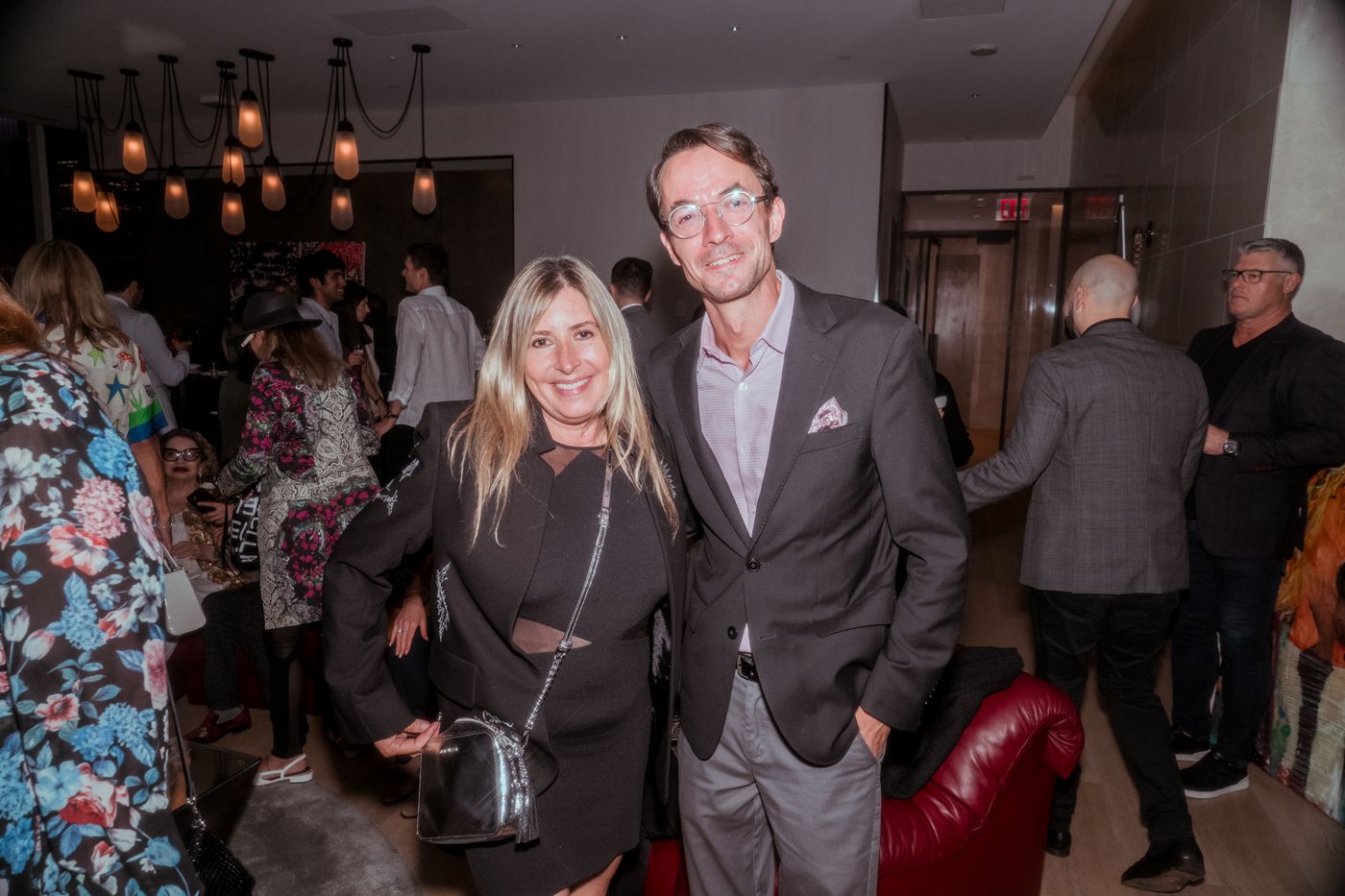
Bartzen and Rockefeller at a Fashion Week party last year headlined by then-mayor Eric Adams.
Photo: Leo The Visualist Media
Around the time she met Matthew Rockefeller, Bartzen had added a middle name to her LinkedIn that elevated her own pedigree: Cartier. She told the Mansion Yacht Club owners that she was connected to the legendary family, heiress to the more than 150-year-old jewelry business.
Andrea Cartier Bartzen seemed to take the event snafus in stride, and even some of her disgruntled guests chalked up the problems to disorganization and the usual struggles of a fledgling business. “She kind of has no business planning an event, but she does have great connections,” said a person who spoke at one of Bartzen’s parties. Besides, people seeking their money back from Bartzen were often too embarrassed about being bamboozled to complain much about it; the risk to one’s own reputation was greater than the financial hit. Bartzen was now seen as powerful, with a robust network, and several people told me they worried she would retaliate if they spoke up. “I would rather my name not be slandered for $5,000,” said the entrepreneur. “It would be a net negative.”
By March, Rockefeller and Bartzen were regaling rich people across Florida with their alleged family lore. Rockefeller told one investor he received daily hate mail about John D. Rockefeller’s impact on medicine. At his birthday party at a Miami Beach bar, he approached Adi Soozin, who manages a small private-equity fund and says she comes from a fifth-generation real-estate family. Introducing himself as a member of the Rockefeller family, he recounted a story of people trying to kidnap him for ransom in Mexico. “We just took it at face value,” said Soozin. “They’re hanging out with all of the right people. We just assumed they just didn’t grow up with us but they’re from the same bubble.” Bartzen, meanwhile, was volunteering, with increasing confidence, that she was a Cartier. “You know I’m part of the Cartier family?” she’d say casually.
Bartzen’s decision to use Cartier as her middle name was objectively shrewd: A number of direct Cartier offspring were daughters who changed names when they married, so Cartier is now used as a middle name among some of today’s descendants. The jewelry business was sold off for a relative pittance decades ago, and none of the family members are currently involved. Unlike institutions that bear the name Rockefeller, Vanderbilt, or Soros, there is no Cartier family office. Today’s living Cartier heirs are not even universally wealthy. Said one, “It’s not like we were brought up wearing tiaras.”
In 2019, Francesca Cartier Brickell, the great-granddaughter of Jacques Cartier, published The Cartiers: The Untold Story of the Family Behind the Jewelry Empire, which included a detailed family tree based on a decade of genealogical research. None of the surnames on any of its branches matched those of Bartzen’s parents or grandparents.
As they were introduced around Palm Beach as the “Cartier-Rockefeller couple” in early 2025, Rockefeller’s claims that, yes, he was indeed related to those Rockefellers struck a few people as off. First, his handshake seemed too soft, one observer sniffed. And they found his clothes to be too on the nose. Tall, rail-thin, and lanky, he often wore flapper-era newsboy caps, as if he were cosplaying John D. Rockefeller on the way to the golf course. He was almost always in a suit, even for video calls.
Then, one afternoon, Rockefeller and Bartzen pulled up to a polo match in an old “rusty-ass” pickup truck, recalls one polo player. “I was like, Yo, this motherfucker is trying to tell people he’s a Rockefeller dude. No way that guy is legit. Nobody drives a piece of shit like that and has a couple hundred grand in their account, let alone hundreds of millions.” Another polo player said he once introduced Matthew Rockefeller to a bona fide Rockefeller descendant, who appeared not to recognize him.
There were other awkward incidents. In early April, police were called to the Ben hotel in Palm Beach, where Global Passion Projects was having a cocktail party, after Bartzen didn’t pay the tab, according to West Palm Beach police records and attendees. “She was in tears, and she didn’t have the money to pay her bill. She needed an $8,000 buyout or else they would have hauled her off to jail,” said a person who was there. Another attendee bailed her out. After all, that amount was pocket change among the crowd with which Bartzen was rolling. “Dropping like $80K on something, or $100K on something, it’s de minimis value. It’s not a lot of money,” said the person. “So we always question those folks that are struggling for that.”
Bartzen’s professional life, however, was blossoming. She started landing speaking gigs in front of high-net-worth audiences. In May, she spoke on a panel at a Family Office Club summit in New York, where she was touted as an “angel investor.” “She said she was an angel investor and not raising capital, and we had no reason not to believe her,” said Richard Wilson, president and founder of the Family Office Club. She told many people on the party circuit that she’d been the “mastermind” behind the launch of several blockbuster drugs on the market, including Botox and the Merck cancer drug Keytruda.
Some health-care executives who’d met Bartzen and seen her speak became suspicious — they’d never heard of her. And they were right to be: Her work on Keytruda’s launch was actually a six-month gig for an Omnicom health-care subsidiary called Wildtype; another three-year résumé stint supposedly leading the launch of a Keytruda drug collaboration turned out to be a contractor position that lasted under a year. Bartzen’s educational background was also largely fabricated. The MIT Registrar’s Office said it had no record of Bartzen being enrolled as a student, nor did Case Western, from which Bartzen claims an M.B.A.
Then in June, Soozin was leaving a voice-memo for Bartzen, explaining what she called “high-society protocol” — a code of etiquette she worried Bartzen might be violating through her behavior toward another heiress — when her mother overheard and asked to see a photo of the person she was instructing. “Honey, no one from the Cartier family would tilt her head that way in a photo; she would have gone to finishing school by the age of 14,” Soozin’s mother said. “Look at the spacing of her highlights. That hair treatment is under $200. No one from the Cartier family would have a hair treatment that cost less than $600.” And then she pointed to Bartzen’s foot, flopped out on the floor inelegantly. “What is that?”
Soon, suspicion turned to gossip turned to outrage among Soozin’s network as people started putting together the pieces. “In Palm Beach, pretty much everyone I knew was calling her ‘the fake Cartier,’” she said. In Newport the next month, security guards escorted Bartzen out of a premier family-office event hosted by Opal Group after she snuck in. It wasn’t that Bartzen had exactly stolen something tangible from the society set; what offended them most was that she’d pretended to be one of them — she’d taken the aura that comes with being not just wealthy, not just old money, but having the bloodline of an aristocrat.
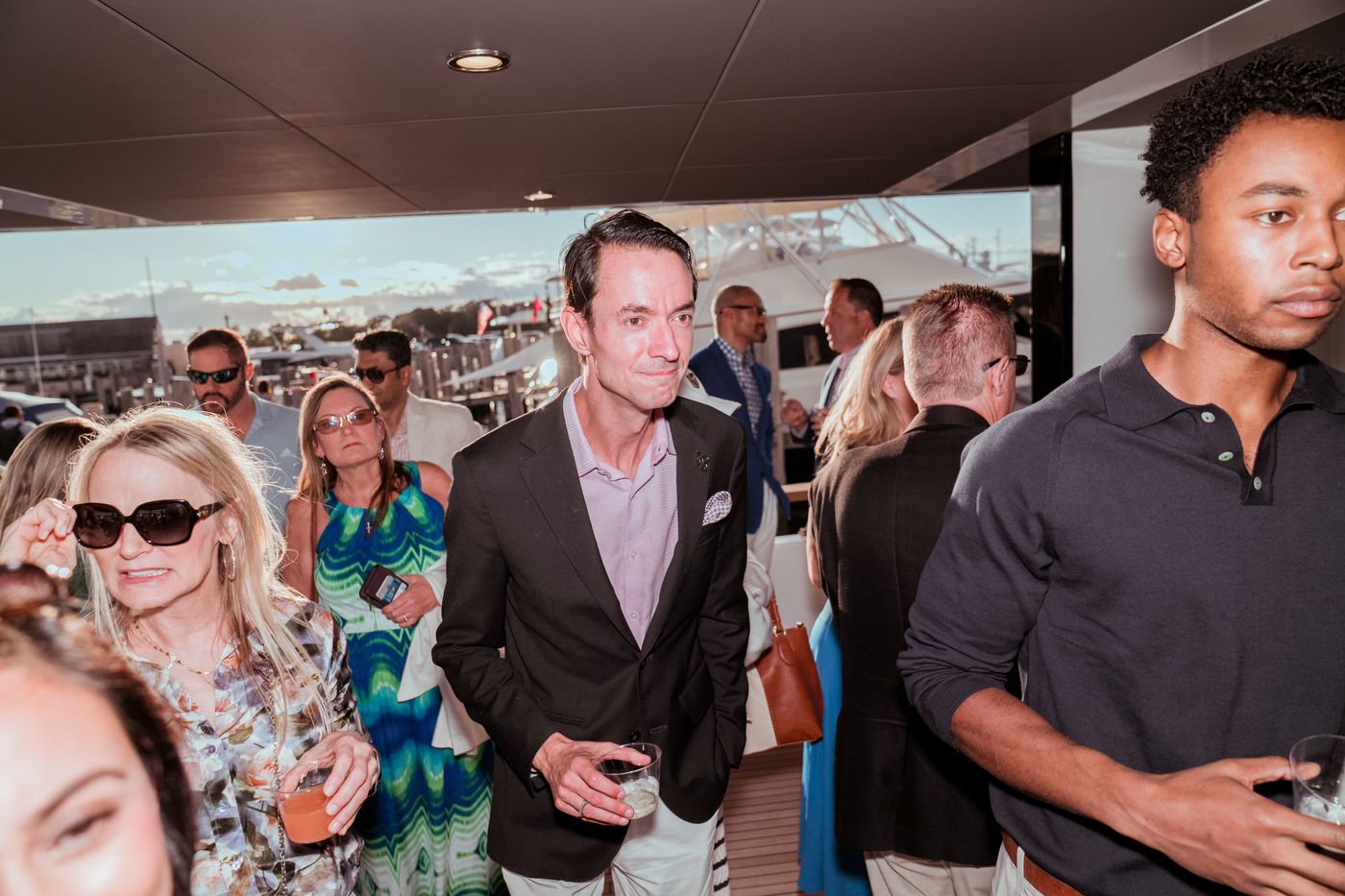
Rockefeller at the Global Passion Projects yacht party in August.
Photo: Leo The Visualist Media
By the time the rumors started spreading in Florida, Bartzen and Rockefeller were already back in New York, preparing for their most ambitious event yet: a three-day Hamptons extravaganza including yacht and garden parties for several hundred guests to benefit the American Cancer Society.
When the August blowout came around, it seemed like they’d truly faked it until they’d made it: The event appeared to be star-studded, at least by dubious or semi-disgraced stars. The chef Todd English cooked, and Prince Mario-Max Schaumburg-Lippe — adopted into a German royal family at age 24 — was there, as was Hansel Bailey, a businessman who had been imprisoned for tax fraud. Even some people who’d heard the rumors about Bartzen and Rockefeller, or who harbored some doubts of their own, attended anyway. After all, Bartzen hardly ever charged her richest guests for tickets, and if the party was good, who cared who was hosting it? “It was still free,” said someone who went, after rattling off a laundry list of reasons they didn’t trust Bartzen. “What if she is a manipulator and she brings value?” said the acquaintance, who now ran into Bartzen regularly at parties. Several people told me that even though they doubted Rockefeller and Bartzen were real heirs, they couldn’t be sure.
Bartzen and Rockefeller had also scored a major get: Cheryl Young, a private adviser of the Rockefeller Global Family Office, had agreed to sponsor the event, and the office’s parent firm, Rockefeller Capital Management, appeared on the invites.
Rockefeller Capital, once it learned of Young’s arrangement, pulled its sponsorship, but the step-and-repeat backdrop was still patterned with the logo for Rockefeller Global Family Office. It was also plastered behind Young as she spoke onstage. “The brand was misused and no authorization was given by the firm,” said a person close to Rockefeller Capital.
Matthew Rockefeller’s opportunity to shine came in a panel about “navigating life within legacy families” and “inherited influence.” He sat alongside J. Bradley Hilton, who oversees the Hilton Family Office. “He was acting like he is reflecting an arm of the Rockefellers. He definitely made it very apparent that he’s speaking as if he is born into a legacy family — you know, ‘As a child, I did experience this type of stuff,’” said a person who was there. “It looked very real and authentic.” A press release recapping the event described Bartzen as a “scion of the Cartier Dynasty.”
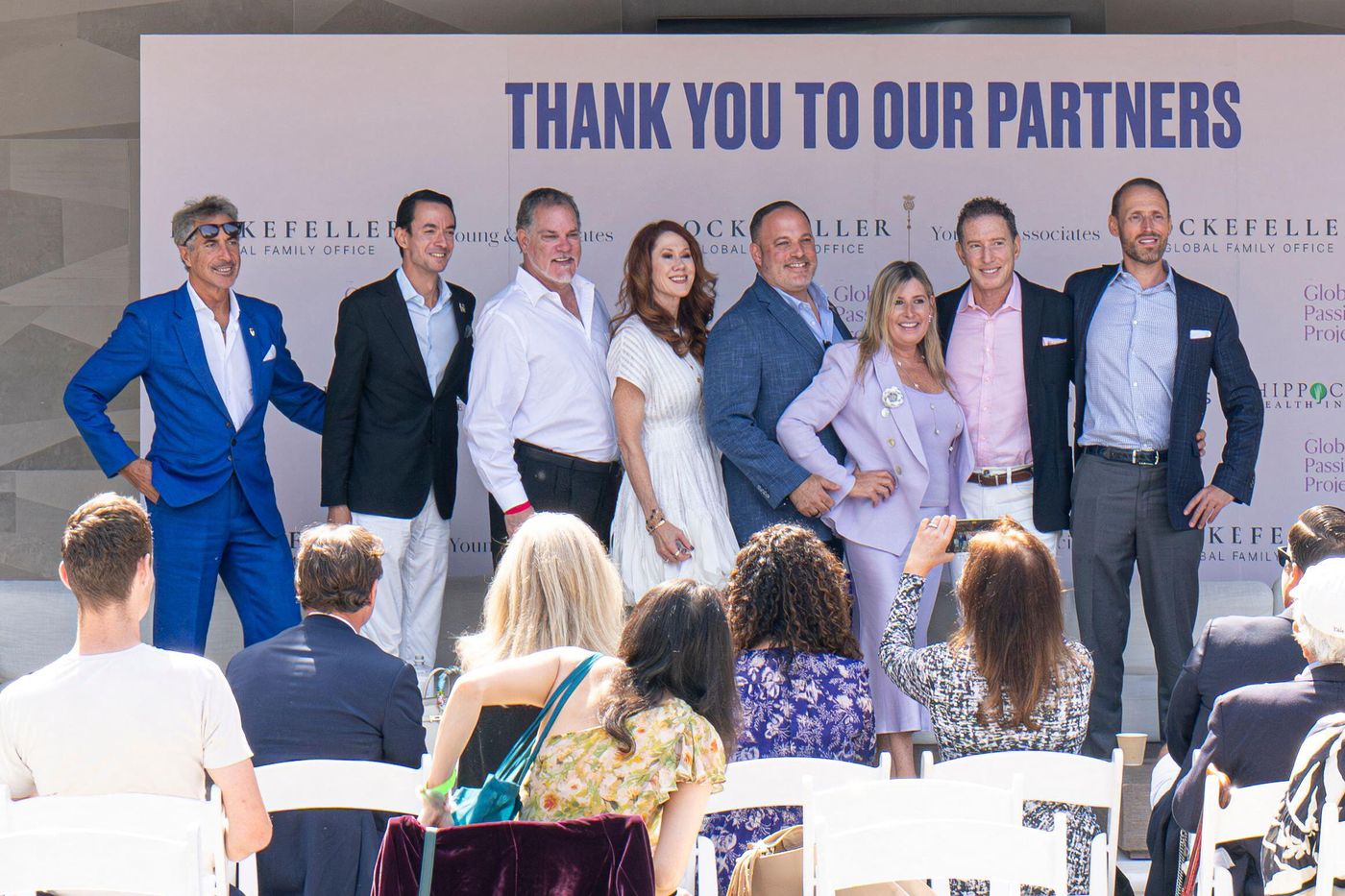
Bartzen and Rockefeller pose with speakers, including J. Bradley Hilton and Cheryl Young, onstage at the Global Passion Projects event in August. The backdrop featured the logo of the Rockefeller Global Family Office, despite the firm withdrawing its sponsorship.
Photo: David Warren/Sipa USA/Alamy Stock Photo
Still, Rockefeller was “a little awkward, a little too emotional. He’s always following Andrea — like a lost puppy,” said the acquaintance. “No Rockefeller would act like that.” In fact, the acquaintance thought, Rockefeller seemed more like an actor. Bartzen didn’t fit how guests envisioned a Cartier either. She was wearing what appeared to be a white Birkin bag, but upon closer inspection, a well-heeled attendee observed that it was fake. “What Birkin has a grommet?” said the guest. Bartzen had touted the American Cancer Society as the beneficiary of the event, but a spokesperson said it had no record of Global Passion Projects, or Bartzen or Rockefeller, donating any money. “What if this is all a collaborative con job?” the guest wondered.
Ironically, the person who took the biggest hit at the event was the only person in attendance with a verified connection to the real Rockefeller family. Young did not respond to repeated requests for comment, but according to people familiar with the situation, Bartzen never refunded the $30,000 Young had paid for the sponsorship — even after Rockefeller Capital revoked it.
But even as people began to suspect Matthew wasn’t really one of those Rockefellers, they didn’t know who he actually was.
It turned out he was an average guy from a blue-collar town who had been eking out a living as an actor and a magician. Born Matthew Wayne Tomasko in York, Pennsylvania, for many years he went by “Matt Wayne the celebrity magician.” He’d received a magic set from his grandfather when he was 5. “From there, it just kind of snowballed,” he said later in a magic-trick video. His mother, Robbie Koser, was a onetime model who worked as a hospice nurse, and his father, John Tomasko, worked for a trucking company. Matthew started working at a local hotel when he was 14, then enlisted in the Navy after he came of age.
He moved to Manhattan with $600 and just enough to cover the first month’s rent, according to an interview he did with New York Resident magazine a few years later. In 2007, he was accepted to the American Academy of Dramatic Arts acting conservatory but dropped out after his first year. By 2010, Tomasko was producing a one-man Off Broadway show called The Complete Performer, starring comedian Ted Greenberg; the following year, he starred in a reality show called Doggie Moms. On the side, Tomasko formed a company called No Social Limits, helping clients make their videos go viral, and posted videos of himself doing coin tricks. “I entertain mainly for celebrities,” he said in one. “I get to do magic tricks for a living. How amazing is that?”

Rockefeller, whose real name is Matthew Tomasko, for years worked as an actor and magician under the stage name Matt Wayne. This image is from a 2015 short film.
Photo: IMDB
A few years later, Tomasko moved upstate with a woman, peddling essential oils for a multilevel-marketing company. “I’ve always had to keep chasing that next deal, the next paycheck, you know — some months are up, some months are down, and it was always a struggle,” Tomasko said in a promotional video for the company. The couple had a son in late 2017 but split within a few years, and Tomasko saw his child only rarely. “It was very difficult because I think he really wanted to father and parent and be really involved in his son’s life and he didn’t want it to be like how he was as a kid,” said an old friend of Tomasko’s from New York. (Tomasko’s parents had long ago broken up.)
Seemingly trying to reinvent himself, Tomasko moved back to Pennsylvania and embarked on a deep dive into his own family history, spending months combing through boxes of old photos in his grandmother’s attic. On Facebook, he wrote about learning his grandmother was adopted after stumbling across her birth certificate, a discovery that seems to have changed his understanding of his own identity. In October 2023, Tomasko posted a photo of himself, in a suit with a blue tie, standing next to the bust of John D. Rockefeller at the National Portrait Gallery. “The countless hours I’ve spent here over the last few years have been filled with fascination and awe,” he wrote in the caption. It was around that time he changed his social-media names to Matthew W. Rockefeller.
The real Rockefellers have no single spokesperson, family office, or philanthropic arm. The family is represented by a constellation of entities, generally operating independently of each other. Few of the major Rockefeller-affiliated entities wanted to talk about Tomasko. “We aren’t aware of this individual being associated with the family,” a source close to the Rockefellers told me. A spokesperson for Rockefeller Philanthropy Advisors added that it has “no association with this person.”
In recent months, Bartzen and Rockefeller — or Tomasko, as a few people now knew him — had been a white-hot topic of gossip in the family-office world and society circles. “It’s sort of like almost everyone knows about this,” said the person who’d seen them in Palm Beach and Miami. “They’re literally all talking about it.” Tomasko’s past as a performer wrote its own punch lines: “You do this magic trick, and all of a sudden you turn into a Rockefeller!” joked someone who spent time with the pair in the Hamptons.
But to others the misappropriated names were much more serious. “She was provided access, I’m sure, based on the story that they tell — people let them in the door,” said the polo player. “It’s total fraud.” Bartzen had seen the videos of Tomasko doing magic, but she remained adamant that he was a Rockefeller. “If you can’t really find the lineage … if they’re fake, that’s a criminal thing, what they’re doing,” said the person in Palm Beach and Miami. Kelly Bagla, a lawyer representing Tomasko who describes herself as a “high-net-worth business attorney,” declined to respond to questions, saying only that the “facts are incorrect” without identifying which ones specifically. Bartzen did not respond to numerous requests for comment — though many people I spoke with reported hearing her complaining about the story or warning those in her network not to speak with me.
By October, Tomasko and Bartzen were on the rocks. Bartzen had traveled to Saudi Arabia to hit the party circuit there and extended her trip. Tomasko fretted to others that she still had $10,000 of his money. One night around 1 a.m. Riyadh time, Bartzen texted Tomasko: “Can you order me an uber?” she wrote. “No I can’t,” Tomasko wrote back. “What the heck is going on with you Andrea?!” “I can’t call an uber! And I’m stuck,” she wrote back.
In December, Bartzen — who by now owes New York State nearly $36,000 in unpaid taxes and interest — threw a party at Art Basel; more events were planned for March and April in Palm Beach. Bartzen claimed a portion of the ticket sales for an upcoming Palm Beach gala in April would be donated to her “Passion Partner,” the American Heart Association. But a spokesperson for the AHA said no such arrangement had been finalized, and the association asked Bartzen to remove the language.
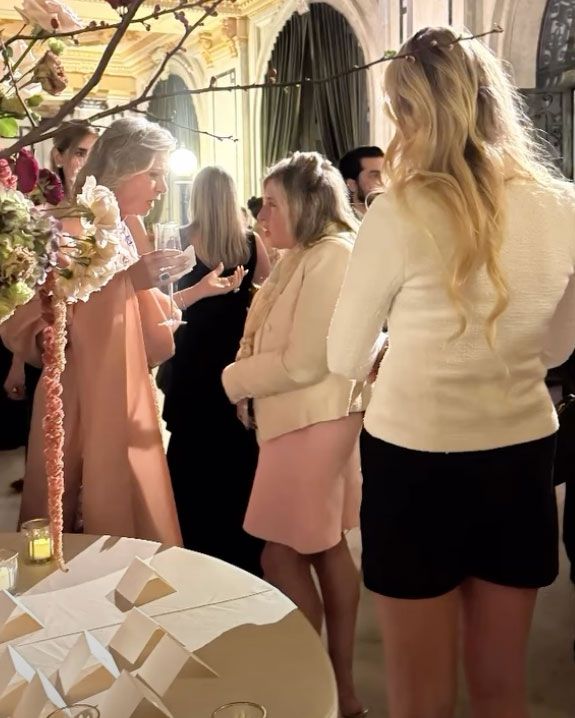
Bartzen, center, is confronted while crashing a black-tie Palm Beach wedding at the Flagler Museum in February.
Then in February, Bartzen crashed the wrong party — a black-tie wedding at the Flagler Museum in Palm Beach. Bartzen wore a short pink dress — the same garment she was photographed in the night before and the night after — and white tweed jacket, while most of the wedding guests wore floor-length gowns and tuxes. When the mother of the bride asked who she was, Bartzen held up a table card. It bore the name of the bride’s best friend, who was standing a few feet away. “I said, ‘You’re so full of shit,’” recalled the mother of the bride. “You need to get the fuck out.”
Bartzen continued to protest that she’d been invited until security arrived, marching her by the arm off the premises. “It was a personal, private event, no different than if I had it in my house, and she decided to break in to come into my party,” said the mother of the bride. The story quickly spread back to people who knew Bartzen from the Hamptons. It was one thing to crash a ticketed event like a charity gala, where anyone could theoretically buy their way in, they said; it was quite another to show up to a stranger’s wedding, planning to stay for dinner. “I want this woman destroyed,” said the bride’s mother.
While Bartzen never responded to me directly, stories and photos of her poured in all winter from Miami and Palm Beach; she seemed to be fretting about the story, going through my Instagram contacts and lashing out at those she believed might have spoken with me — even as she continued showing up at events to which she had not been invited. At the end of January, I received a notification that she viewed my LinkedIn profile. Within a few days, Bartzen had removed “Cartier” from her own profile.