For the past 16 years, James Martin has been among the most prominent cheerleaders for Louisiana’s still-unrealized offshore wind industry.
Gulf Wind Technology, the company he formed five years ago with partners David King and Mitchel Graff, created a cutting-edge technology center at the former Avondale Shipyard for the manufacturing and testing of wind blade prototypes designed to operate in the region’s challenging wind conditions.
But last year, after the second Trump administration essentially froze all investment in domestic offshore wind projects, the company’s leaders faced an existential decision: pivot or perish.
They chose pivot.
Last fall, the startup shortened its name to GWT and expanded its focus beyond wind to include industries that can benefit from the expertise it developed building lightweight, strong and aerodynamic materials.
These days, the venture’s founders are eyeing opportunities in aerospace, maritime, energy and defense — and they’re celebrating the completion of their first post-pivot gig: the repair of a giant, multimillion-dollar radio telescope in New Mexico owned by a U.S. government agency.
Last week, while hosting a visit to GWT’s 30,000-square-foot facility, Martin expressed optimism about his company’s new direction overall.

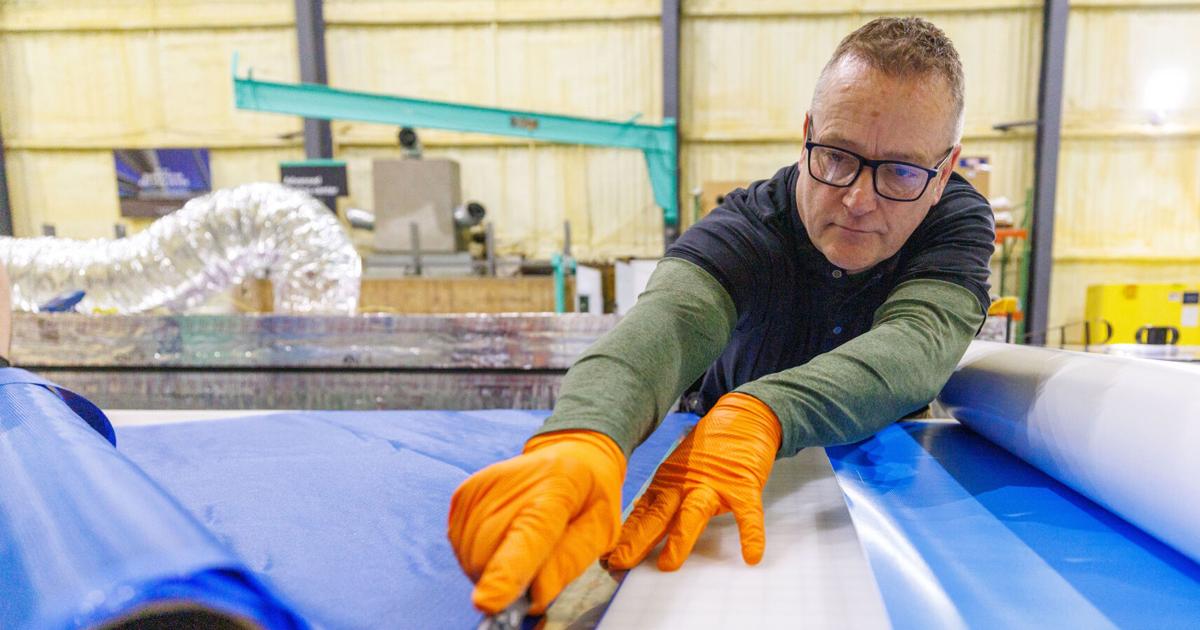
James Martin rolls composite material between his fingers at GWT in Avondale, La., Wednesday, March 18, 2026. (Staff photo by Enan Chediak, The Times-Picayune)
“We’ve spent years figuring out how to make wind blades lighter, stronger and cheaper — and we’re set up at a facility that will allow us to expand quickly into production and shipping at scale,” he said. “Now we’re ready to apply those strengths to booming sectors of the economy.”
‘Similar to wind’
Last year, workers discovered a broken piece on a government radio telescope that’s part of a larger array of instruments loaded with tech that allows them to listen to radio waves coming from outer space. All those delicate components can wear out after years of exposure to the elements.
The agency started making calls to find someone who could handle the repair. The work required engineering know-how and the ability to make replacement parts out of carbon fiber “composite” material, a lightweight alternative to metal used in aviation, auto racing, wind energy and other industries.
Louisiana company GWT repaired a prototype radio antenna that is part of the National Radio Astronomy Observatory’s proposed Next-Generation Very Large Array telescope initiative in New Mexico. (Photo courtesy of NSF/AUI/NSF NRAO)
The hunt led to GWT, which had spent the previous five years creating and studying wind blade prototypes while also building a service division that repairs and improves blades and turbines globally.
Martin sent out a project manager and engineer to assess the problem. Within a week’s time, the team had manufactured a replacement part and sent it back west for installation.
“We know how to fix a wind turbine, which is a large structure with a foundation, a tower, electronics and generation equipment,” Martin said. “A large satellite dish is similar: One captures energy from the wind, and the other has to withstand the wind.”
Now, GWT hopes to parlay the New Mexico success into steady work by standing up a U.S.-based manufacturing facility for telescope components and more. It’s investing $12 million this year on new equipment, personnel and product development to help it compete for work.
“We want to design, manufacture and service many products for many customers,” Martin said.
Service work supporting expansion
As GWT looks for more composite manufacturing work in other industries, it’s paying the bills through its service work on existing onshore wind infrastructure. The company also gets hired to evaluate risk for lenders when infrastructure is bought or sold.
Even though new U.S. offshore wind projects are on hold, the nation has more than 100,000 turbines in more than 40 states, and wind produces about 11% of the country’s electricity, enough to power more than 40 million homes, government data shows.
Last year, Avondale-based GWT made repairs and improvements to a wind farm in the Dominican Republic. The company is expanding its focus beyond wind energy projects to aerospace, defense, energy and other industries. (Photo courtesy of GWT)
GWT gets hired to make repairs, replace parts and enhance the performance of existing turbines and blades. It has built a customer base of more than 20 clients who manage wind farms of various sizes. Last year, it signed a six-month contract with a utility company in the Dominican Republic that led to five teams working around the clock making upgrades to a farm.
The income from that service work is supporting changes at GWT’s manufacturing and testing facility, where engineers and technicians are making prototypes to show off to customers looking for a reliable supply chain.
During a recent visit to the technology center, there was visible evidence of the new strategy.
A dozen employees buzzed around the cavernous space as a cross-section of a drone wing prototype sat on a worktable near a carbon fiber chassis that could be used to build an unmanned vehicle. In an enclosed area, a 3D printer bigger than a commercial refrigerator was filled with hundreds of thousands of dollars’ worth of liquid orange resin. Adjacent shelves held mock-ups of hydrofoils and other car parts for one of GWT’s side hustles: wind-tunnel testing for one of the world’s major racing teams.
Workers service a vacuum pump at GWT in Avondale, La., Wednesday, March 18, 2026. (Staff photo by Enan Chediak, The Times-Picayune)
Martin is especially excited about the potential of making aerospace components.
“Elon Musk got approved to put a million satellites into orbit,” he said. “And the war in Ukraine has highlighted the need for high-throughout, low-cost products, which is our bread and butter.”
From the Isle of Wight to New Orleans East
Martin was born and raised off the southern coast of England on the Isle of Wight, which itself has become a manufacturing hub for wind turbines. He joined the industry in the 1990s. Then, in 2010, a startup company he co-founded was wooed by Louisiana economic development officials to set up shop at the Michoud Assembly Facility in New Orleans East. Working from that site for several different companies, Martin spent the next 12 years helping design blades that are now in use worldwide.
In 2021, when the Biden administration was prioritizing renewable energy, Martin and his partners launched GWT with the hope of creating designs that would be viable in the Gulf of Mexico, where moderate wind speeds occasionally give way to hurricanes and other storms. The partners set up shop on the site of a former thriving shipyard, now reborn as a logistics hub called the Avondale Global Gateway, where they have invested millions in equipment that can bind together carbon fibers and various resins to make composite components. The space is designed to bring products from concept to reality quickly.
James Martin, right, has a conversation by the 3D printer at GWT in Avondale, La., Wednesday, March 18, 2026. (Staff photo by Enan Chediak, The Times-Picayune)
The factory’s location on the banks of the Mississippi River — and its access to more unused industrial space on-site — were both big draws as Martin and his partners envisioned mass producing blades and shipping them via barges.
In 2023, the oil giant Shell contributed $10 million to a partnership with GWT to develop and test new blade designs in the hopes of gaining a competitive advantage in the Gulf. The same year, the company purchased a used turbine to install at Port Fourchon. It would have been the first one operating in Louisiana, but the project was scrapped after the Trump administration halted offshore wind projects under construction and canceled new leases, permits and funding. Supply chain disruptions from the pandemic and the war in Ukraine created additional problems for the nascent industry.
“There’s no longer a market for us to mass produce that product,” said Martin, who believes the country’s turn away from wind energy may be temporary.
In many states where it is a key contributor to the power grid, utilities and local leaders are helping make the case for it from a purely economic standpoint.
Said Martin, “In Texas, they get rid of all the political narratives and it’s just about trading electrons.”