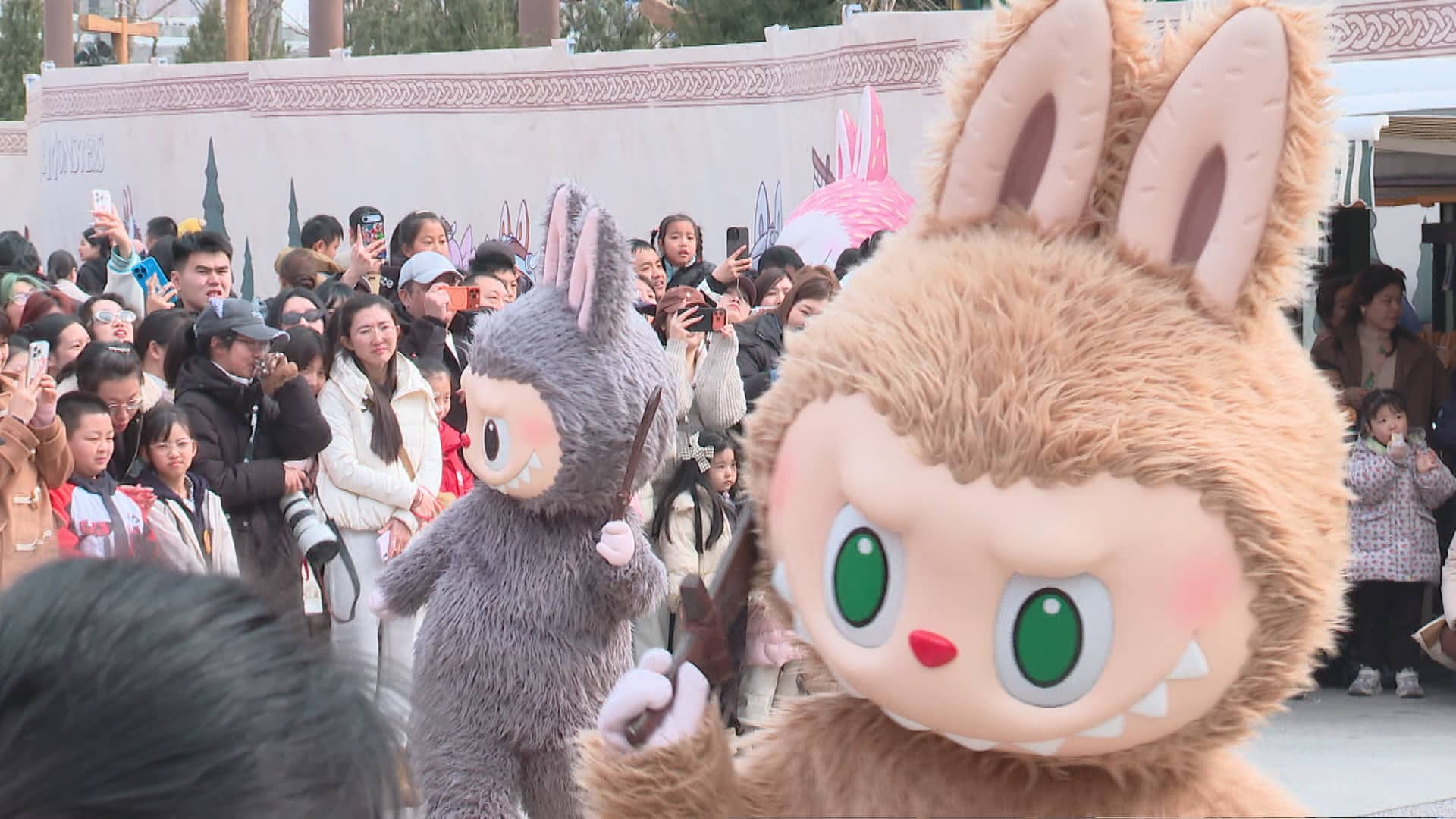
A performance featuring Labubu in Pop Land in March 2026.
CNBC
Pop Mart knew Labubu would be a hit, but it didn’t expect the shaggy little elf-monster to take over the world. Then, almost as quickly, the question followed: Is the bubble about to pop?
It’s a pressure Pop Mart has learned to live with. Investors have been asking some version of that question for years – about Labubu, about the pouty-lipped Molly, about ruddy-cheeked Twinkle Twinkle – said Si De, the Beijing-based toymaker’s chief operating officer.
The Labubu craze has since cooled, and Pop Mart’s stock has retreated some 40% from its August peak. Powered by Labubu, Pop Mart’s revenue and net income in 2025 surged 185% and 309%, respectively.
But shares fell over 22% after the earnings release Wednesday as investors weighed whether the company can keep up the momentum beyond the initial hype.
CEO Wang Ning sought to reassure the market during the earnings call, saying, “Pop Mart has more than just Labubu” — and likening the expectations for the company to a “rookie racing driver suddenly thrown onto an F1 circuit.”
No one knows how long a character will stay popular, Si said. But Pop Mart is clear on how one fades: when you stop investing in it.
“We learned this from Disney. They have a very simple truth: continuous investment,” the 38-year-old executive told CNBC this month. “When you keep making the right investments, the [intellectual property] has a chance to keep going.”
For Pop Mart, that means going global and building worlds around its characters: films, theme parks, fashion tie-ups. The motive is not vanity projects, but commercial bets designed to keep its products like Labubu embedded in people’s lives.
“Of course, we hope that Labubu can also last 80, 90, or 100 years,” Si said, noting Mickey Mouse is nearly a century old. “But this road is very long.”
The method behind the monster
The story of Labubu – which can look like an overnight success – actually began with years of quiet grinding.
Pop Mart first launched Labubu as part of a blind-box collection in 2019 after licensing the character from Hong Kong-Dutch artist Kasing Lung, who created it for a picture-book series several years earlier. For the plush products that became wildly popular, Pop Mart’s team spent about two years developing and prototyping designs.
This painstaking process was not the exception. Pop Mart scours the world for artists each year, Si said, but most don’t make the cut. Of the tiny fraction who sign with the company, they go through a long incubation process, including internal competition, before the company decides where to concentrate its resources.
Hong Kong artist Kenny Wong created Molly in 2006, planting the seeds for Pop Mart’s move into design toys a decade later.
CNBC
The shortlist is deliberately kept small. “We aim to help four, five, maybe six IPs truly grow world-class,” Si said, drawing from Disney’s playbook where a handful of characters generate the lion’s share of value.
Pop Mart, founded in 2010 as a retailer for trendy products for young consumers, pivoted to focus on design toys in 2016 with its first major IP: Molly, a wide-eyed, somewhat sullen girl created by Hong Kong artist Kenny Wong.
He first sketched her back in 2006, after meeting a girl at a fundraiser where he was illustrating portraits. Bespectacled and loudly introducing herself as Molly, she looked at him “with a little bit of stubbornness and nervousness” – and Wong saw himself in her. He wanted to design a character that says, “We may not be perfect in this world, but we are unique,” he told CNBC.
Data-driven, vibe-based
Once products enter the market, the process kicks in like clockwork. Pop Mart tracks sales and social media data closely. A new series drops Friday, and by Sunday, sales figures will signal whether it has legs. Running their own stores and online channels keeps the feedback loop tight. An agile supply chain means they can scale or cut orders quickly.
“We don’t really make predictions. Instead, we continuously adjust our products based on data,” Si said.
But data alone cannot explain why certain characters resonate.
Si doesn’t know what the next big one will be after Labubu – and doesn’t think it’s about dissecting the zeitgeist.
Pop Mart’s Chief Operating Officer, Si De, spoke with CNBC about the company’s systematic approach to artists and products — and its ambitions beyond Labubu.
CNBC
“With all our products – not just Labubu, but also Molly and other IPs – everyone’s feelings when they see them aren’t necessarily the same,” he said.
He compared it to visiting an art museum: people drift past paintings until one stops them. What moves each person is different. Pop Mart’s job, as he sees it, is to keep putting out designs, stories and experiences, and let the encounters happen.
That thinking also shapes how the company approaches artificial intelligence. Pop Mart uses AI for efficiency, such as in customer service and coding, but will continue to trust human judgment for art and understanding human emotions, Si said.
The long game
Pop Mart says it’s in a phase of global expansion and diversification, where the product is no longer just the toy. Markets outside mainland China accounted for about 44% of Pop Mart’s revenue in 2025, and contributions from the U.S. and Europe are expected to grow, Si said.
The stakes of staying relevant are high. Repeat customers who rushed to buy Labubus during periods of tight supply helped spike revenue growth in mainland China last year, according to HSBC. Pop Mart later ramped up production to curb scalping and resale prices have since fallen.
As the Labubu frenzy fades, HSBC last month trimmed its revenue growth forecast for Pop Mart this year from around 30% to under 24%, and expects a 11% to 13% cut in 2026-2027 earnings. The bank added it remained confident in the company’s ability to develop and globalize new IPs beyond Labubu.
Other growth initiatives include partnerships with Uniqlo and the Paris-based leather goods company Moynat. Pop Mart has also moved into jewelry, with some Labubu gold necklaces fetching above $2,000. This month, it teamed up with Sony Pictures and filmmaker Paul King to bring Labubu to the big screen.
Pop Land, Pop Mart’s theme park in Beijing, is undergoing reconstruction and expansion.
CNBC
But theme parks may be the company’s most ambitious project. Si called them a “huge dream” for Pop Mart.
Pop Land, located in Beijing, is still in its early stages and undergoing reconstruction and expansion. Its goal is “360-degree immersion,” said Si: live performances and more storytelling to send people home wanting more. Watch videos. Buy products. Fall for them harder.
That diversification is also a hedge. Regulators in China and Singapore have introduced or planned tighter rules on blind box sales, reflecting growing concern about their addictive and gambling-adjacent appeal. Si said the company has embraced those rules.
The geopolitics of cute
Geopolitics has forced the company to adapt.
As U.S.-China trade tensions escalated, Pop Mart diversified production across Vietnam and Southeast Asia. But with tariff rates constantly shifting, the company has shifted its focus toward supply-chain efficiency over tariff strategy, according to Si.
Pop Mart has also been cited as an example of Chinese soft power: a consumer brand from Beijing that has achieved genuine cultural traction in the West, something few Chinese companies have managed. Si wants to move past that framing.
“I see a lot of media trying to tie us so closely to politics. O.K., first, we cannot avoid the fact that we are a Chinese company,” he said. “But we hope to be a brand that connects artists from around the world with fans from around the world.”
Kenny Wong, creator of Molly, one of Pop Mart’s signature characters, working in his studio.
CNBC