
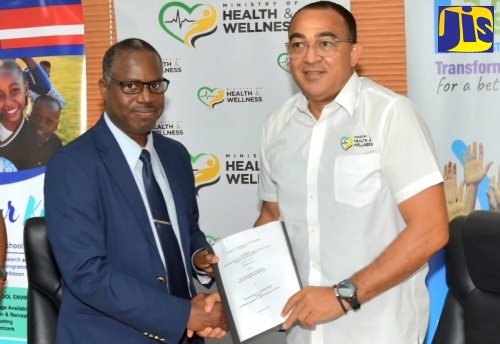
The Jamaica Health and Lifestyle Survey IV (JHLS IV) is well under way, as the Ministry of Health and Wellness (MOHW) undertakes a comprehensive study to assess the health status of the Jamaican population and inform health policy.
Led by Professor Trevor Ferguson, Dr. Novie Younger Coleman and Dr. Shelly McFarlane, the survey is being conducted in collaboration with and commissioned by the Ministry of Health and Wellness (MOHW) through its Health Systems Strengthening Programme.
Field operations, including data collection, commenced in January and are scheduled to run until May. Due to the recent impact of Hurricane Melissa, field work in western Jamaica is expected to begin in March and may extend into June or July.
Professor Ferguson, who is Director of the Epidemiology Research Unit (ERU) at the Caribbean Institute for Health Research (CAIHR) at the University of the West Indies (UWI) Mona, tells JIS News that the field teams began by mapping selected electoral divisions before moving into communities to identify households selected to participate. Professor Ferguson tells JIS News that JHLS IV places strong emphasis on non-communicable diseases (NCDs), which remain the leading causes of illness and death in Jamaica. “We are looking at prevalence of risk factors and prevalence of the conditions. These include hypertension, diabetes, heart disease, kidney disease, and sickle cell disease,” he says.
The ERU Director explains that participants will be asked about their health experiences and will undergo physical measurements, including blood pressure, weight, and height, to determine obesity levels.
Additional assessments include waist, neck, and hip circumference measurements, finger-prick blood tests for blood sugar and cholesterol, and scheduled blood and urine samples to evaluate kidney function and sodium intake.
In Kingston, St. Andrew and possibly St. Catherine, selected participants will also be invited to complete a 24-hour urine collection to better assess salt-consumption patterns. Trained data collectors from UWI are visiting selected households to administer questionnaires and are expected to display their official University-issued identification. Participation is voluntary and requires consent. “It is very important that they get informed consent from the participants, so they will be asked to provide consent, and once consent has been obtained, then the questionnaire is administered,” Professor Ferguson tells JIS News.
He says that the questionnaire is comprehensive and can be completed in more than one sitting, and even partial participation is welcome.
Professor Ferguson says that while NCDs form the core focus, the survey also covers infectious diseases, including COVID-19, HIV and sexually related conditions, as well as mental health, violence and injuries, and broader social factors influencing health. In addition, in response to the passage of Hurricane Melissa in October 2025, researchers have introduced a new ‘Hurricane Melissa Impact’ module to examine the storm’s effects on social well-being, mental health, and the treatment and control of chronic diseases.
Professor Ferguson tells JIS News that the addition of the post-Hurricane Melissa module received ethical approval and reflects the study’s commitment to capturing timely public health information.
“It is a wide-ranging study, but because NCDs are the major cause of morbidity and mortality, they take up a large chunk of what we ask,” he notes.
Professor Ferguson says that the survey’s findings will directly inform health policy and service planning in Jamaica.
“The Ministry of Health and Wellness will use the data to guide decisions on the number of healthcare professionals required, the development and upgrading of facilities, procurement of medication, and the inclusion of conditions under the National Health Fund,” he states. “The Ministry uses these data to guide policy and planning because it’s the most comprehensive evaluation of the health of the Jamaican population,” he adds.
Beyond national planning, the data will also support regional and international reporting, including to the Pan American Health Organization (PAHO) and the World Health Organization (WHO).
The survey further contributes to research and capacity-building, supporting postgraduate training and strengthening Jamaica’s public health leadership. “Several students have done doctoral degrees out of this work as well as masters theses, so it does provide that policy and planning information but it also helps with capacity-building,” Professor Ferguson points out.
The JHLS has been conducted periodically since 2000-2001, with subsequent rounds in 2007-2008 and 2016-2017. JHLS IV continues this vital tradition of evidence-based health monitoring.
Data analysis and report preparation are expected to take approximately six months after the field work concludes, with the final report projected for completion by January 2027. Findings from the survey will be shared at a national dissemination meeting and made publicly available on the Ministry of Health and Wellness website.
Professor Ferguson emphasises the importance of Jamaicans participating in the research, which, he notes, is in the nation’s interest.
“Governments and countries need reliable information to plan effectively. By participating, Jamaicans are contributing to policies that will improve healthcare quality and outcomes for all,” he says.
Speaking at the contract signing for the survey in June 2025, portfolio Minister, Dr. the Hon. Christopher Tufton, indicated that the survey provides the MOHW with an opportunity to develop specific and targeted programmes, as it captures age cohorts, geographic distribution and some of the main causes of illnesses, including lack of knowledge of one’s health status.
“Too many Jamaicans don’t know [that they are ill] until they end up in an accident and emergency ward. They don’t know that their blood sugar level is out, and they don’t know they are hypertensive, until they get a stroke. So, those are the… practical realities that we have to confront and deal with, which is why the data is so important,” he said. Minister Tufton informed that data from past surveys have had a significant impact on national health planning.