
Although rising health care costs remains a key issue for businesses in the state, at least one proposed remedy will have to wait until next year.
That was part of the message from Gov. Ned Lamont and House Speaker Mat Ritter (D-Hartford), who joined other state elected officials in speaking to hundreds of business people Wednesday during Connecticut Business Day.
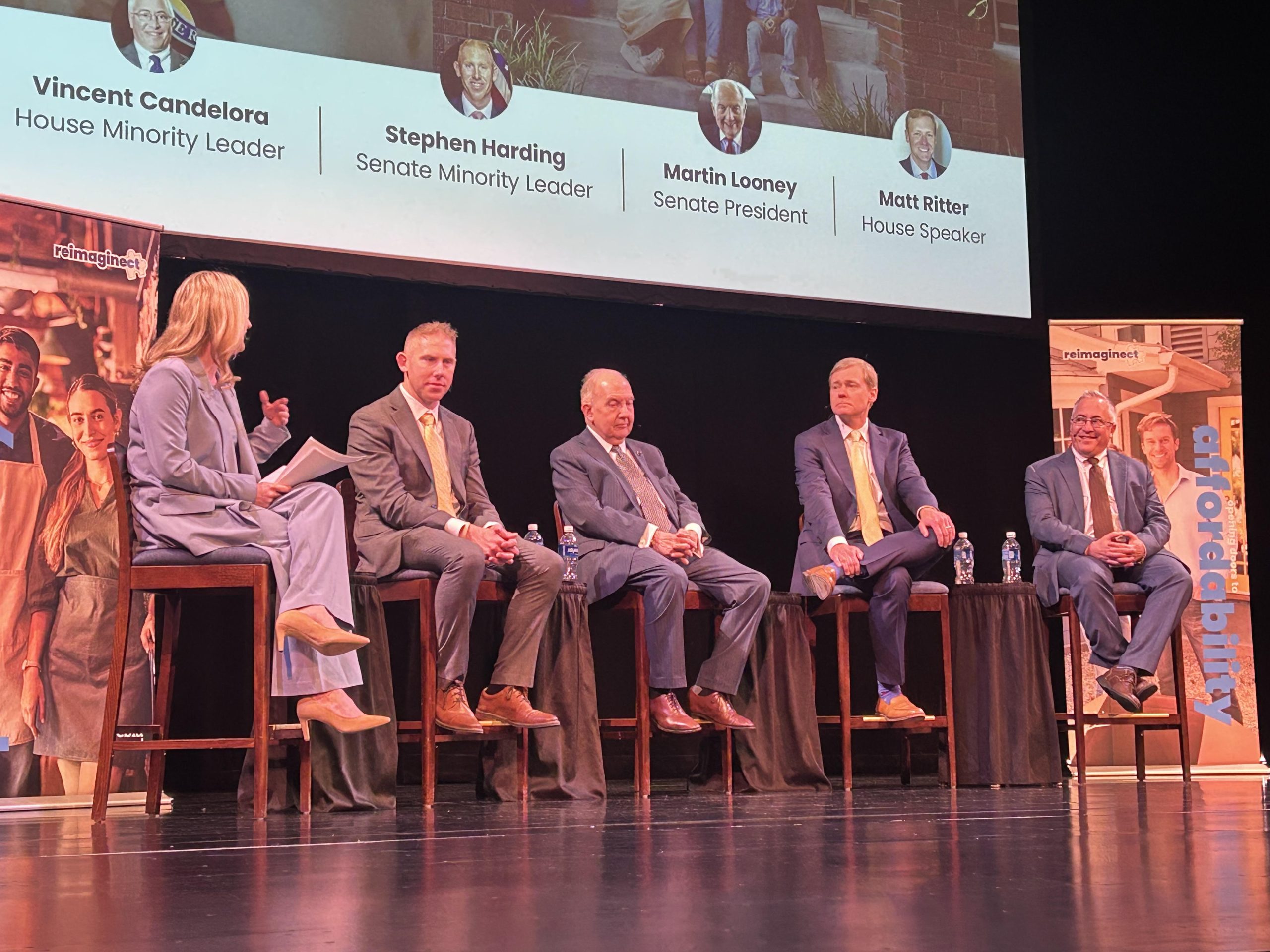
The annual event, hosted by the Connecticut Business & Industry Association at the Bushnell Performing Arts Center in Hartford, was attended by more than 320 people and offered a chance to discuss policy priorities that affect state businesses with as many as two dozen legislators.
Katie D’Agostino, president and CEO of the Central Connecticut Chambers of Commerce and president of the Connecticut Association of Chambers of Commerce Executives, welcomed attendees and highlighted three main priorities for businesses during the current legislative session.
Those priorities are affordability, efficiency and workforce readiness.
D’Agostino said one of the biggest priorities she has heard from businesses, and especially small businesses, is health care affordability.
“Small businesses are being crushed by rising premiums,” which in many cases are rising by double digits each year, she said.
Legislation to allow businesses to pool their workforces in an effort to reduce the cost of premiums is an important proposal that “deserves serious attention now,” D’Agostino said.
CBIA President and CEO Chris DiPentima echoed her comments, while adding a plea to the state legislature: “Why not be small business champions?” he asked.
The event featured two panel discussions, followed by remarks from Lamont.
The second panel featured legislative leaders including Ritter, Sen. Majority Leader Martin Looney (D-New Haven), Sen. Minority Leader Stephen Harding (R-Brookfield) and House Minority Leader Vincent Candelora (R-North Branford).
Among a variety of topics, the panel discussed health care, including Lamont’s proposal for a “Connecticut Option.” Harding said he is concerned about the ultimate cost of the program, which is intended to help businesses reduce the costs of insurance.
Ritter, however, said the governor’s proposal is not for a “public option,” with the intent instead to help businesses leverage their bargaining power and not to have the state operating in the insurance business.
Ritter added that the idea likely would be put off to the 2027 legislative session.
Lamont later said health care costs are crushing the state, its municipalities and businesses, and that his proposed Connecticut Option is trying to find a way to send people seeking health care to the places “with the best value.”
“No, it’s not a public option. No I don’t want the taxpayers taking the risk on things,” he said. “It will be managed by one or more insurance companies.”
He added that developing that program “is going to take a year or so.”
The panel also discussed Lamont’s proposal for a gas tax holiday as a way to offset rising gasoline prices caused by the conflict with Iran.
Ritter said the legislature has approved such proposals in the past, but he wasn’t sure it was the best way to deal with the issue. He noted that out-of-state drivers, and especially truckers, would benefit from it and that there might be alternatives to consider that would be more focused for Connecticut residents.
As for a proposal to allow striking workers to collect unemployment, Looney expressed strong support while Candelora called it a “nightmare.”
He noted that the unemployment fund is paid for by businesses and said it was never intended to be used in that way.
The event’s first panel featured state Treasurer Erick Russell, state Comptroller Sean Scanlon and Secretary of the State Stephanie Thomas. In response to a question from moderator Chris Davis, CBIA’s vice president of public policy, Russell said one of the biggest challenges for Connecticut has been its pension fund, but that progress has been made.
“We just announced in our Investment Advisory Council meeting last week that for the 2025 calendar year, we performed at 14%,” he said of the pension fund. “To put that in perspective, we added $9.3 billion in assets” to the fund.
Russell added that, over the past three years, the fund has grown 12.4%, and over the past decade state pensions have gone from 30% funded to about 65% funded.
Lamont also spoke about the fund, saying that for the first time in decades it is among the top 10 performing funds in the U.S.
“If you have a $70 billion pension fund and you’re making a difference of 1% or 2% a year, that’s $1 billion a year,” he said.
Following his remarks, Lamont took questions from the audience. The first was asked by Molly Kellogg, chairman, president and CEO of Hubbard-Hall, a chemical company based in Waterbury.
Kellogg said her company is planning to expand and is deciding where to do that.
“Why should I put $5 million in Connecticut vs. $5 million in South Carolina? Help us reinvest in Connecticut,” she said.
Lamont said he would “make the case for Connecticut on a couple of fronts,” noting that the state has gotten its fiscal house in order and isn’t raising taxes as other states are doing.
He also said that Connecticut is a small state, “so we’re one phone call away” if a company needs assistance.
“And by the way,” he added, “have you been in South Carolina in July? Oh boy!”