Introduction: Markets rising after Trump says Iran war will end ‘very soon’
Good morning, and welcome to our rolling coverage of business, the financial markets and the world economy.
Oil prices are falling and stocks are rebounding after US president Donald Trump said the war with Iran would end “very soon’.
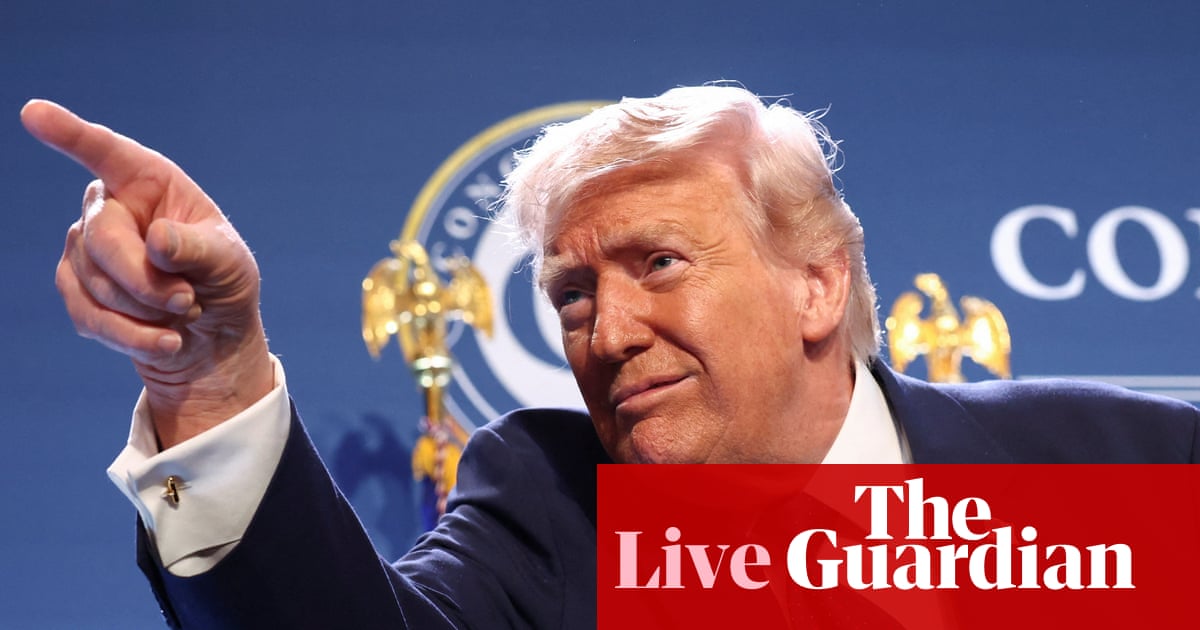
Speaking from his Doral resort in Miami, the president described the war in Iran as a “little excursion” that had succeeded “much faster than we thought”.
He said his administration was “looking to keep the oil prices down”, as “they went artificially up because of this excursion”.
The remarks triggered a relief rally across markets, although Trump indicated that the war would not be ended within the next week.
Oil prices are dropping sharply, with the international benchmark Brent crude now down 6.8% to $92.19 a barrel, after surging past $100 a barrel on Monday morning.
Stock markets rose in Asia, which has been one of the most exposed regions to higher energy prices. Japan’s Nikkei 225 share index has risen by 2.5%, while the South Korean Kospi jumped 6%. Hong Kong’s Hang Seng index is also up by 2%.
While Trump has said the war may be ending soon, he has also vowed to hit Iran “TWENTY TIMES HARDER than they have been hit thus far” if it “does anything” to stop the flow of oil through the strait of Hormuz.
About a fifth of global oil and seaborne gas tankers typically pass through the strait, which has already in effect been closed for a week, heightening concerns over energy supplies which have propelled prices higher.
Tehran declared that it would not allow “one litre of oil” to be exported from the region if US and Israeli attacks continue, Iranian state media reported on Tuesday, citing a spokesperson for the regime’s Revolutionary Guards (IRGC).
The agenda
Key events
The UK housebuilder Persimmon is the best performer in Europe today, with its shares rising by almost 10% after it reported a rise in annual sales and profit.
Pre-tax profit for the year was up 11% to £397.3m, with revenue up 17% to £3.75bn. Overall new home completions were up 12%.
However Richard Hunter, head of markets at the broker Interactive Investor, notes the Iran war could weigh on the property sector. While oil prices are falling this morning, they are still elevated, feeding concerns around inflation and lowering the likelihood of interest rate cuts.
Whereas one or even two interest rate cuts had been priced in for this year, the current estimate is that there could actually be one rise, which would impact mortgage affordability.
That being said, there are a number of tailwinds which could yet revitalise the sector. More broadly, there remains a noticeable supply shortage of homes domestically and government reforms to planning should oil the wheels of being able to break ground. At the same time, the group noted that for some, inflation-beating pay rises and the relaxation of lending rules led to higher enquiry rates and has underpinned growth alongside wider mortgage availability.
Still, Dean Finch, chief executive at Persimmon, said in a statement that the impact of the Iran conflict on consumer sentiment “remains to be seen”. He said:
Assuming the conflict with Iran and its impact is short, Persimmon is set to grow again in 2026.
FTSE opens higher, joining global market rally
The UK’s blue-chip FTSE 100 share index has opened 1.4% higher this morning, as the relief rally across global stock markets continues.
European markets are following Asia higher, with the Italian FTSE MIB up 2.4%, the German Dax up 2.1% and the French Cac 40 up 1.9%. The Stoxx Europe 600, which tracks the biggest companies across the continent, is up 1.5%.
European gas prices falling
European natural gas prices are falling this morning too, with the Dutch month-ahead gas contract (the European benchmark) down 16% to €46.59 per megawatt hour (MWh), down from as high as €56 on Monday.
But Susannah Streeter, chief investment strategist at the broker Wealth Club, warns that given that the fighting continues and the strait remains impassible, investors may still be worried.
Oil prices remain more than 25% higher than before the conflict began. Trump has pledged that the US Navy will provide a guard for tankers through the strait, but any timeline for that is highly obscured, with forces for now focused on taking out military infrastructure rather than becoming ship escorts.
Until a longer‑term resolution is found, companies and consumers are still set to pay the price for the attack by the US and Israel on Iran. The repercussions for an array of everyday costs affecting companies and households are becoming clear.
Prices at the pumps have already increased, and motorists are being warned to drive more conservatively to offset an expected further rise in costs. More generous fixed‑rate energy tariffs have been scrapped, and households are bracing for a rise in the energy price cap in July. Borrowing costs are set to stay elevated for longer due to the inflation pressures higher energy costs will bring, and better mortgage deals have been withdrawn.”
Oil prices are already down by more than 6% this morning, with brent crude at $92.19 a barrel. It peaked at just over $119 on Monday.
Jim Reid at Deutsche Bank says investors will be watching for signs that shipping through the strait of Hormuz can recover from its suspended levels, especially after Saudia Arabia became the latest country to cut oil production yesterday.
Remember that the oil moves have been much more contained further out the futures curve, with December 2026 Brent futures currently trading at $74.95/bbl.
We will also be watching whether plans to release oil reserves materialise. Yesterday’s virtual G7 finance ministers’ meeting didn’t get to that point yet, with their statement saying they “stand ready to take necessary measures”, and France’s finance minister said they were “not there yet”. Overnight, Japan’s Finance Minister Katayama said that G7 energy ministers are expected to meet to discuss the process of oil reserve release today.
Introduction: Markets rising after Trump says Iran war will end ‘very soon’
Good morning, and welcome to our rolling coverage of business, the financial markets and the world economy.
Oil prices are falling and stocks are rebounding after US president Donald Trump said the war with Iran would end “very soon’.
Speaking from his Doral resort in Miami, the president described the war in Iran as a “little excursion” that had succeeded “much faster than we thought”.
He said his administration was “looking to keep the oil prices down”, as “they went artificially up because of this excursion”.
The remarks triggered a relief rally across markets, although Trump indicated that the war would not be ended within the next week.
Oil prices are dropping sharply, with the international benchmark Brent crude now down 6.8% to $92.19 a barrel, after surging past $100 a barrel on Monday morning.
Stock markets rose in Asia, which has been one of the most exposed regions to higher energy prices. Japan’s Nikkei 225 share index has risen by 2.5%, while the South Korean Kospi jumped 6%. Hong Kong’s Hang Seng index is also up by 2%.
While Trump has said the war may be ending soon, he has also vowed to hit Iran “TWENTY TIMES HARDER than they have been hit thus far” if it “does anything” to stop the flow of oil through the strait of Hormuz.
About a fifth of global oil and seaborne gas tankers typically pass through the strait, which has already in effect been closed for a week, heightening concerns over energy supplies which have propelled prices higher.
Tehran declared that it would not allow “one litre of oil” to be exported from the region if US and Israeli attacks continue, Iranian state media reported on Tuesday, citing a spokesperson for the regime’s Revolutionary Guards (IRGC).