
Seventh American service member dies in Iran war, CENTCOM confirms
A seventh U.S. service member has died from injuries in Iran’s initial counter attack as conflict continues across the Middle East.
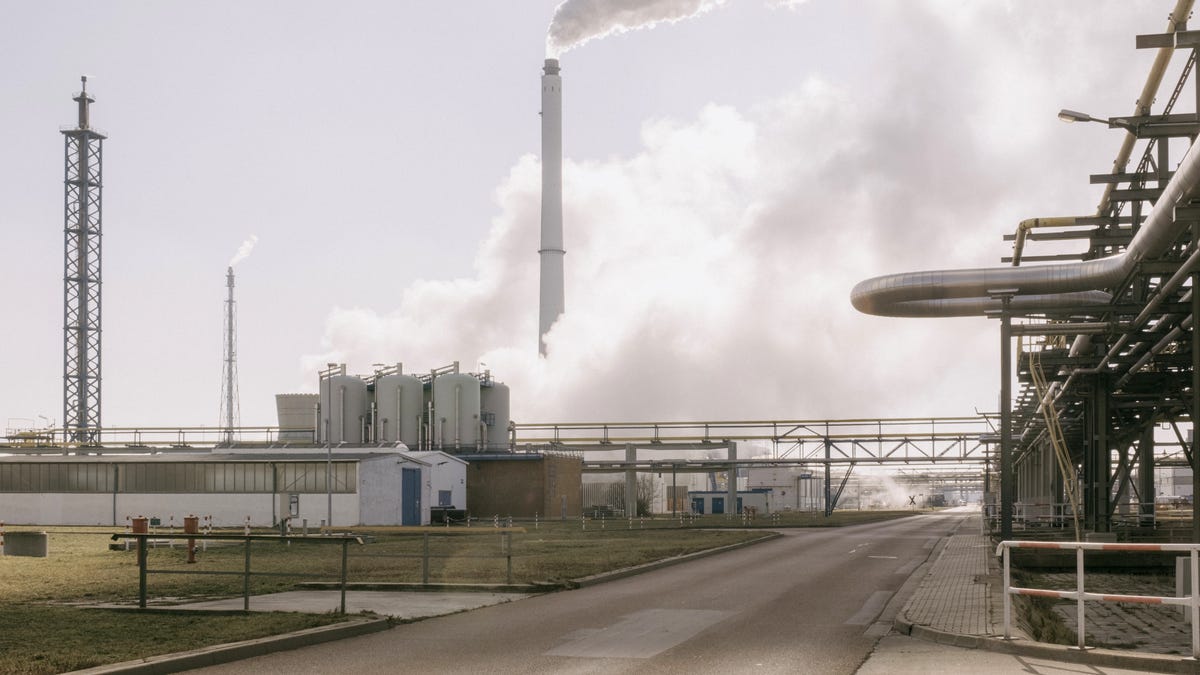
In the east German industrial town of Leuna, Christof Günther had been looking forward to a quiet Christmas with his family when the risk of a disaster at the local chemical park he helms disrupted any sense of seasonal calm.
A site run by Domo Chemicals, which makes compounds that end up in fuel tanks, swimsuits and food packaging, unexpectedly filed for insolvency after running short on the cash needed to operate equipment to convert benzene into nylon. In the midst of the winter cold, an uncontrolled shutdown risked leaking toxic substances, threatening nearby operators as well as the 14,000 residents living in Leuna’s cluster of red-tiled houses.
Like dozens of other chemical plants in the region, the family-owned company got tripped up by higher energy costs due to Russia’s invasion of Ukraine and rising carbon prices in the European Union. New capacity from China and softening demand have further squeezed margins.
These challenges are set to intensify in the aftermath of the U.S. and Israeli assault on Iran. As energy prices soar, Europe’s chemical producers stand to pay about €3 billion ($3.5 billion) more annually just for natural gas if the post-attack surge persists, according to an estimate by Sebastian Bray, head of chemicals research at Berenberg. On Monday, European natural gas prices jumped as much as 30% to extend their biggest weekly advance since the energy crisis four years ago.
Because of Leuna’s history and structure, the east German chemical park is particularly exposed, making it a test case for an economy reliant on energy and raw material imports.
The challenges are evident in the monthly gas bill for InfraLeuna — the operator of the chemical complex. The expense had shot up to around €10 million from €6 million before the war in Ukraine, and at current prices, it will be about €17 million, according to Günther, the site’s managing director.
“In practice, we will see chemical plants being shut down,” the 56-year-old said. “The chemical industry and energy-intensive industries in Germany are in a state of acute emergency.”
The problems at Domo were well-known to Günther. But the insolvency filing still caught him off guard and triggered frantic talks to avert catastrophe.
“There was no model to follow,” he said from his office in the neo-classical headquarters of the park — a century-old chemical hub that boasts 94 kilometers (58.4 miles) of railways, 40 kilometers of roads and 20 kilometers of piping.
Belgium-based Domo had been attempting to overhaul its business since 2024, even reaching out to expensive debt funds for a last-ditch loan. The company put forth a recapitalization plan in December 2025 that included a “significant” funding commitment, but stakeholders didn’t agree, Chief Executive Officer Yves Bonte told Bloomberg.
To avoid a dangerous closure, Günther and the preliminary insolvency administrator eventually managed to secure emergency financing from the German state of Saxony-Anhalt. With the government intervention raising echoes of the communist system from which the park emerged, the deal kept Domo’s plant — which employs some 500 people — operating at a minimum safe level.
The administrator is now discussing takeover options for the Leuna site and another Domo plant in Premnitz with several investors. The state has agreed to provide financing only until the end of this month. That means the future of the operations is still up in the air, and potentially even more complicated by the turmoil caused by the conflict in the Middle East.
It remains to be seen what will happen if no investors can be found, said a spokesperson for the preliminary insolvency administrator.
To prepare for potential disruptions of oil and gas supplies, the EU set up an energy task force, which started meeting last week. A renewed energy shock would hit an economy that’s still in recovery mode from previous price jumps, according to Veronika Grimm, a member of Germany’s council of economic experts.
Already, the strained prospects for European chemicals producers had caused financing to dry up, increasing the likelihood of failures like Domo’s. Since 2022, plant closures in Europe have surged sixfold and investments in the sector have tumbled by more than 80%, according to a report by consultancy Roland Berger for industry group Cefic.
As Europe’s industrial powerhouse, the issues are particularly severe in Germany, where manufacturing output has been on a downward trend since 2017. Public focus has been on carmakers like Volkswagen AG falling behind Chinese competitors. Yet without chemical supplies, Europe’s industrial fabric risks fraying.
“The threat to the chemicals industry is more dangerous for Germany than the crisis in the automotive sector, since chemicals firms will quietly invest elsewhere while automotive firms would rather fight for market share,” said Joachim Ponseck, a restructuring and insolvency lawyer at Baker McKenzie in Frankfurt. “Chemical park operators have fewer strategic moves,” since they can’t reduce energy prices on their own or relocate easily.
Within the chemical sector, Leuna is a special case. After being heavily bombed in World War II, facilities were reconstructed by Soviet-controlled East Germany to be an anchor for the region’s industrial revival.
The site, which employed nearly 30,000 people in its heyday, is connected directly to Russian oil fields via the Druzhba pipeline. That provided easy access to energy and feedstocks, which account for 70% or more of the cost of producing commodity chemicals, like Domo’s polyamide.
Before those links fractured in the aftermath of Moscow’s invasion of Ukraine, they were seen as a strategic advantage. When Leuna was carved up and privatized in the 1990s following the fall of the Berlin Wall, the facility was so desirable that some suitors resorted to bribery to secure assets there — a scandal that became known as the Leuna Affair.
The difficulties finding an investor for Domo’s operations is indicative of the change in fortunes, and concerns are that it could be the next domino to fall and put Germany’s largest contiguous chemical park at risk.
“We need chemistry in Germany in every way — from basic chemicals to the corresponding products — not only to ensure resilience, but also to ultimately preserve industry,” Gitta Connemann, a state secretary in the German ministry for economy and energy, said during a press conference about Leuna’s future in February.
Chemical parks operate as tightly integrated “Verbund” systems, which means that companies depend on one another as customers for each other’s products and jointly finance infrastructure such as power generation, steam supplies and waste management.
The interdependence that once made Leuna efficient and competitive now also makes it vulnerable. When one plant falters, others need to shoulder more of the costs, putting pressure on the entire network.
Aside from the looming closure of the Domo site, other operations in east Germany’s chemical cluster are under strain. Less than 30 minutes by car from Leuna, Dow Chemical Co. will close an ethylene cracker in Böhlen and its chlor-alkali and vinyl operations in Schkopau by the end of 2027. Ammonia producer SKW Piesteritz in Wittenberg temporarily shut operations in 2022 after gas prices spiked following the outbreak of Russia’s invasion of Ukraine and remains under pressure.
Similar struggles are evident across the sector. BASF SE, Europe’s biggest chemical company, has slashed around 4,800 jobs over the past two years. Ineos — owned by billionaire Jim Ratcliffe — has seen its bonds targeted by short sellers as the heavily indebted conglomerate grapples with price pressures.
“The industry is currently in the process of shutting down,” Ratcliffe said, reaffirming a call for government intervention even before the United States and Israel attacked Iran. “Without a chemical industry, we cannot run hospitals, we cannot feed people, we cannot defend ourselves.”
The strained conditions mean prospective investors can negotiate terms that are almost punitive. LyondellBasell’s sale of a package of European production sites, including one in Germany, is a case in point. Under the deal, which was announced in June, the U.S. chemical maker injected €265 million into the business to win over private equity firm Aequita.
“Before in the chemicals industry, you would always find a buyer” if an operator ran into trouble, said Maximilian Dressler, a turnaround consultant at EY. “But that has become difficult, given the staggering losses in the sector.”
To prevent contagion in Leuna, Günther missed out on eating traditional Christstollen cake with his family to speak daily with Domo’s preliminary insolvency administrator and state officials. After weeks of negotiations, a short-term deal was reached on Jan. 12. It has already cost taxpayers a double-digit million-euro sum.
On the political front, the situation is particularly sensitive. Voters will elect a new state government in September and the far-right Alternative for Germany, or AfD, is the clear leader in the polls, with support at nearly 40%.
The nationalist party’s appeal is particularly strong in Germany’s former communist east, where people had their lives disrupted by reunification and feel sidelined by the mainstream. For local officials, that meant a balancing act between preserving jobs while not sliding back into state control.
“Until 1989, we had socialism here — where the state ran the companies — that’s not my idea of economics,” said Sven Schulze, the member of Chancellor Friedrich Merz’s conservative bloc who was appointed Saxony-Anhalt’s premier in the midst of the crisis.
While the clock ticks down on Domo’s rescue, the arrival of new companies offers grounds for optimism. In February, startup MicroHarvest GmbH announced plans to locate its first large-scale production plant at the park, making new sources of food protein using fermentation. UPM-Kymmene Oyj’s biochemicals unit and a subsidiary of Japan’s Daicel Corp. are also new additions.
Central and local governments have also earmarked €1.2 billion to develop a research institute near Leipzig devoted to making the chemical sector more sustainable. It’s projected to employ up to 1,000 people by 2038.
Despite the new investments, the mood in the town is tense. For the people of Leuna, which have relied on chemical production to sustain the community for generations, the war in Ukraine and the conflict in the Middle East create a rupture that feels deeper than the collapse of the Soviet bloc.
The oil refineries being hit in the Middle East are “our lifelines,” said Manuela Grieger, who followed her parents to work at Leuna’s chemical plants and navigated its ups and downs for more than four decades. “In principle, I believe that when something is destroyed, something new can emerge. But at the moment, I’m missing the light at the end of the tunnel.”
The 65-year-old first walked through the gates of the chemical park as a teenager in 1977, and joined the works council in 1990 to help steer her colleagues through restructuring that led to more than half losing their jobs. In the early 2000s, she saw stability gradually return and the chemical park transformed into a success story.
“I imagined things differently after reunification,” Grieger said. “Everything is in flames and there’s no bright spot — I’m not used to that.”
With assistance from Rachel Graham