While its office vacancy rate is still hovering around 25 percent, the office market in the core of Downtown Boston has bounced back more quickly from post-pandemic doldrums than the surrounding Back Bay, Seaport, East Cambridge, and broader central business district, at least according to one new study.
The study, commissioned by the Downtown Boston Alliance — formerly called the Downtown Boston Business Improvement District — and completed by frequent DBA real estate research partner Newmark, shows the district’s office vacancy has steadily improved in past year and a half.
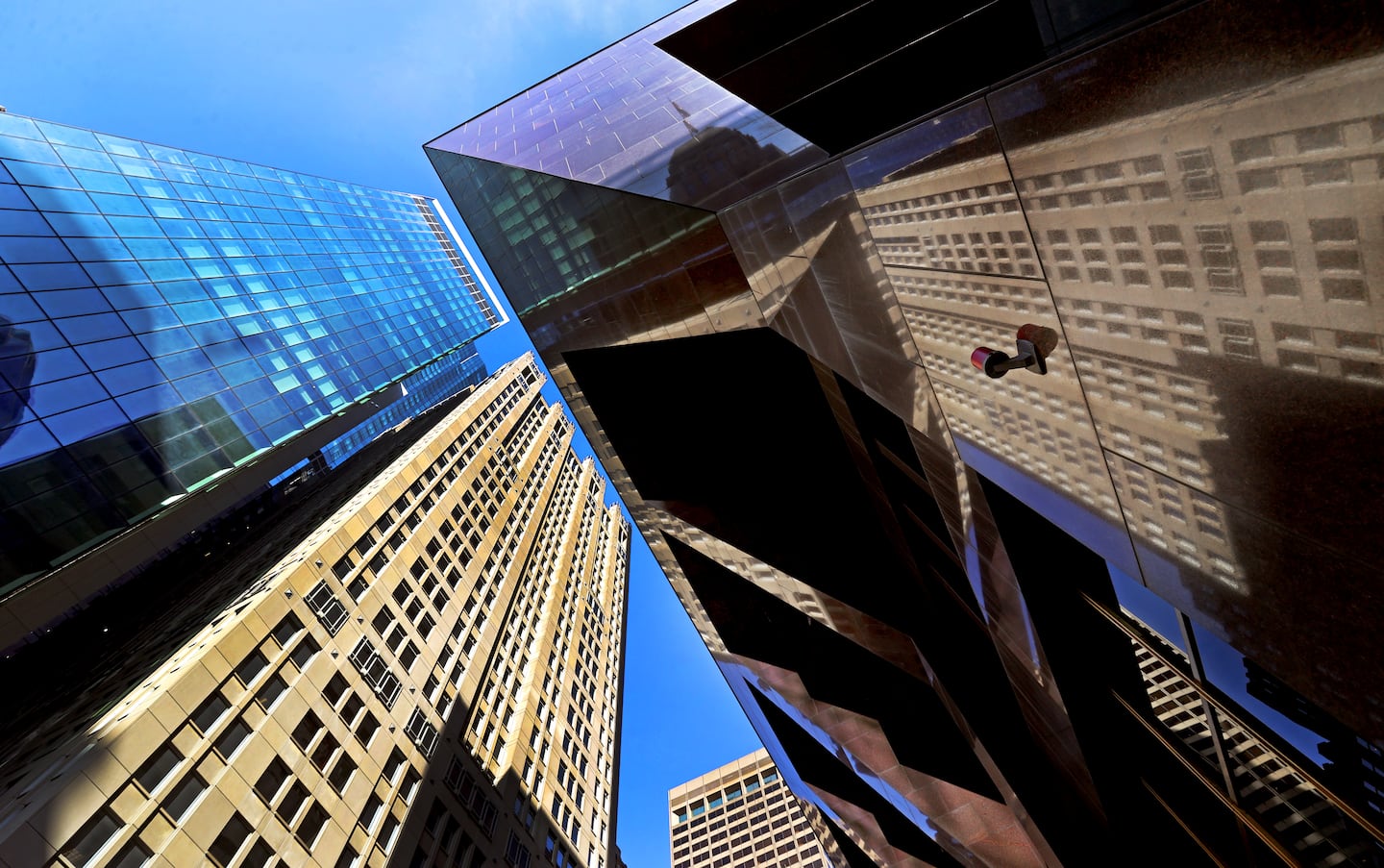
The DBA’s service area includes most of Downtown Crossing up to Congress Street, representing about a quarter of the downtown central business district. Still, it’s highly concentrated: About two-thirds of the 24.6 million square feet of commercial space in the DBA area is office space. While it includes prominent towers like Winthrop Center and 100 Federal St., it does not include properties farther from Downtown Crossing, like the newly completed tower above South Station or the recently renovated One Post Office Square tower.
The neighborhood’s office vacancy rate peaked in mid-2024, at 28.5 percent and is now 25.2 percent, a decline of 3.3 percentage points. That’s a faster rate of recovery than nearby business districts, the report shows, even if those submarkets have lower vacancies. The 19.9 percent vacancy in the remaining central business district is down just 0.4 percentage points from its peak vacancy at the end of 2024, while Back Bay’s 18.1 percent vacancy is improved by 1.5 percentage points from its peak in early 2025, Newmark data show.
Michael J. Nichols, the president of the Downtown Boston Alliance, said the office leasing activity was coming not just from one industry or one specific tenant, but a broader range of recommitments or expansions by existing tenants, along with some new lease deals.
“There is a palpable new energy as more companies and workers enter the neighborhood more often,” Nichols said in a statement. “The region’s most accessible office district is also the most rapidly healing one from the scars of the pandemic.”
Another factor: office to residential conversions that have chipped away at the vacancy rate by taking sparsely populated offices, particularly older or less- expensive ones referred to as Class B properties, off the market. The city has some 22 applications to convert 1.3 million square feet into 1,517 units. That office to residential work is pretty much the only construction activity happening in downtown right now, and developers are continuing to hunt for obsolete office buildings that could be repositioned.
Newmark researcher Liz Berthelette stopped short of calling the DBA’s six straight quarters of office vacancy declines a recovery. But the neighborhood is “very far into positive momentum,” including making headway on filling up ground-floor retail vacancies, said Berthelette, who leads northeast research and national life science research for Newmark.
“We don’t have a lot of submarkets, or really any, that have had such strong downward vacancy decline,” Berthelette said.
Still, the region isn’t out of the woods yet. In East Cambridge, for example, office demand historically came from venture-backed or blue-chip technology firms, biopharmaceutical companies, or big pharma companies. Those have all faced substantial challenges in the past year.
“There’s still risk. There’s still challenges,” Berthelette said. “The whole market’s not in full recovery yet.”
Craig F. Walker/Globe Staff
Catherine Carlock can be reached at catherine.carlock@globe.com. Follow her @bycathcarlock.