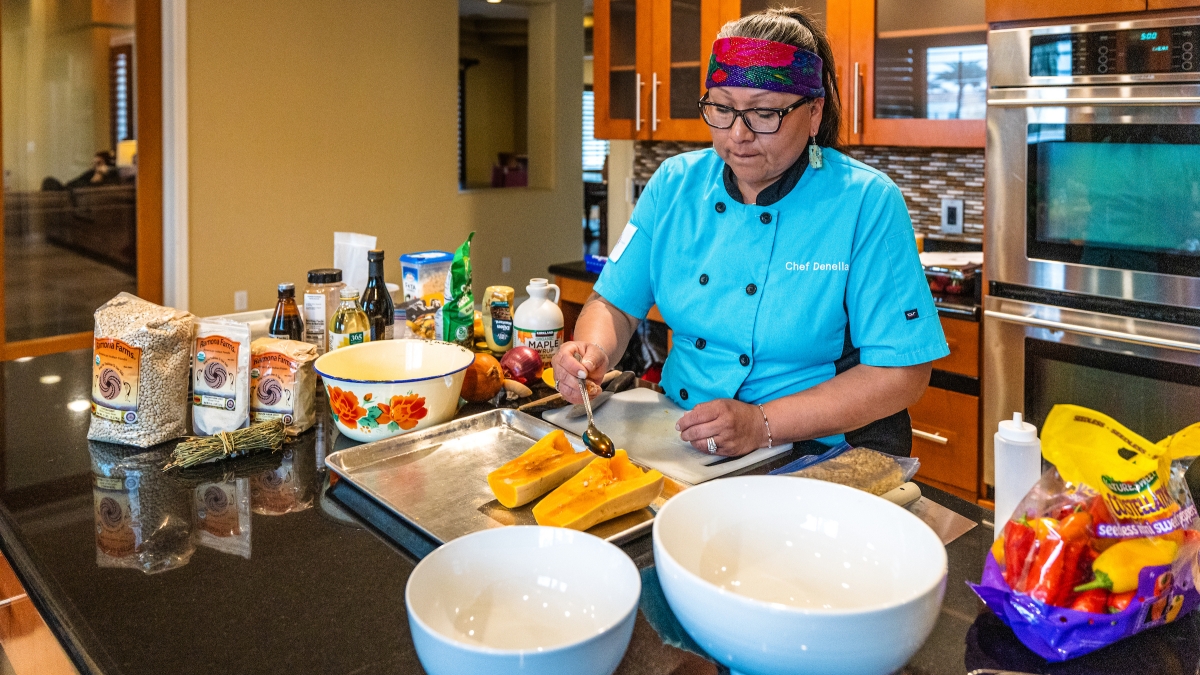
Three years ago, Denella Belin was not looking to become her own boss. A Navajo chef from Tuba City, Arizona, she had what many would consider strong job security.
She was working as a sous chef at a tribal-owned casino in the Valley, a position she had spent years building toward. She had five children, more than a decade of kitchen experience and a steady paycheck. Entrepreneurship was not part of her plan
Then someone asked her a question she could not shake.
Representatives from Project DreamCatcher attended a small food demonstration Belin was leading. Afterward, they asked whether she had ever considered turning her work into a business.
Her answer was immediate.
“I loved my job. I had a committed position,” she said. “I wasn’t looking for a business opportunity.”
But the question lingered.
“They told me there was a market for what I was doing,” Belin said. “When someone sees something in your work, I reflect on that, good or bad. I ask myself why they said it and what it means.”
Three or four months after attending the weeklong cohort in fall 2022, Belin made a decision she once believed was beyond her capacity. She left her casino position and used her final paycheck to launch her own business.
“Project DreamCatcher gave me the foundation to believe I could become someone I hadn’t imagined before,” she said.
Today, she owns Nellas Innovative Kreations, a Phoenix-based catering company established in 2023.
Belin’s story reflects what Project DreamCatcher has cultivated for nearly a decade: confidence rooted in culture and entrepreneurship grounded in sovereignty.
For Zuzette Kisto of the Gila River Indian Community, that shift did not mean leaving a job. It meant redefining retirement.
After 32 years working in marketing and public relations for her tribe, Kisto stepped away from full-time employment with a desire to build something of her own.
“I’ve always had a dream of creating a business,” she said. “I felt it was a great opportunity to dive into all aspects of what it would take for me to become an entrepreneur.”
Encouraged by her friend April Tinhorn, a member of DreamCatcher’s first cohort, Kisto joined in August 2025. She arrived with decades of professional experience and questions about how to shape it into something intentional.
“I don’t want to be someone who simply adds every skill they have into one business,” she said. “I want to enter my business with a clear structure — a defined set of services. I don’t want my business to run me.”
A program built for Indigenous women
Over the past several years, the global headquarters of Thunderbird School of Global Management on ASU’s Downtown Phoenix campus has become, for one week at a time, a gathering space that feels both scholarly and ceremonial. Women travel from tribal communities across Arizona and the Southwest carrying business plans, lived experience and ambition.
Project DreamCatcher is a free, culturally grounded business education program created by the Freeport-McMoRan Foundation in partnership with Thunderbird. Its goal is to build the capacity of women business owners from tribal nations across Arizona.
“What makes this program different is that it was designed specifically for the Indigenous and tribal populations we serve,” said Mary Sully de Luque, academic director of Project DreamCatcher and a professor of management at Thunderbird. “It’s really their program. I always say I’m a guest in their program, because I am.”
Since launching in 2015, Project DreamCatcher has graduated approximately 350 Indigenous women and supported the creation or growth of nearly 120 Native-owned businesses across industries including food, health care, consulting, logistics, technology and cultural preservation.
“This wasn’t just a program they funded,” said Michelle Lyons-Mayer, senior director of global development at Thunderbird. “This was a community they joined.”
Ondrea Barber, manager of Native American affairs for Freeport-McMoRan, said the long-term investment reflects the company’s commitment to tribal communities.
“We have seen the positive impact it has in tribal communities on an individual level, with families, and across communities as a whole,” Barber said. “It provides a glimpse into what is possible and a pathway to business ownership where many community members may not have seen that as an option for themselves.”
Jacob Moore, vice president and special advisor to the president on American Indian affairs at ASU, said Project DreamCatcher reflects the university’s broader commitment to serving tribal communities.
“Project DreamCatcher is a good example of ASU’s ability to offer unique and effective learning modalities that meet the economic, social, cultural and overall health of the communities it serves,” Moore said. “Thunderbird School of Global Management didn’t just assume that standardized business curriculum would be sufficient. The Project DreamCatcher program validates the wisdom, teachings and experiences that the women bring with them and integrates that knowledge with MBA-level business concepts.”
The first cohort and building trust
Long before Belin walked into a DreamCatcher classroom, Tinhorn was helping launch the first cohort.
Tinhorn, who is an enrolled Hualapai citizen and is also Navajo and Chinese, is the CEO and founder of Phoenix-based Tinhorn CX, a consulting firm she established in 2010. Her company focuses on business wellness through strategic planning, tribal connection and facilitation services, primarily serving Indigenous-led nonprofits, tribal health corporations and tribal governments.
In 2015, she received a call from Katherine Zuga, then program manager, who was working to recruit enough applicants to launch DreamCatcher’s inaugural class. At the time, eligibility was limited to Arizona women entrepreneurs enrolled in the Hualapai, San Carlos Apache, Tohono O’odham and White Mountain Apache tribes.
“They needed 20 applicants and had not been able to reach that number after three cycles,” Tinhorn said.
She helped recruit, using relationships across those tribal communities.
“That’s how the inaugural cohort was established,” she said.
Her involvement continued well beyond that first class. Tinhorn CX designed the DreamCatcher logo, conducted alumni surveys through the ASU Kauffman Inclusion Challenge grant, hosted workshops and recruited participants. Today, she returns to lead sessions on topics such as money mindset and marketing, and serves on panels.
For Kisto, Tinhorn’s participation influenced her own decision years later.
“She was the first cohort and she talked about it,” Kisto said. “I was always inspired seeing it on social media, hearing people’s stories.”
A week that changes trajectories
DreamCatcher is structured as an intensive, weeklong, in-person experience. Each cohort includes about 30 women from multiple tribal communities. Lodging, meals and transportation are covered so participants can focus fully on their development.
Participants complete master’s-level coursework in entrepreneurship, leadership, accounting and pitching. They visit Native-owned businesses and build relationships that often extend beyond the classroom.
“When women come from communities where there may be very little commerce, entrepreneurship can feel isolating,” de Luque said. “When they come here, they realize they’re not alone.”
That realization stood out to Kisto.
“First and foremost, it was the sisterhood,” she said. “Being surrounded by other women striving to become entrepreneurs, or who were already entrepreneurs, was incredibly inspiring.
“For me, it’s knowing there are other Native women out there who want to empower themselves, their communities and their businesses. Just taking that leap of faith and saying, ‘I have skills to offer. I am valuable.’ It was inspiring to know you’re not alone.”
The coursework also left a practical impact, particularly the financial training.
“(The instructor) explained how to set rates and prices in a way that was easy to understand,” Kisto said. “He showed us how to factor in all necessary information when pricing services for potential clients.”
Graduations include blessings and ceremonies led by alumnae, with participants wearing traditional attire and carrying tribal flags.
“In some tribal cultures, there are beliefs around death, spirituality and generational wealth that affect how you talk about finance or long-term planning,” de Luque said. “We create space for those conversations, and we’re very attentive to what is appropriate.”
“The connections continue long after the cohort ends,” Barber said. “Women stay in touch, share resources and lift one another up.”
Businesses rooted in community
Many DreamCatcher businesses grow from cultural practice and community need. Some begin with catering for ceremonies or beadwork. Others expand into health care, trucking, consulting and digital education.
Through Kisto Consulting LLC, a company she established 11 years ago for Native outreach work, Kisto is refining her focus on presenting and consulting in management and women’s empowerment, drawing in part from her experience as a caregiver.
“I want to have a business that I love,” she said. “Not just a business based on skills I happen to have.”
Lyons-Mayer said many DreamCatcher ventures are inseparable from identity.
“For many of them, business is about preserving culture,” she said. “It’s not separate from identity.”
Kisto agrees that Native women often carry entrepreneurial leadership within their communities.
“I grew up on my reservation. I was born and raised here, and I still live here,” she said. “From watching my aunts and my mom, I’ve seen that Native women carry a strong inner power. We’re doers. We figure things out, get things done and provide for our families and communities.”
Tinhorn said supporting Native women entrepreneurs creates ripple effects.
“Native women bring in approximately two-thirds of household income in tribal communities,” she said. “If someone wants to make a difference in tribal communities, support and buy from Native women business owners. The impact spans generations.”
Belin sees that generational impact at home.
“I’ve worked in kitchens for 15 years,” she said. “For most of my kids’ lives, I worked long hours. Becoming a business owner has allowed me to be home more and be a better parent.”
A decade after its launch, Project DreamCatcher has grown from a single cohort into a statewide network of Indigenous women entrepreneurs.
“Ten years ago, we were hoping to build a strong cohort,” Lyons-Mayer said. “What we see now is a thriving ecosystem of women who are mentoring one another, hiring one another and proving that sovereignty and entrepreneurship go hand in hand.”
About the Author: “Levi \”Calm Before the Storm\” Rickert (Prairie Band Potawatomi Nation) is the founder, publisher and editor of Native News Online. Rickert was awarded Best Column 2021 Native Media Award for the print\/online category by the Native American Journalists Association. He serves on the advisory board of the Multicultural Media Correspondents Association. He can be reached at levi@nativenewsonline.net.”
Contact: levi@nativenewsonline.net