Mere hours after LSU poached football coach Lane Kiffin from its SEC rival Ole Miss last fall, giant billboards around Baton Rouge were already proclaiming news of the deal to the Capital City’s Tiger fans.
The digital screens that allowed for the quick turnaround — nonexistent a few decades ago and commonplace today — are an example of how the nation’s $9 billion outdoor advertising industry has evolved dramatically since its early days, when hand-painted signs took days or weeks to complete.
Few understand the details of that evolution more than Sean Reilly, CEO of Lamar Advertising, the 124-year-old, Baton Rouge-based media company that owns the boards used for the Kiffin ads along with more than 300,000 other signs across North America.
The publicly traded Pelican State success story has evolved to become the largest outdoor advertising company in North America, with $2.2 billion in revenues last year, 160,000 billboard “faces” and another 150,000 highway logo signs, bus signs and airport signs.
Over the past decade, its stock price more than doubled. And in the fourth quarter of 2025, share value rose 8.8% compared with the industry’s growth of 1.4%.

An ad celebrating Lane Kiffin’s selection as head football coach at LSU was posted on several digital billboards in Baton Rouge a few hours after the deal was done in December 2025.
Part of Lamar’s success is due to an aggressive acquisition strategy. Last year alone, it spent $300 million buying up competitors.
The company has also embraced technology — from digital billboards in the early 2000s to sophisticated software today that can link ads on signs to ads on consumers’ phones.
Reilly said the plan is to keep on buying and to continue investing in the digital billboard side of the business, which now generates about a third of overall company revenues despite only making up 3% of inventory.
Those are some of the reasons he’s bullish about the road ahead.
“Our audience is the driving public,” he said during an interview last month at Lamar’s stylish Baton Rouge headquarters. “As long as people get stuck in traffic, we’re in good shape.”
Florida origins
Lamar began in 1902 as the Pensacola Advertising Company, which designed and fabricated posters for concerts and events. A few years later, co-founder Charles Lamar moved its headquarters to Baton Rouge, where, for decades, he led a regional venture that benefited from the early days of America’s love affair with cars.
Lamar’s son Charles Jr. led the company from the mid-1940s until 1958, when Kevin Reilly, who married into the family, took the reins and began buying up regional competitors. Reilly’s son Kevin Jr. was CEO from 1989 to 2011, when his younger brother, Sean, assumed the job. During both brothers’ time at the helm, the company’s “expansion through acquisition” strategy kicked into high gear, fueled by a cash infusion from taking the company public in 1996.
Lamar CEO Sean Reilly stands in front of Lamar Advertising headquarters, Tuesday, January 20, 2026, in Baton Rouge, La.
During its more than a century in existence, the company has weathered challenges, including an unsuccessful foray into the TV and radio business, new regulations from the 1965 Highway Beautification Act, and the 1990s-era ban on outdoor cigarette ads. But Sean Reilly credits the company’s resilience to several key moves, including buying competitors in small and medium-sized markets, launching a division that makes and manages logo signs at highway exits, and an early embrace of digital technology.
Also important was Lamar’s conversion in 2014 to a Real Estate Investment Trust, a corporate tax structure that makes sense for companies with lots of income-producing real estate and stable cash flows.
And Lamar has lots of real estate.
Like its competitors, the company leases or buys land that can accommodate signs along roads and in crowded urban areas — and it navigates the local, state and federal permitting required to display ads. Currently, it owns the land under 10,000 of its billboards and leases the space under 70,000 others.
To manage the lines of business, Lamar has about 1,000 account executives in roughly 200 offices nationwide. Graphic designers in Baton Rouge and other offices help build ads for customers, whose fees vary widely based on location.
“Las Vegas costs more than Baton Rouge,” said Reilly, who estimates about 80% of his company’s customers are “main street” businesses like car dealers, attorneys, hospitals and retailers.
Technology is changing the industry
Digital billboards are the fastest-growing part of Lamar’s business.
The company unveiled its first digital board 25 years ago in Baton Rouge and has since grown the network to more than 5,000 board faces, adding more than 500 last year alone.
“We want to put up as many as we can, as fast as we can,” Reilly said. “What holds us back is permitting and regulation. Each one is its own construction project, and sometimes it’s about getting power to the site.”
Digital boards enable the company to sell one screen to multiple customers at the same time, with ads rotating every few seconds. One screen can cycle through up to eight ads per minute for customers who will pay monthly fees starting at around $1,000 for their time in the spotlight.
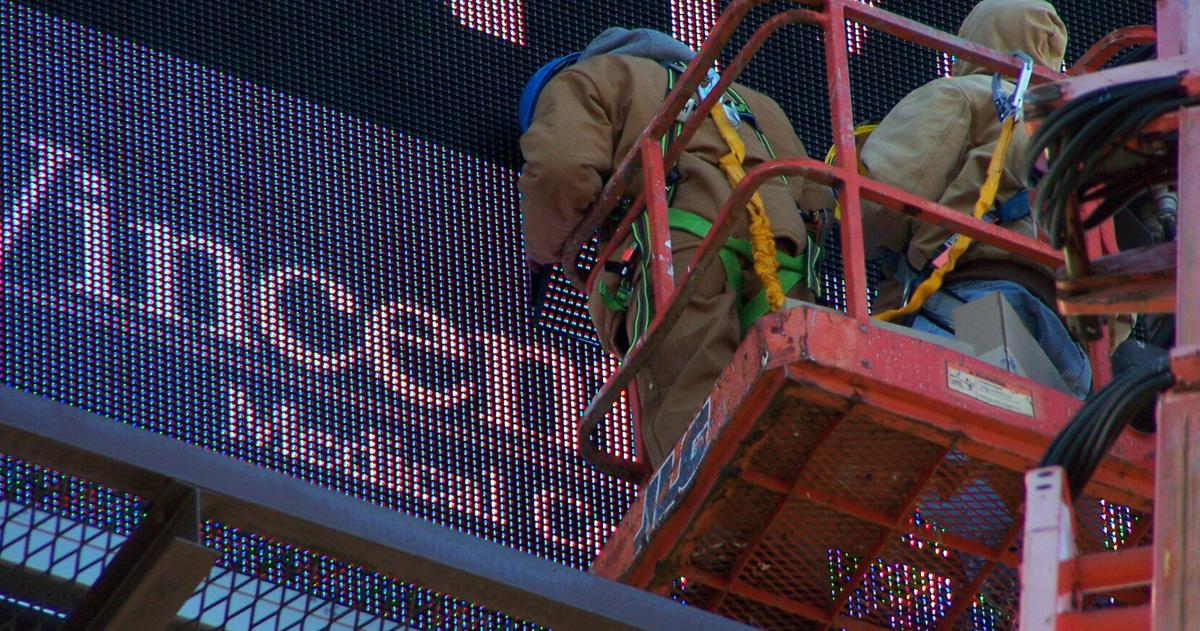
In this undated photo, crews install a new digital panel for Lamar Advertising.
The technology also enables clients to advertise different products or services throughout the day. LSU’s athletic department might promote a volleyball match at one point in a rotation of ads and a football game later. Restaurants can advertise breakfast in the morning and lunch at midday.
Digital billboards also open the outdoor advertising market to new categories of customers — small businesses that might not have been able to afford a traditional static ad but can buy a share of rotating screen time.
Newer digital innovations are unlocking additional possibilities.
Using “programmatic” ad-buying software platforms, advertisers can buy digital ads that only activate under specific conditions. A fast-food restaurant, for example, might promote breakfast sandwiches on digital boards only in the morning, near the restaurant’s locations, and when mobile phone location data shows heavy traffic.
“If there’s a match, the ads show up automatically” Reilly said. “There’s no contract and no salesperson.”
The boards also allow for contextual advertising. A tire company might display one message during a snowstorm and another during clear weather.
“Geofencing” is another newer tool in the tool kit. Using software from a third-party vendor, Lamar’s advertisers can send custom ads to apps or websites on mobile devices owned by customers who drive near a specific screen — much like a beer company can send ads to the smartphones of fans watching a game at a certain venue.
In 2021, the company invested $30 million in Vistar Media, a leading programmatic platform that was acquired last year by T-Mobile.
“We still work with them, and the acquisition was a way for us to better understand the space,” said Buster Kantrow, a Lamar executive vice president.
Old-school billboards still dominate
Despite the dizzying possibilities of the digital displays, their low-tech counterparts still make up 97% of all Lamar’s billboard faces, which is why they won’t be going away any time soon.
Unlike digital boards. which can cost hundreds of thousands of dollars to manufacture and install — and thousands more to power and maintain — static boards are much simpler and cheaper. They’re mostly still made the old-fashioned way, by strapping preprinted vinyl sheets to metal frames held up by one or more steel columns. LED floodlights illuminate them from above or below.
And for some customers, they just make the most sense.
“Think Cracker Barrel,” Reilly said. “They just want a sign that says ‘Pancakes, Exit Here.'”
Past and future
Lamar’s headquarters looks like a museum dedicated to the history of the industry.
Hand-painted sections of tin cover one long hallway. Old canvas signs are protected by plexiglass. An office is decorated with the pulleys and hooks sign painters used to do their work. And there’s even a wall built from dozens of sections of vertical triangular slats that were used in “tri-vision” billboards — a 1960s innovation — that could rotate to show three different ads and which remain in use today in a few rare cases.
A worker inspects an outdoor video screen owned by Lamar Advertising in this undated photo.
But as it preserves its past, the company also looks to the future.
In December, Lamar named Ross Reilly — Kevin Jr.’s son and Sean’s nephew — president of its outdoor division. The younger Reilly had been a company VP since 2019 and now will oversee Lamar’s billboard display business, including its national sales, programmatic and operations efforts.
This September, Lamar executives will celebrate the 30th anniversary of the company’s listing on the Nasdaq stock exchange. Next year will mark the 125th anniversary of its founding.
Amid all that, Sean Reilly said the near-term plan is to keep doing what’s been working: more acquisitions, growing the digital footprint, and using AI and other tools to make automated ad buying more efficient.
“It’s amazing what we can do these days,” he said.