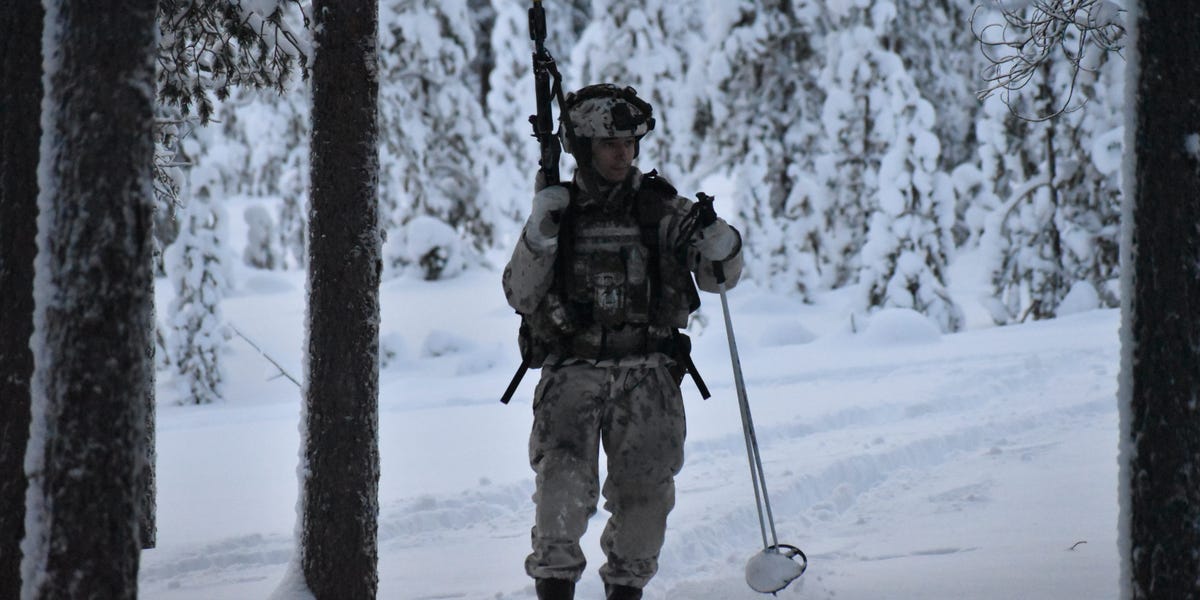
SODANKYLÄ, Finland — Among the many challenges NATO soldiers face in the harsh Arctic environment, the possibility of frozen weapons is one that risks leaving them most vulnerable.
It’s anything but easy to keep guns, drones, and other equipment in the right conditions far above the Arctic Circle, where temperatures routinely drop below 0 degrees Fahrenheit, and the heavy snow brings unwanted moisture that can cause jamming and other problems.
NATO military personnel training in northern Finland told Business Insider during a visit to the region in late January that they can’t afford to let their guns get too warm if they want them to work in this climate.
The biggest problem with weapons in these conditions is temperature variation, said Maj. Mikael Aikio, the Arctic section leader of the Finnish Army’s Jaeger Brigade, which is leading a winter warfare training and cold-weather survival course for roughly 20 NATO soldiers.
The monthlong course, hosted in Finland’s northern Lapland region, teaches NATO soldiers how to live, move, and fight in the harsh Arctic environment.
Jake Epstein/Business Insider
This type of training has become a growing priority for NATO as officials call for greater Arctic defense amid increasing Russian and Chinese activity in the High North. Western forces could find themselves fighting on frozen battlefields as the alliance and its adversaries compete for influence in this strategic region.
‘My hands are the worst enemy’
Lapland, like other northern regions in NATO’s seven Arctic states, is a tough place to operate in winter. The biting cold, limited sunlight, and deep snowfall force troops to move slowly and with caution. And limited support infrastructure makes sustainment even more difficult up north.
In the Arctic, survival is only the first challenge. Troops must also keep their weapons functioning; even minor equipment failures can hand the enemy an edge.
Canadian Cpt. Vincent Lemelin, one of the participants in the Arctic warfare training course, said all technology struggles in this part of the world, especially anything that requires charging, such as drones.
Anything that gets covered in snow eventually becomes damp or wet, Lemelin said, so soldiers try to keep their guns cold at all times to avoid having ice or snow melt and introduce any moisture that might freeze and prevent it from working properly.
Jake Epstein/Business Insider
Finnish Lt. Laura Lähdekorpi, another course participant, said she carries a brush with her at all times to clear snow from her gun, especially from sensitive areas like the optics, which are more vulnerable to buildup. Soldiers are trained to ensure their weapons are dry to prevent anything from freezing up.
Lähdekorpi said firing a cold gun is a challenge. Her outer gloves are too bulky, so she strips them off and uses a thin liner to pull the trigger, but that leaves her hands exposed to the weapon’s metal frame, which holds the cold.
“I think my hands are the worst enemy for me,” she said. “I have to keep them warm.”
Proper weapon care doesn’t end when training stops. Soldiers are taught to keep their guns at a steady ambient temperature. Bringing them into a warm tent, for instance, can cause condensation that later refreezes.
Soldiers can’t leave the guns outside their tents, as they might be stolen in real-world conditions. Instead, they bring them inside but place the weapons on the ground or in a space that is almost as cold as it is outside.
Jake Epstein/Business Insider
Proper firearm temperature management is not the only equipment struggle in the harsh Arctic. Drones are also relatively limited in their capabilities, especially in extreme cold, when temperatures drop below -14 degrees Fahrenheit.
During a combat exercise in the middle of the Arctic warfare course, soldiers practiced using drones to collect targeting data and call in artillery strikes against a simulated enemy force made up of Finnish conscripts.
Using small drones for reconnaissance, targeting, and fire support missions is standard practice in the Russian war against Ukraine, and they are expected to continue to be a key part of the kill chain in future conflicts, despite their limitations.
Aikio, a Jaeger Brigade major, said drones need special handling in Arctic conditions. Leaving them exposed on snowmobiles before launch risks damage from the elements, and once airborne, icing on small propellers and limited visibility can quickly degrade performance.
Learning to keep weapons and other gear operational in this environment is one of many skills NATO soldiers are being taught to master in Finland, roughly a third of which lies above the Arctic Circle. The country also knows cold-weather combat, making it well-suited to teach the rest of the alliance winter warfare.
Lemelin, the Canadian captain, described the course as a “humbling experience;” it’s critical exposure for the NATO alliance as Western militaries grapple with a rapidly changing Arctic environment and an expanding adversarial footprint.