For the past 15 years, a Lafayette company has built a national wound-care business out of an often-discarded byproduct of childbirth to help solve a nagging health care challenge affecting millions of people: untreated chronic wounds like bedsores and diabetic ulcers.
Tides Medical collects placentas, transforms them into skin substitutes and distributes them to hospitals, clinics and care facilities to treat chronic and surgical wounds. Over the years, it has used donated amniotic tissue from new moms across Acadiana to manufacture enough wound care patches to cover four basketball courts.
Annual revenue soared above $100 million as the company earned private and public sector accolades as a rare, vertically integrated Louisiana biotech company. But recent Medicare reimbursement changes aimed at preventing fraud have sharply disrupted the industry. As its core business of making skin grafts from placentas faces challenges, Tides is now looking to a new technology as an engine for its future growth.
Production process
The placenta is the body’s only nonimmunogenic organ — that means there’s no need to match blood types or do the same type of tissue-typing necessary when transplanting organs. And there’s almost no chance the body will reject it.
“We get all the placentas that we need locally,” said CEO Joe Spell. “We have a team that goes in when the mother has a planned C-section and she’s agreed to donate the placenta. Our team goes into the birth, they bring a sterile basin, we collect the placenta there.”
Tides Medical has hundreds of placentas on hand at any given time. They’re stored in a medical-grade freezer at negative-80 degrees, where they can remain for up to a year before being processed using a proprietary method.
Two workers at a time carefully wash the tissue, separating its layers in one of the four “clean rooms” at the company’s 12,000-square-foot Lafayette headquarters.
“Then we use some drying methods to make it into the consistency of tissue paper,” resembling a Listerine breath strip, he said.
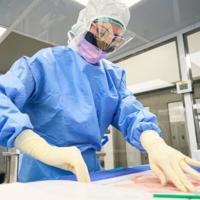
Tides Medical manufactures skin substitutes from placentas donated by expectant mothers in the Lafayette area.
About 40 different skin grafts can be produced from a single donated placenta. The whole process takes about two weeks.
After the grafts are sterilized, they are put into final packaging that can be stored for up to five years.
“It’s sort of been our niche, almost,” he said. “We try to offer a concierge-level service to the provider.”
Reimbursements busted
Last year, Tides Medical was ranked by Inc. among the fastest-growing private companies for the third consecutive year, posting revenue growth of 226% for the three-year period from 2021 to 2024.
But recent changes to Medicare reimbursement rules aimed at ferreting out fraud and abuse in the wound care market is forcing the company to pivot, at least temporarily.
Between 2019 and 2024, Medicare spending on skin substitutes rose from $256 million to $10 billion. While some of the growth was the result of more use of the products in in-home case settings, the U.S. Justice Department also attributed the increase to large-scale fraud, following several high profile investigations.
A Phoenix couple was sentenced last month to more than a dozen years in federal prison for submitting more than $960 million in fraudulent claims to federal health care programs in a scheme that involved taking millions of dollars in illegal kickbacks from a skin graft distributor.
At the peak of the fraud, there were 300 different products on the market, Spell said, and some of Tides’ competitors were selling products for $5,000 per square centimeter. The Louisiana company’s grafts, by comparison, went for $400 per square centimeter.
Medicare has since capped everyone’s products at $127 per square centimeter — a significant challenge that caused Tides’ revenues to fall off by 40% in 2025.
“Medicare just sort of took a blunt force instrument to the problem, and it’s definitely presenting a lot of challenges,” Spell said. “We’re doing our best to figure out how to work in our new environment.”
Ahead of the reimbursement change, Tides laid off nearly half of its employees. It now processes only about two placentas a week.
Still, Spell sees a huge unmet need for his products. He estimates only about 600,000 of the 3.8 million people who suffer from chronic wounds are receiving treatment.
“We have the capacity to make enough to take care of 10% of the patients out there that have chronic wounds,” he said. “Capacity is not our problem right now, it’s just market demand.”
‘Bio-ink’-ing a deal
While the business of manufacturing amniotic skin substitutes from placentas is going through a rough patch, Tides Medical is looking for growth from an innovative new medical device.

The Aplicor 3D bioprinter uses “bio-ink” made out of freshly harvested fat to produce personalized skin grafts made from patients’ own tissue. Lafayette-based Tides Medical is the exclusive U.S. distributer of the printers, which were invented by the South Korean company Rockit Healthcare.
Tides is now the sole U.S. distributor of the first federal Food and Drug Administration-approved intraoperative 3D bioprinter, the Aplicor 3D, which can be used to produce wound care products personalized for individual patients.
Invented by the South Korean biotech company Rokit Healthcare, the devices have already been deployed in major research hospitals like the Mayo Clinic. The Opelousas General Health System wound care center is set to be the first location in Louisiana with the technology.
Patients’ wounds are scanned with a specially calibrated iPad and artificial intelligence software is used to design a personalized skin graft. Then, health care providers harvest fat from the patient’s body, usually the abdomen, which is processed into a “bio-ink.”
The whole process takes about an hour, and clinical studies show it is about 87% effective with just a single application, Spell said. Grafts produced from placentas tend to require re-applications.
While the Korean firm has the patent on the device, Tides has filed for intellectual property protections for new bio-ink uses.
Spell said the company is following the same business as conventional printing corporations like HP — effectively giving away the printers and pursuing its profit by providing cartridges and support.
“We think that the beginning of a new bio-revolution is going to be bio-inks,” Spell said.