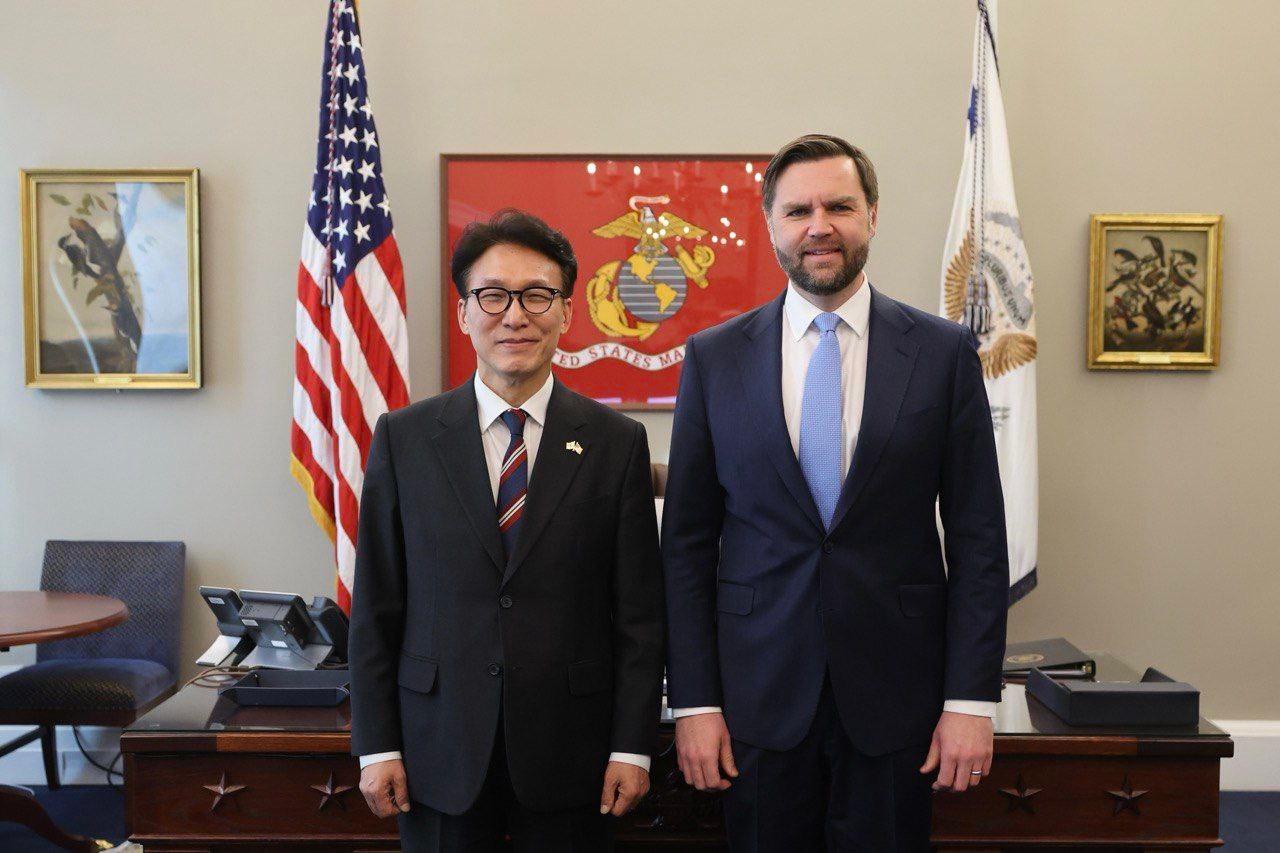
Prime Minister Kim Min-seok, left, and U.S. Vice President JD Vance pose at the White House in Washington, Friday (local time). Courtesy of Prime Minister’s Office
In a meeting with U.S. Vice President JD Vance, Prime Minister Kim Min-seok emphasized that the Korean government is not treating U.S.-based e-commerce giant Coupang unfairly in its investigation into the company’s massive data breach and other labor-related allegations.
To prevent misunderstanding over the Coupang matter and other diplomatic issues, the two exchanged direct contact numbers to establish a hotline, according to the Prime Minister’s Office on Saturday.
Speaking to Korean correspondents in Washington Friday (local time), Kim said, “Vice President Vance raised several issues of interest, including questions about Coupang … He asked specifically what problems the U.S. company was facing.”
Their discussion took place a day after two major U.S. investors in Coupang said they petitioned the U.S. Trade Representative (USTR) to investigate the Korean government for what they call “discriminatory” treatment of the company. They also filed arbitration claims against the Korean government, saying the probe caused billions of dollars in losses.
They also claimed President Lee Jae Myung is anti-U.S. and pro-China and that Kim urged regulators to investigate Coupang “with the same determination used to wipe out mafias” — which the Prime Minister’s Office already clarified was a distortion of Kim’s remarks.
Kim said he explained details about the data leak affecting 33.7 million customers, the company’s delayed report about the breach to the authorities, and the recent unfounded accusations against the president and prime minister.
To counter those claims, Kim said, he provided Vance with English translations of his full remarks and related press releases.
“I made it clear that there has been no discriminatory treatment against U.S. firms (including Coupang),” Kim said. “Vice President Vance expressed his understanding, suggesting that under the Korean legal system there must have been some legal issues involved.”
When asked whether it seemed unusual for the U.S. vice president to mention an issue involving Coupang — a company that is not among America’s major corporations — Kim emphasized the strength of bilateral relations between Korea and the United States.
“Relations between the leaders of Korea and the United States have gone beyond a stage where they could be shaken by the lobbying of any particular company,” Kim said. “The alliance is far stronger than that.”
Kim also criticized Coupang’s conduct as falling short of global standards and even describing it as “anti-American.”
“Rather than adopting an attitude that falls short of both the law and common sense, and trying to resolve the issue in an anti-American and anti-business manner that does not align with the sentiments of the overwhelming majority of their business customers — the Korean public — I would like to advise Coupang to acknowledge the legal problems and work them out through rational business practices,” Kim said.
In addition, he said the two sides agreed to maintain close communication going forward, exchanging direct contact numbers and establishing a hotline to prevent misunderstandings.
“Vice President Vance asked that this issue to be managed carefully so it does not lead to misunderstandings or unnecessary escalation between our governments,” Kim said. “I fully agreed with that approach, and told him that we would share factual updates on Coupang’s situation as quickly and transparently as possible.”