As the demolition excavator crashes its metal jaws through Warrington’s former Unilever soap factory, Carl Oates says the town is good at handling change. Once contractors have finished, his company plans to open a datacentre,reinventing a site from the first Industrial Revolution for the next.
“As one industry closes, Warrington has been quite good at opening new ones – and we hope datacentres is one of those new spaces.”
A director of a local property firm, Dante Group, he knows the blue corrugated-metal factory looming over Bank Quay station is a well-known local landmark on the Cheshire skyline. Alongside wire, beer and gin, soap helped to power Warrington’s industrial development. But few will miss it.
“There’s a mentality here around of just getting on with it. We’re trying to do big things here if we can.”
In an age of stalling economic progress, Britain could do with a few more towns like Warrington. According to a report published on Monday by the Centre for Cities, the town on the Mersey, between Manchester and Liverpool, has enjoyed economic growth 2.2 times faster than the national average since 2013.
If this growth had been replicated nationwide, the thinktank says the average UK urban resident would have had £3,200 more in their pocket, and the British economy would be 4% larger – enough to undo the economic damage from Brexit.
“Increasing living standards at more than twice the national average is a significant achievement, and Warrington shows what sustained, place-based growth can deliver,” says Andrew Carter, the Centre for Cities chief executive. “These places offer practical lessons for how growth can be unlocked elsewhere.”
That Warrington should be an economic template could raise eyebrows. At the heart of the post-industrial north-west of England, it often gets lumped in with the “red wall” towns of the M62 rugby league belt, where living standards more generally have gone sideways at best.
As the first thing visitors see at Bank Quay, the rusting soap factory Oates is dismantling does little to scrub any bias away.
“When people come in [by train] and see that horrible blue building they go: ‘Yeah, I was right: dirty manufacturing town,’” says Stephen Fitzsimons, chief executive of Warrington Chamber of Commerce. “But it really isn’t. It’s been a long time since it was. We are quite pleased [the factory] is coming down.”
These are preconceptions I know more about than most: Warrington is my home town.
As a teenager, if anyone had told me I was growing up in a model of economic prosperity I probably would have laughed. Things were not at all bad – but we often felt a few paces behind Manchester and Liverpool, never mind London. The proliferation of boarded-up shops in the town centre suggest room for progress. But I can still tell Warrington is doing something right.
According to the Centre for Cities, this is the most prosperous town in northern England, as the only urban location out of more than a dozen in the region analysed by the thinktank where workplace wages are above the UK average.
Part of its success is down to its position. Plotted on a map, Warrington’s transport connections resemble the distinctive British Rail double arrow logo: “You’ve got three motorways [M6, 56 and 62]; the west coast mainline; two railways east to west; the ship canal, and two airports.
“Now, the airports – Warrington East and Warrington West – for some reason, they insist on calling themselves Manchester and Liverpool. We don’t know why,” Fitzsimons jokes. “But if you’re in a European city and your airport is 20 minutes outside the centre, that’s in your city, isn’t it? Well, we have two of them.”
Locals hope this month’s £45bn government commitment to build Northern Powerhouse rail – including the redevelopment of Bank Quay station with low-level platforms for a new Liverpool-Manchester line – will provide another economic boost.
“It will be huge for the town,” says Charlotte Nichols, one of its two Labour MPs. “One thing I hate is when people’s only experience of Warrington is looking out of the window at Bank Quay. It’s long overdue some TLC.
“I want us to have something there that is an advert for the town that we are.”
Good transport links have helped the town to attract investment for decades. Ikea (where I had a part-time job as a teenager) picked Warrington for its first UK store in 1987. In recent years the logistics sector has boomed, including at the vast Omega development straddling the M62.
Another quietly booming sector is nuclear. A jewel in Warrington’s crown – kept relatively under wraps given the secretive history of atomic energy – it supports more than 6,000 highly skilled jobs. Its presence is down to the government picking a wartime munitions factory in the town for the base of Britain’s nuclear programme in 1946. Sellafield, the decommissioning plant, has its headquarters here as a consequence, rather than its main site 100 miles north on the Cumbrian coast.
Nichols says this mix of industries helped Warrington avoid the worst of deindustrialisation, which hit nearby towns like Wigan, St Helens and Leigh much harder. “When there has been a decline in one area – such as coal or steel, for example – there has been a pickup somewhere else.”
According to the Centre for Cities, the nuclear cluster has helped to attract other fast-growing industries, including cyber and cloud-computing. The local share of knowledge-intensive jobs has doubled in the past decade – faster than anywhere else in Britain – leaving Warrington with the same concentration of cutting-edge firms as Oxford.
“If you took the whole economy and plonked us in the south-east, we wouldn’t look out of place,” says Fitzsimons. “It is a southern economy in the north of England.”
Walking through the condemned Unilever site, Oates says his datacentre will contribute further. “Warrington has long been known as an industrial town with an eye for innovation.”
It will, however, only employ a handful of staff when built, compared with the 116 jobs lost at the washing powder factory.
Warrington has wide local inequalities – particularly between the more affluent Cheshire suburbs to the south, and the poorer north in what used to be Lancashire.
Food bank use has risen by more than 200% since 2019, a third of children live in poverty, and almost one in six people require debt advice.
To support the local economy the council has taken an activist, yet at times controversial, approach: racking up debts of £1.5bn to fund a high-stakes investment spree.
The Labour-led council argues the debts financed revenue-generating assets – offsetting a decade of Tory austerity. But critics say councillors went too far. Amid recent financial troubles for councils nationwide, the government sent in a team of envoys to rein things in.
Hans Mundry, who took over as council leader in 2023, says debt levels have come down. “Everyone else told us it went too far. So when I came in, that was my job to try to put things right. And we’ve been turning the corner.”
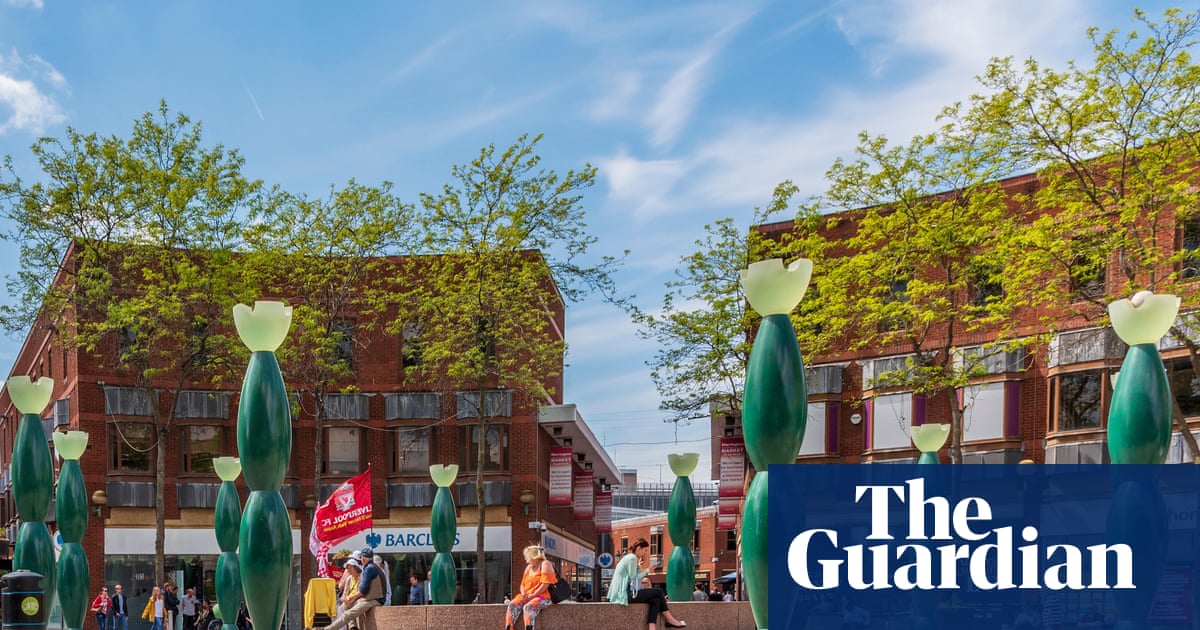
However, the Centre for Cities praised the authority for its investments in Birchwood Park, where the nuclear cluster is based, and Omega. The council-funded regeneration of Time Square and the old 1970s market in the town centre are award-winning. It also applauded councillors for releasing greenbelt land for residential development; helping to keep housing costs down.
Sipping a cappuccino in the market’s Cookhouse food hall, Fitzsimons says the economy has benefited. “For public-private working, Warrington is really, really strong. It [the investments] helped to bring businesses here,” he says.
“It was not ideal, but all local authorities were put in a position where they had these funding black holes. They had to do something – and Warrington went on the front foot.”
Local leaders hope Warrington will benefit from more freedom under the government’s devolution agenda: a new Cheshire and Warrington combined authority is planned this year, with mayoral elections taking place in 2027.
The view is that Manchester and Liverpool have benefited from their mayors; Andy Burnham (who grew up in the same Warrington suburb as me), and Steve Rotherham. But the town in the middle has been overlooked. The disappointment was only compounded by the last government’s levelling up promise, which many locals feel amounted to little more than lip service.
“We all know the investment hasn’t been put in,” says Steve Purdham, a serial entrepreneur who chairs the incoming combined authority’s business advisory board. “For big ideas – like the Northern Arc, or transportation between Liverpool and Manchester – you need very vocal mayors like Andy and Steve.”
The trouble for the town’s current Labour representatives is they could be mustered out. Nigel Farage’s Reform UK is predicted to win here comfortably at the next general election. Support for rightwing populism is clear from several of the town’s roundabouts, where St George’s cross flags and union jacks flutter – including outside Nichols’s office in the suburb of Orford.
Mundry says some locals see the town’s flaws more readily than its progress. “It’s a natural thing – like when you go on holiday. You come back after a wonderful two weeks away, and you remember the two things that went wrong.”
Nichols says voters are right to be frustrated, despite Warrington’s economic outperformance. Labour promised change. “It’s not unreasonable for people to expect that [change] quicker than they’ve seen it,” she says.
“We’re doing better than a lot of places, and that much is true. But we’re still not where anyone would want us to be.”