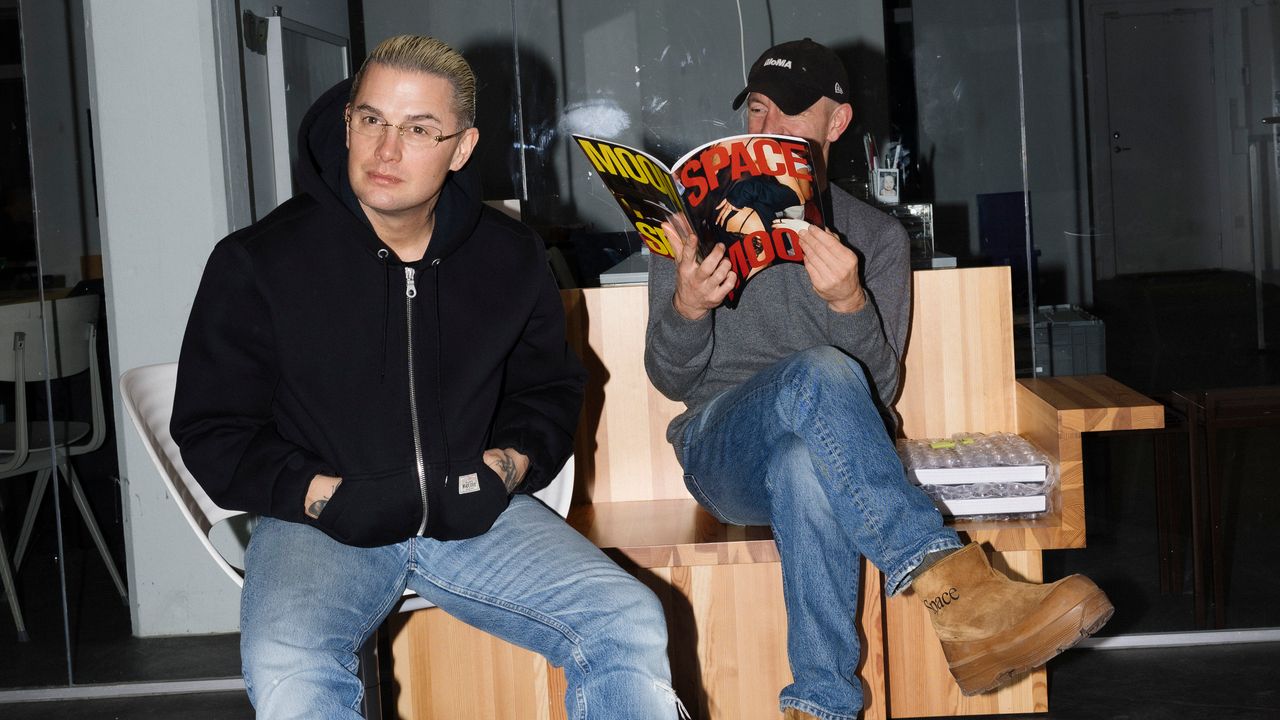
“From our side, what we believe in is pragmatism,” Bjerregaard says. “The world is a very bad place right now because everything is a divide, everything is in conflict. There are great forces that want to take things apart and to create conflict and polarize the world. From our side, it’s very much been about putting things together, and not in a great compromise, but again, just like whether it’s money and love or whether it’s avant-garde and commercialism . . . . “
Measured success
In terms of experience, Bjerregaard and Gjesing are the “adults in the room”, yet neither has lost their belief in the magic of creativity. As the latter said: “Without fashion, it’s a pretty boring world.” Their end goal isn’t cashing out, yet over the past four years, Moon reports, they’ve “maintained a stable annual turnover of approximately DKK 24–26 million (approximately $4 million)” at a time when endless growth seems to be the predominant model. Gjesing doesn’t see it that way.
”We don’t subscribe to the thought that it can just be an endless growth and not be a strategy, or it’s like becoming as big as possible. I think you need the nuances in all of that. From a personal perspective, it feels a bit greedy when ultimate bigness is the goal; it doesn’t feel like you’re really looking at it the right way, and then also the failure can become so big.” Customers are more educated today, he adds, and look for more nuanced brands. And when growth is your only goal, it leads to burnout.
“The brands we’ve been involved with that are into constant performance and constant growth, it really destroys the employees, it destroys the brands, and it also just ends up damaging their relationship with the consumers,” says Bjerregaard. “Of course, there are a lot of successful growth stories, but from our side, if you look at the last 10 years and look at the next 10 years, it doesn’t make sense.”
Enough has changed, in fact, that Gjesing cautions against looking to other industry success stories — like Acne or Ganni — to try to imitate their paths.
“There is so much that has to do with timing, luck, and a window of opportunity that opens, and then it closes. So it’s so difficult, almost to the level of impossible, to just say, we want to be like them, because you don’t know why they ended up there,” he says. “All of these things, you cannot really track backwards. It’s easier to get bad advice than it is to get good advice. And you can have advisory boards, and you can have all these people, but if they don’t have a hand on the stove when they’re giving you advice, and there’s also a chance that you will go in the wrong direction, and you won’t see it before it’s too late.”