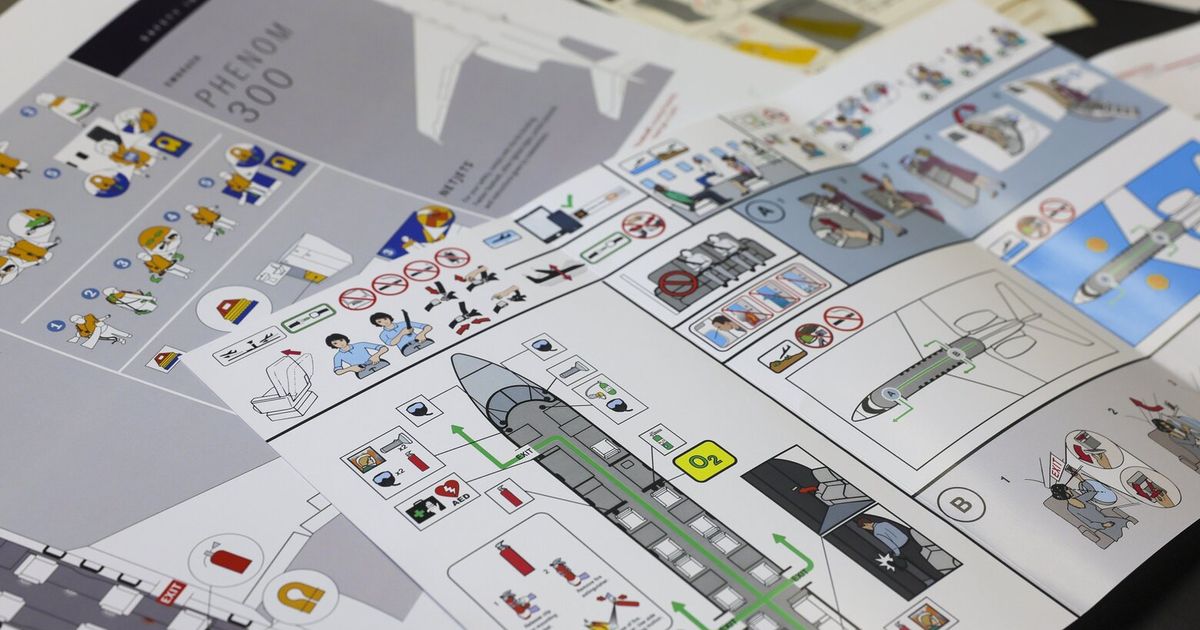
LACEY, Thurston County — In an unassuming office park a 90-minute drive south of Seattle, one company is churning out dozens of the trifold safety cards travelers find tucked into their seat back pocket after boarding a flight.
There’s a good chance you’ve seen one. The Interaction Group prints about 16 million safety cards every year. Since its founding in 1971, the company has worked with over 600 airlines on 18,000 projects.
CEO Trisha Ferguson credits The Interaction Group’s founders with researching, designing and printing the first illustrated safety card, ushering in a switch from text-heavy pamphlets to hand-drawn illustrations meant to help passengers in an emergency.
The idea came from two psychologists who worked at what was then Douglas Aircraft, before it merged with McDonnell Aircraft Corp. and ultimately with Boeing. After researching aviation accidents, the psychologists recommended airlines give passengers easier-to-understand instructions about how to evacuate the plane.
More than 50 years later, illustrated safety cards are ubiquitous, and regulators require airlines to fly with safety cards unique to each aircraft.
The Interaction Group has seen the switch from hand-drawn illustrations to digital designs, from sketches featuring passengers in suits and skirts to hoodies and sweatpants, from practically all-white figures to a diverse cast of characters, following research that readers are more likely to pay attention to content that looks like themselves.
Designing safety cards can be tedious work — sometimes designers at The Interaction Group have to test details as small as whether a hand should be moved just 30 degrees to the left for better comprehension, Ferguson said.
The cards change to reflect new safety guidelines and lessons about how readers interpret information. In the ’80s, for example, The Interaction Group learned readers associate a red X with a treasure map and thought the symbol was marking the spot instead of indicating something passengers should not do. The company switched to a circle with a long slash through the middle.
“Every single little piece of these has intention and has science behind it,” Ferguson, 49, said during a recent visit to the company’s Lacey headquarters. “Feedback is the breakfast of champions around here.”
A shift in the industry
Safety cards — pamphlets describing what to do in case of an emergency — began appearing more than 100 years ago, according to Fons Schaefers, a safety card collector and amateur historian based in the Netherlands.
He found a 1924 “safety leaflet” from KLM Royal Dutch Airlines, which he believes is among the first iterations of the safety card. Many major airlines, like Pan Am, started making and distributing their own cards after World War II. Those were more like “small books,” Schaefers said, with some stretching to 24 pages.
In the 1960s, the Federal Aviation Administration mandated safety cards, hoping to reduce the number of deaths from aircraft accidents.
Around the same time, psychologists Daniel Johnson and Beau Altman were researching why aircraft fatalities were not decreasing, even as planes were getting safer. Working for Douglas Aircraft, the pair found that even when passengers survived the impact of the crash, they often were unable to safely exit the plane. They recommended a picture-focused safety card to replace the text-heavy pamphlets.
Airlines liked the idea and asked for help executing it, according to Ferguson.
So Johnson and Altman formed what was then called Interaction Research Corp., working from their garage in Long Beach, Calif. It took three years to design and illustrate the first safety card.
The company moved to Olympia in the 1980s to be closer to Boeing.
Today, there are few companies that make aviation safety cards. Asked about major players, Schaefers pointed to two Washington-based firms founded by former Interaction Group employees, and another competitor that may now be defunct. Several airlines still make their own cards, he added.
After years of researching safety cards and cabin safety, Schaefers worries the pamphlets aren’t as effective as airlines and regulators want them to be. The cards today are cluttered, he said, filled with so many symbols that it’s difficult to pick out the most important details.
And, in the crucial moments of finding emergency exits and getting out of the plane, most passengers leave their safety card at their seat, Schaefers said. They’re relying on memory from when they scanned the card at the start of the flight.
Ferguson fully disagrees, pointing to a 1977 accident that she calls a “significant shift” for the industry.
In that case, Boeing 747s operated by Pan Am and KLM collided on the runway in Tenerife Island off Morocco, killing 583 people on board both planes. The people who survived credited the safety cards, Ferguson said, saying the pamphlets helped them open the exit.
After that crash, Ferguson said, The Interaction Groups’ founders, Johnson and Altman, testified before Congress about the importance of easy-to-understand safety cards.
Designing the card
Safety cards are similar in form to a comic strip. Illustrators use a new panel to depict each step of a process, like how to don an oxygen mask.
Every detail is crucial — and every design change is tested.
The Interaction Group’s goal is to have 90% of readers understand the safety card, Ferguson said. The company has at least 100 people review each panel and describe what they think the card is telling them. Researchers find subjects in shopping malls, coffee shops and libraries.
Ferguson and her team used to see the airplane they were preparing a card for, moving through the safety procedures and taking photographs of every step. Illustrators would then use the photos for reference.
They didn’t use the actual photo because there was too much “visual noise.” Illustrations strip out the background, making it easier for passengers to absorb the information.
Cards used to be drawn in pencil, traced in black pen, transferred to a plate and sent to a printing press. Now, much of the work is digitized, designed on an iPad or computer, but still hand-drawn.
Ryan Trickle, a graphic designer with The Interaction Group since 2001, said the hardest part of the job is drawing human figures again and again while keeping the style exactly the same for every panel in an airline’s card.
On a recent visit, Trickle was preparing two design options for Korean Air. He described one as “smooth,” with faceless characters, and the other as a New Yorker-style cartoon, with dark sketch lines around people’s arms and faces.
Airlines make choices about the card’s style, but much of the content is set by aviation safety regulators. Those requirements differ by country.
Airlines used to experiment with characters, tucking in a ballerina or Albert Einstein and making a Where’s Waldo-type game, promising a prize if a passenger identified all the characters.
Today, airlines are leaning into their own form of branded content, sneaking their logo onto seat backs or other parts of the card. Ferguson calls those “Easter eggs.”
There’s a fine line to balance between making safety humorous and serious. But the goal is to keep the passenger reading the card. The more they look at the content, Ferguson said, the more likely they’ll know what to do in an emergency.
‘Always something new’
The Interaction Group has two printing facilities — one for really large projects and another in a back room of the company’s Lacey office.
The printing operation is a family affair. Ferguson’s father, a retired arts and music teacher, lends a hand. On Fridays, her daughter, a student at St. Martin’s University next door, stops by as well.
The room is filled with stacks of safety cards, some fresh off the printer, others waiting to be laminated, and still others folded and wrapped in neat bundles held together by rubber bands.
Airline orders range in size — from just five safety cards for a helicopter or private plane to hundreds of thousands for large commercial airlines.
In some cases, The Interaction Group sends a digital file and the airlines use a local printer for the final product. In others, the company takes on every step of the process, from design to regulatory approval to printing and shipping.
There’s no standard time frame for completing an order, Ferguson said. In a few cases, they’ve churned out an order the same day it was placed, after a frantic call from an airline that needed the card to satisfy regulatory requirements before taking off.
The rest of the company’s office, surprisingly quiet for its proximity to a small-scale printing press, is filled with relics. The walls are decorated with framed illustrations of old safety cards, people and aircraft in various stages of design.
On a recent visit, Ferguson had an example in mind for every type of safety card she described. She’d often run to the back room to pull out a specific card from a specific time to illustrate how things have changed or to show a favorite design.
They’ve made safety cards for Led Zeppelin, Bon Jovi, Bad Bunny and Harry Styles. They’ve designed fake safety cards for the movie “Fight Club” and “one of the Bourne movies.” They’ve been involved in private jets for countless political campaigns, though never Air Force One.
They used to be responsible for MGM Resorts’ fleet of planes that flew people to Vegas casinos and, years ago, the Playboy fleet. They’ve never seen so many beds on one plane, she joked.
The industry is always changing, with new safety recommendations from regulators or new requests from airlines coming all the time. Lately, Ferguson is focused on new guidance on lithium-ion batteries, which are common in power banks, electric toothbrushes, razors and other electronics.
The batteries are prone to overheating, smoking and burning. To lower the risk of a fire, the FAA prohibits lithium-ion batteries in checked baggage and is considering limits on how they are stored in carry-on luggage and used in-flight.
The Interaction Group is studying how to tell passengers they can’t store power banks in the overhead compartment or charge power banks using in-seat power outlets. They found users don’t recognize a black rectangle with a lightning bolt in the middle and four green dots on the side as a power bank. But, adding a charging cord from the bottom of the rectangle increased comprehension to 92%.
The decision to include information about lithium-ion batteries on the safety card is still up to the individual airlines, but Ferguson said it’s a good example of keeping up with new “learnings.”
“We have 55 years of aviation illustrations and safety equipment, and instructions, so we are not often starting from scratch,” Ferguson said. “However, there is always something new in aviation.”