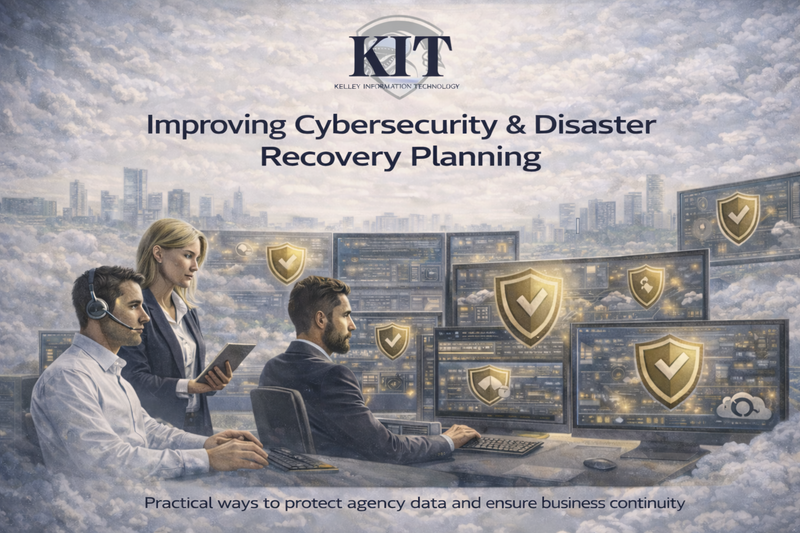
Kelley Information Technology outlines key cybersecurity actions every SMB executive in Central Florida should take to mitigate risks and ensure business resilience.
— Cybersecurity in Central Florida: 10 Things Every SMB Executive Should Check Right Now
In the face of growing cyber threats, KIT today published a comprehensive cybersecurity guide aimed at small and mid-sized business (SMB) executives in Central Florida. As cyberattacks become more sophisticated and pervasive, business leaders must recognize cybersecurity as an essential leadership responsibility, with direct consequences for a company’s financial stability, legal standing, and reputation.
Cybersecurity is no longer a technical issue delegated to IT—it’s a leadership responsibility with direct financial, legal, and reputational consequences. Across Central Florida, small and mid-sized businesses (SMBs) are operating in an environment where cyber threats are accelerating, compliance expectations are tightening, and insurers are demanding evidence of controls—not intentions. Ransomware groups, credential thieves, and supply-chain attackers increasingly target SMBs because defenses are often fragmented and oversight is inconsistent. Most cyber incidents don’t happen because leadership ignores security. They happen because executives assume the basics are already handled. In many cases, they aren’t.
Below are 10 cybersecurity checks every Central Florida SMB executive should review right now. These are not technical checklists—they are realities aligned with modern risk management, emerging compliance standards, and Zero Trust principles.
Understanding Where Critical Data Resides
One of the most fundamental issues that KIT highlights is a lack of visibility into where critical data is stored. Customer information, financial records, and intellectual property often reside across a variety of cloud platforms, servers, and third-party applications. KIT emphasizes that For leadership teams, cybersecurity for small business starts with visibility. You cannot secure—or govern—what you cannot clearly identify.
Without clear visibility into data storage, protecting that data becomes a reactive process rather than a strategic one. Executives are advised to begin by conducting a comprehensive audit of their business data to establish a clear and proactive security framework.
The Role of Multi-Factor Authentication (MFA)
Multi-factor authentication (MFA) has quickly moved from a recommended best practice to a baseline security control. Yet, many SMBs still treat MFA as optional for employees. KIT warns that relying solely on passwords is no longer sufficient protection against breaches, particularly those driven by phishing and credential theft.
For businesses to reduce risk, KIT asserts that MFA must be mandatory for all employees across platforms such as email, cloud services, VPNs, and remote access. This simple measure significantly reduces the chances of an attacker gaining unauthorized access through compromised credentials.
Ensuring Effective Ransomware Recovery
While many businesses have backups in place, KIT stresses that the effectiveness of these backups is often compromised during a ransomware attack. Backups should be isolated, protected, and regularly tested to ensure they are recoverable in the event of an attack. Furthermore, executives need to understand how long recovery would take and how downtime would impact the business.
A proactive cybersecurity plan should include regular testing of backup systems to verify their integrity and functionality under real-world conditions.
Access Control and Zero Trust Principles
In an age of sophisticated cyber threats, the need for a robust access control model has never been more critical. KIT advises executives to implement Zero Trust principles, ensuring that access to sensitive systems and data is strictly controlled. This includes regularly reviewing who has access to what, ensuring that employees only have access to the resources they need to perform their job functions.
SMBs must abandon legacy models that allow employees to accumulate broad permissions over time. Instead, access should be based on the principle of least privilege, with temporary access being reviewed and removed promptly.
Automating Patching to Prevent Exploits
Keeping systems up-to-date is one of the most effective ways to prevent cyberattacks. KIT emphasizes the importance of automating patching processes to ensure systems are continuously updated with the latest security fixes. Manual patching processes leave room for vulnerability accumulation, which can be exploited by cybercriminals.
Executives should ensure that their IT teams have automated systems in place to monitor, report, and apply updates in a timely manner to prevent security gaps from opening up.
Employee Awareness and Phishing Prevention
Phishing attacks are becoming more sophisticated and harder to detect. KIT highlights the importance of regular, ongoing security awareness training for employees. Executives should ensure that training includes simulated phishing tests and other tools to measure employee resilience over time.
By cultivating a strong cybersecurity culture, businesses can enhance their employees’ ability to recognize threats and prevent breaches caused by human error.
Managing Third-Party Vendor Access
Many SMBs rely on third-party vendors who have direct access to their internal systems. KIT advises executives to carefully control, monitor, and regularly review vendor access to minimize the risk of a supply chain attack.
It is essential that businesses document the permissions granted to vendors and ensure that these permissions are appropriate for the services they are providing. Vendor risk management is a critical component of any cybersecurity strategy.
Incident Response Planning
When a cybersecurity incident occurs, the effectiveness of the response can determine the extent of the damage. KIT underscores the importance of having a clear, documented incident response plan that outlines who is responsible for specific tasks during an event.
Responsive IT support during an incident is not just a technical function—it determines how quickly leadership can assess impact, contain risk, and protect the organization’s credibility.
Compliance Considerations for SMBs
KIT also reminds SMB executives that regulatory compliance is no longer an afterthought. Frameworks such as HIPAA, PCI DSS, and the FTC Safeguards Rule have specific cybersecurity requirements that apply even to businesses not traditionally considered “regulated.” Failure to meet compliance requirements can lead to legal penalties and reputational damage.
Executives are encouraged to conduct regular compliance audits to identify gaps and ensure that their cybersecurity practices align with the latest legal and regulatory standards.
Cybersecurity as a Governance Responsibility
Finally, KIT urges executives to regularly review their organization’s cyber risk posture. Cybersecurity cannot be fully delegated to the IT team—it must be a top priority for business leaders. KIT stresses the importance of treating cyber risk alongside other business risks, such as financial and operational risks.
By aligning cybersecurity governance with executive oversight, businesses can close gaps faster, improve decision-making, and ensure a stronger, more resilient organization.
About Kelley Information Technology
Kelley Information Technology (KIT) provides professional computer consulting and IT support for small and mid-sized businesses across Central Florida. Since 2017, we’ve helped organizations reduce downtime, improve efficiency, and align technology with real-world workflows. Our consulting-first approach combines proactive IT planning, cybersecurity guidance, cloud solutions, and responsive support—bringing enterprise-grade reliability to SMBs without enterprise pricing. Local businesses rely on KIT for clear recommendations, dependable service, and technology designed to support growth, security, and long-term stability.
Media Contact:
H. Russell Kelley
Co-Founder
Kelley Information Technology
Email: service@kelleyitsupport.com
Twitter
Contact Info:
Name: H. Russell Kelley
Email: Send Email
Organization: Kelley Information Technology
Website: https://kelleyitsupport.com/
Release ID: 89181654
In the event of any inaccuracies, problems, or queries arising from the content shared in this press release, we encourage you to notify us immediately at error@releasecontact.com (it is important to note that this email is the authorized channel for such matters, sending multiple emails to multiple addresses does not necessarily help expedite your request). Our diligent team will be readily available to respond and take swift action within 8 hours to rectify any identified issues or assist with removal requests. Ensuring the provision of high-quality and precise information is paramount to us.