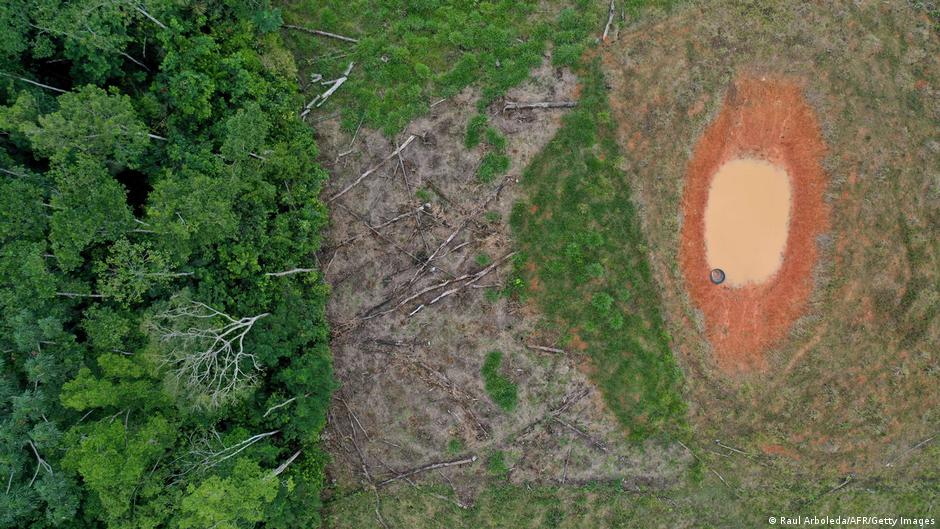
The world spends 30 times more money destroying nature than protecting it. That’s according to a new report from the United Nations Environment Programme (UNEP) that exposes a massive gulf between so-called “harmful investments” and financing that promotes nature preservation.
The global environment agency’s latest “State of Finance for Nature” (SNF) report is calling to phase out the US$7.3 trillion (€6.2 trillion) in global investments that damage nature — including into high-emissions energy infrastructure and manufacturing, for example.
Of this, some two-thirds is from private sources concentrated in the utilities, industry, energy and materials sectors. The rest comes from public coffers and includes harmful government subsidies into the fossil fuel, agriculture, transport and construction businesses.
Based on 2023 data, the report shows that nature-positive investments reached $220 billion — some 30 times less than harmful investments.
The authors note that nearly half of the global economy significantly depends on nature, and yet governments, business and finance are eroding “our collective nature bank.”
“Without nature, the foundation of our economy collapses,” states SNF, which notes that 73% of nature’s wildlife populations have vanished since 1970, undermining vital ecosystem services such as pollination, clean water and soil fertility that ultimately support human economies.
“If you follow the money, you see the size of challenge ahead of us,” said Inger Andersen, UNEP executive director, in a statement. “We can either invest into nature’s destruction or power its recovery – there is no middle ground.”
Investing in nature-based solutions
To begin this recovery, the SNF report suggests redirecting finance into nature-based solution (NbS) assets.
These include investments that limit climate change such as carbon sequestration through reforestation, or financing that addresses land degradation through sustainable land management that also stops desertification. Such moves could generate up to $30 for each dollar invested.
These NbS assets are one part of the SNF report’s roadmap for transitioning to a nature-positive economy. The goal is to give governments and private corporations the tools and insights to begin a “big nature turnaround,” and to achieve the goals of the Global Biodiversity Framework. Adopted by the UN in 2022, it plans to halt and reverse nature loss by 2030 and achieve a full recovery by 2050.
“Harnessing the opportunity of the big nature turnaround means re-purposing the trillions of dollars in nature-negative finance that are flowing around the world that degrade natural infrastructure that underpins human well-being and a large part of our global economy,” states the report.
To begin this transformation, the authors advise that NbS investments need to grow 2.5 times to $571 billion annually by 2030, while harmful investments need to be “phased out or repurposed.”
While private money only provided a small portion of nature-positive NbS funding in 2023, the report described “positive momentum” in terms of biodiversity offsets, with 37 countries legally requiring some kind of biodiversity compensation for certain developments.
Despite growing skepticism about these “compensation mechanisms” that offset nature harm, the report authors concedes that, in the absence of these schemes, much nature damage would not be compensated.
Ultimately, governments and business leaders need to “embed” nature into pivotal economic sectors and unlock a multi-trillion dollar “nature transition economy.”
Corporations, for example, could become more cost competitive by investing in resource-efficient technologies, along with regenerative and circular business practices that lower costs and improve resilience.
The report also found that nature-related investment opportunities extend beyond forestry, infrastructure and agriculture, and include financing for products and services that harness natural processes.
Governments, it said, should help foster these “emerging opportunities,” pointing to innovations such as bacteria-infused concrete that can self-heal by repairing cracks with limestone. The technology could extend the lifespan of buildings and reduce emissions in the construction sector, according to the report.
Realizing the nature-positive economy of the future
Some governments and business leaders globally are already applying this methodology as they green urban areas to mitigate heat-island effects caused by concrete or asphalt and lack of vegetation, embed nature in road infrastructure through roadside greening and wildlife corridors, or by creating emissions-negative building materials.
The SNF report encourages regenerative agricultures practices that improve soil health and optimize diversity. This is to counter the damaging effects of industrialized agricultural systems that rely on chemicals and exhaust soils.
Of the public investment in nature-based solutions in 2023, biodiversity and landscape protection investment grew by 11%, but at the same time spending on sustainable agriculture, forestry and fishing fell.
Still, whatever nature-positive public spending occurred in 2023, it was modest compared to environmentally harmful state subsidies, which exceed some US$2 trillion annually, noted the report.
“While financing nature-based solutions crawls forward, harmful investments and subsidies are surging ahead,” said UNEP’s Inger Andersen. “This report offers leaders a clear roadmap to reverse this trend and work with nature, rather than against it.”
Edited by: Jennifer Collins