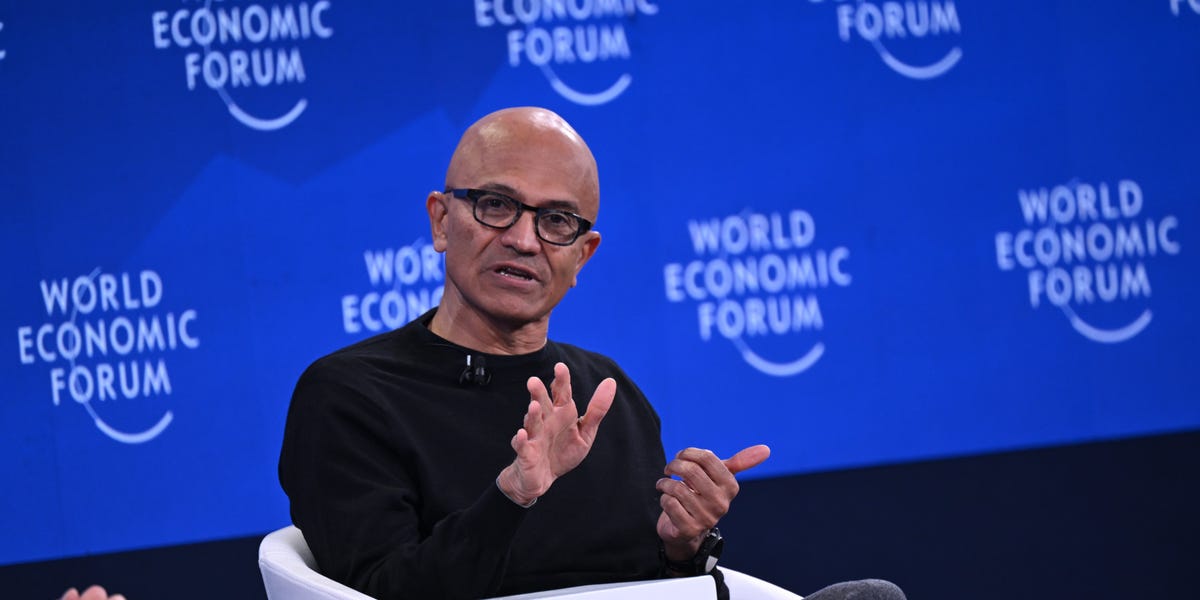
The AI race doesn’t need to be a zero-sum game, says Satya Nadella.
On an appearance of the “All-In” podcast recorded in Davos on Wednesday, the Microsoft CEO said current competition is intense — but that’s not a bad thing.
“The way I always think is it’s always helpful when you have a complete new set of competitors every decade because that keeps you fit,” he said. He added, “It’s a pretty intense time. I’m glad there’s the competition.”
Nadella said that when he joined the computer giant in 1992, Novell, a Utah-based software and services company, was the “big, existential competitor” Microsoft had.
Novell’s dominance declined in the late 1990s, and it was acquired in 2011.
Nadella said that the tech industry as a whole will continue to dominate economically.
“At the end of the day, when I look at it as a percentage of GDP, five years from now, where will tech be? It will be higher,” he said, referring to gross domestic product. “So we’re blessed to be in this industry. It’s a lot of intense competition, but it’s not so zero-sum as some people make it out.”
Nadella said that his approach is a different take on Peter Thiel’s advice. He said Microsoft avoids competition by understanding what customers really want from the company rather than treating everybody like a competitor.
The Microsoft CEO’s embrace of competition matches the approach one of his predecessors, Bill Gates, and top rival, former Apple CEO Steve Jobs, took toward competition.
“Competition is always a fantastic thing, and the computer industry is intensely competitive,” Gates said in a 2005 interview. “Whether it’s Google or Apple or free software, we’ve got some fantastic competitors, and it keeps us on our toes.”
Jobs famously shifted his perspective on competition after returning to Apple in 1997. He went from dismissing Microsoft’s taste and originality to saying that Apple needed to focus on its own success rather than Microsoft’s failure.
“If we want to move forward and see Apple healthy and prospering again, we have to let go of this notion that for Apple to win, Microsoft has to lose,” he said at the 1997 Macworld Expo.