To begin, I’d like to ask about Japan’s manufacturing sector from a broad perspective.
Japan’s manufacturing tradition has long been defined by meticulous attention to detail and the spirit of continuous improvement — what is often referred to as monozukuri. This philosophy has supported Japan’s rise as a world manufacturing powerhouse. However, in recent years, Japanese companies have faced increasingly complex challenges — from geopolitical tensions and trade friction to demographic decline.
In this environment, what do you believe defines Japanese manufacturing today, and what advantages can Japanese manufacturers still bring to the global market?
You are absolutely right — our business began and expanded in Japan, but the domestic market has clearly passed its peak. This is closely tied to Japan’s demographic changes. Looking back, I would say that around 1990 was the peak period for domestic demand, and by the early 2000s, the decline had become visible.
As demand decreased, one of our major customers — particularly automakers — began expanding overseas. Naturally, we needed to follow them. We have shifted our strategy to maintaining our domestic foundation while establishing a strong global presence. That’s how we reached where we are today, though we still have room to grow.
Initially, our focus was entirely on production efficiency, with a strong emphasis on increase output. But once the domestic market began shrinking, we realized efficiency alone was no longer enough. We had to shift our focus to understanding our customers — what they were thinking, what problems they faced, and how we could support them more deeply.
This change, I think, is true across much of Japanese industry. It wasn’t necessarily a conscious pivot, but rather a natural evolution. When quantity-based growth is no longer possible, companies must redefine their value, and that’s when Japan’s monozukuri spirit — the pride in craft, precision, and teamwork — becomes even more meaningful.
In simple terms, pure cost competition is not sustainable. We cannot compete with countries like China purely on price or volume. Instead, we focus on creating systems and solutions that only Japanese manufacturers can provide — ones built on craftsmanship, reliability, and mutual trust.
You mentioned that as Japan’s domestic market contracted, companies like yours expanded overseas alongside your customers. When operating abroad, what are some of the key differences you’ve observed in work culture and management approach, and how have you adapted to them?
That’s an important point. One of the biggest challenges in overseas operations is the difference in workplace culture. For example, in some of our facilities in Vietnam and India, we’ve seen situations where employees wait for the next document or instruction from an earlier process, even when they have nothing to do.
In Japan, that would rarely happen. If someone has a spare moment, they naturally help their colleagues. That spirit of mutual assistance — of working together as a team — is deeply rooted in Japanese workplaces. It’s not limited to manufacturing; it applies equally in offices or administrative departments.
At first, our local teams may not fully understand why we encourage this approach. But as we explain its purpose and they see the positive results, they begin to adopt it. Over time, they come to appreciate that collaboration produces better outcomes for everyone.
We emphasize this philosophy wherever we operate — in Vietnam, the Philippines, India, or the United States. Building a cooperative, team-oriented culture is central to how we do business globally.
Given today’s uncertain international environment — with geopolitical tensions, U.S.–China decoupling, and the lingering effects of the pandemic — expanding overseas has become increasingly complex. How is Maruichi navigating these risks as you grow your global footprint?
Our core business is manufacturing steel pipes, and one of our key principles is local sourcing. We try to purchase raw materials locally wherever possible, rather than insisting on using materials from Japan. In some cases, these materials may still be imported, but our policy is to use whatever is best and most accessible locally.
Equally important is matching our production scale to the capacity and demand of each market. Of course, we sometimes export products, but that is not our main objective. We don’t view overseas production as a way to supply Japan; rather, each operation serves its own local market using locally sourced inputs to provide the best possible products for that region.
Turning to your expansion in the United States — particularly Texas — Maruichi has been investing heavily in new facilities, including MST-X, with approximately 80 million dollars invested since 2021. Much of this seems focused on the semiconductor sector. Could you explain the strategic rationale behind these investments and what opportunities you aim to capture?
The semiconductor industry represents one of the key growth fields of the future. Producing high quality pipes used in semiconductor fabrication plants is therefore a natural growth opportunity for us.
That said, the semiconductor business has very different dynamics from our traditional markets. It’s highly cyclical — periods of strong demand are often followed by sudden slowdowns when inventories rise and prices drop. Our conventional steel pipe business has never seen such volatility, so this has been a learning experience.
We began investing in this field around 2021, and while we have experienced both highs and lows, our long-term perspective hasn’t changed. We are confident that semiconductor demand will grow steadily over time.
Our new U.S. plant currently has substantial unused capacity — we’re operating at only about 10%. It’s difficult to predict exactly when utilization will rise, perhaps in about a year or so. But we take a long-term view; we don’t make decisions based on short-term market fluctuations.
We also have the financial strength to endure temporary slowdowns. By next year, I expect production will be at a much higher level, but for now, we’re prepared to operate at 10–20% utilization until the market strengthens.
You’ve mentioned the “bright annealing” process as an important part of your production for the semiconductor industry. Could you describe this process and its significance?
Certainly. In semiconductor production, the most critical pipes are the very small-diameter ones — typically 6 to 12 millimeters. These pipes must undergo bright annealing (BA), which smooths and purifies the internal surface of the pipe.
However, BA on its own is not enough. By additional process — electropolishing (EP) — we can further smooth the inner surface. Since specialized gases flow through the pipes, even minor flow irregularities can impact semiconductor quality.
At present, Maruichi does not yet perform electropolishing in-house. We work closely with Valex, a U.S. company that specializes in this technology. Most of our BA pipes are sent to Valex for EP processing.
However, given the growing demand in Japan’s semiconductor sector, we are currently in discussions with Valex about introducing EP capabilities at Maruichi in Japan. We believe it’s important to bring this advanced process home and provide integrated solutions domestically.
To put it simply: bright annealing is a mechanical process that improves the pipe’s inner surface, while electropolishing refines it even further through electrochemical treatment. Both are crucial for producing the ultra-clean pipes needed for semiconductor manufacturing.
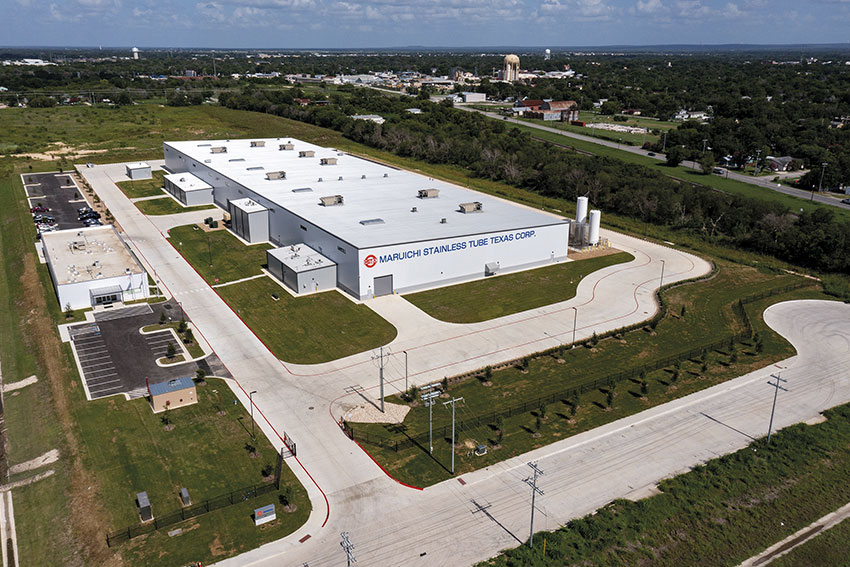
Exterior view of MST- X (Texas)
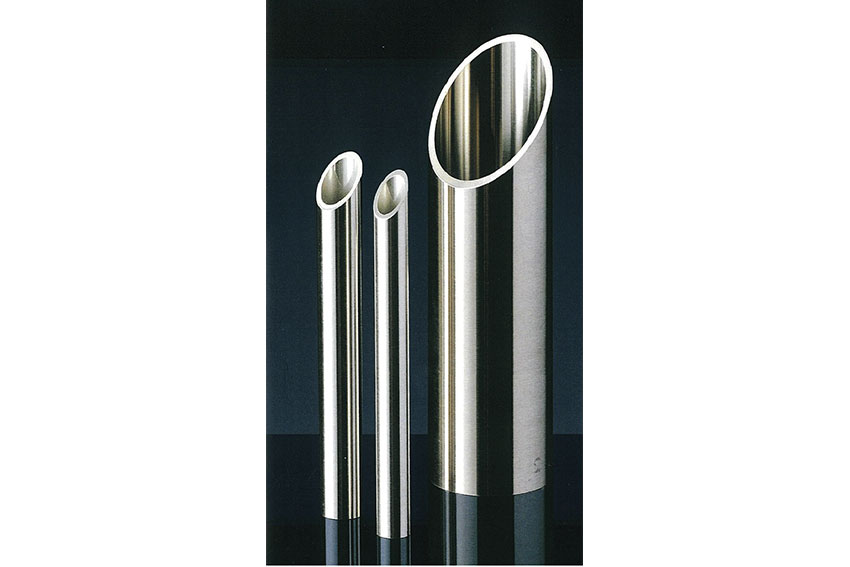
Stainless steel precision tubes
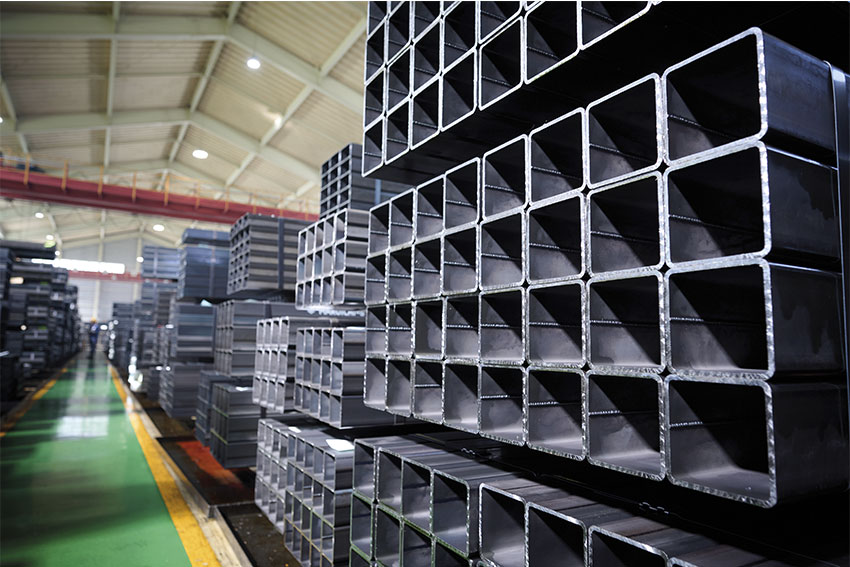
Steel tubes for structures
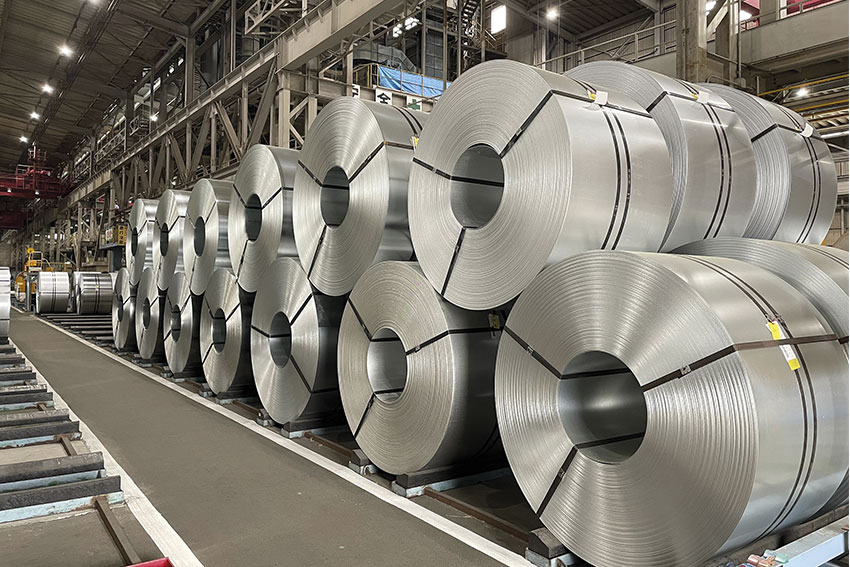
Surface-treated steel sheet
Looking further ahead, Maruichi has set ambitious global growth goals for 2030. How does your expansion in India — and potentially Africa — fit into this long-term strategy?
We see India as a major growth opportunity. The country is making strong efforts to develop its semiconductor industry, and demand for steel pipes there is expected to grow rapidly. I’ve personally worked with India for about ten years, so I’m very familiar with its market conditions.
Doing business in India can be challenging, but I believe it’s essential for Maruichi’s future to establish a firm base there. We are therefore exploring various ways to invest effectively and sustainably in that market.
Looking even further ahead, we view India as a potential bridge to Africa. Africa is not yet a large market, but it has tremendous long-term potential. Whether we expand into Africa directly or through India, we definitely see it as part of our growth horizon.
Interestingly, the president of our Indian subsidiary is Indian and has previously worked in Africa, which gives us valuable insight and connections. Our trading partner also has strong networks in African markets, providing us with local intelligence and support.
So yes — both India and Africa are indispensable components of Maruichi’s long-term growth strategy.
Approximately what proportion of your production currently serves the semiconductor sector?
Currently, about 10 to 15 percent of our stainless steel pipe production — roughly 1,000 tons of stainless steel pipes per month — is supplied to semiconductor-related applications.
For more information, please visit their website at: https://en.maruichikokan.co.jp/
To read more about Maruichi Steel Tube, check out this article about them.