
OTTAWA COUNTY, MI — Less spending among low-to-middle income earners is having a negative effect on Ottawa County’s manufacturing sector.
Meanwhile, on the national stage, the rapid investment in data centers is offsetting the losses from President Donald Trump’s tariff war.
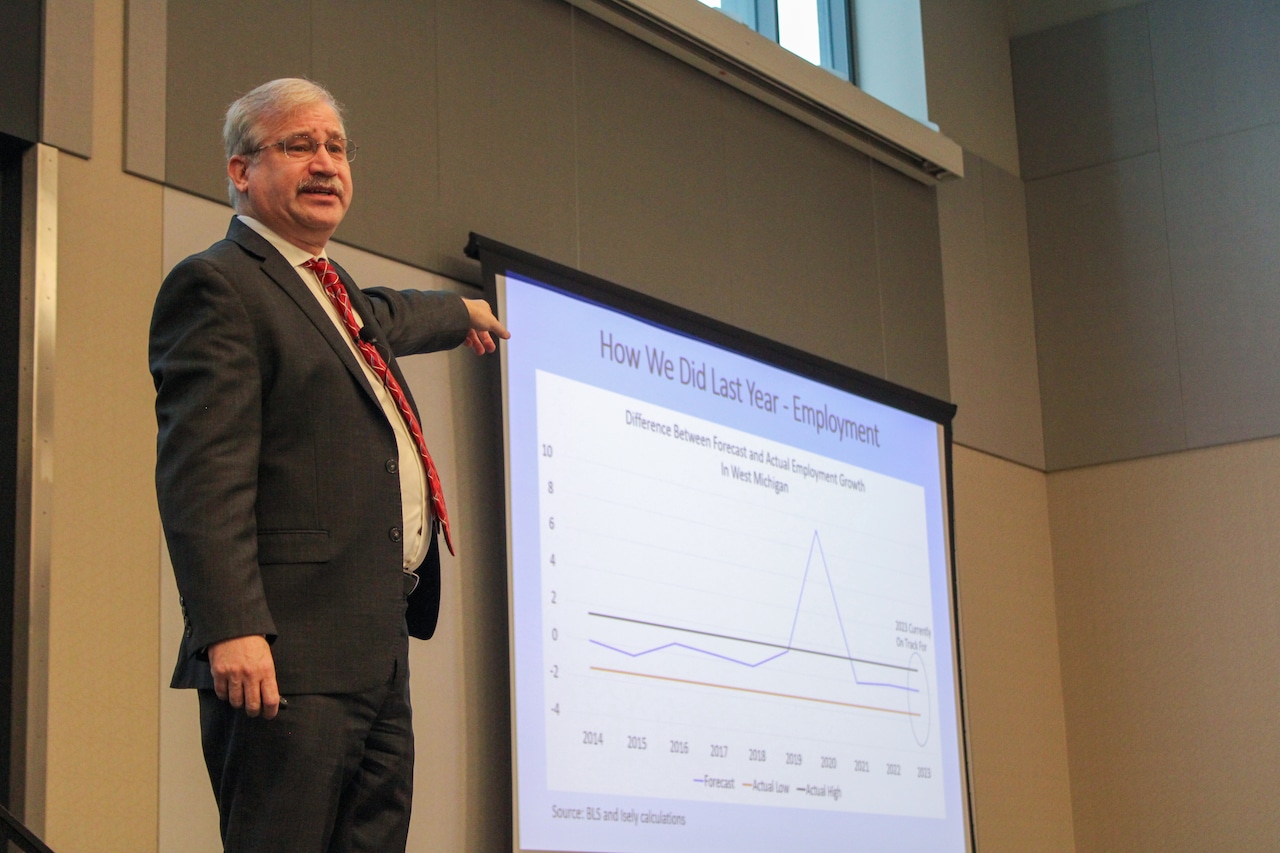
This week, economist Paul Isely presented his findings and predictions for 2026 at the Michigan West Coast Chamber of Commerce’s annual economic forecast at Engedi Church in Holland.
An associate dean and professor of economics at Grand Valley State University’s Seidman College of Business, Isely frequently gives presentations like on Tuesday, Jan. 13, to business and economic groups about the West Michigan economy and its relationship to the national and state economies.
Consumer spending trends
While people in the top 30% of income are spending like they normally would, consumer spending has slowed for the lower 70%. Instead of placing the blame entirely on inflation, however, Isely pointed to heightened consumer expectations brought on by increased spending, or “revenge spending,” that followed the COVID-19 shutdowns.
“Incomes between 2018 and today, even in Ottawa County, have gone up faster than inflation,” he said. “The reason we’re unhappy is we reset the amount of consumption that was normal, and we can’t afford that.”
The bottom 70% of consumers becoming more price-sensitive has a negative ripple effect on manufacturing, which is especially concerning for Ottawa County as a manufacturing hub, Isely said.
Job growth and losses
According to U.S. Bureau of Labor Statistics data, 35% of employment and 44% of wages in Ottawa County come from manufacturing. By comparison, food service, retail, health care and construction all make up just 34% of employment and 22% of wages in the county.
Ottawa County also lost about 2,500 manufacturing jobs between 2024 and 2025. This is partly because of automation, but also due to the automotive industry’s shift away from electric vehicle production.
The automotive industry creates a lot of wealth in Ottawa County, with parts manufacturers like Gentex being one of the region’s top employers, but because of political disputes over electric vehicles versus internal combustion engines, that industry also comes with a lot of volatility.
“If you’re in ICE (internal combustion engine) you’re not hurting, but you probably don’t want to do a lot of additional investment, because you’re not sure if that’s going to be there three years from now,” Isely said.
Ottawa County has kept roughly the same number of jobs year over year by replacing those higher-paying manufacturing jobs with lower-earning food service and hospitality jobs, Isely said.
The rate of new orders also went down in West Michigan significantly in the latter half of 2025. Manufacturers started off the year optimistic because they were certain of the switch to internal combustion engines, but that optimism was tempered once the effect of Trump’s tariffs started to hit in the latter half of the summer, Isely said.
“That has us a little bit worried right now,” he said.
Outlook for 2026
Tariffs were the primary question for employers at the beginning of 2025, but new state laws regarding minimum wage and paid sick leave created some uncertainty as well.
Gov. Gretchen Whitmer in February 2025 signed into law two bills changing the state’s minimum wage, tip credit and sick leave law after state lawmakers approved a last-minute compromise.
Under the new wage law, minimum wage will increase to $15 by 2027, with increases each year after tied to inflation. The first increase was slated for Feb. 21, 2025, with the wage increasing from $10.56 an hour to $12.48.
The new sick leave law required businesses with fewer than 11 employees were required to provide 40 hours of paid sick leave starting Oct. 1, 2025. Businesses with 11 or more employees were required to provide 72 hours of paid sick leave immediately after the signing.
In a recent survey of Ottawa County employers, 27% of respondents said the new sick leave law negatively affected business, while just 8% said the new minimum wage law hurt them, Isely said.
“The minimum wage we didn’t expect to be a big deal because wages were already above the minimum wage,” Isely said. “We really expect the minimum wage increase next year to be the one that starts to affect businesses, as opposed to the one this year or the one last year.”
A narrow majority (53%) said some state or federal policy negatively impacted business, whether it be wages, sick leave or tariffs.
Business confidence for the new year is up significantly from last year, with 72% of respondents saying they were optimistic for 2026, compared to 67% at the start of 2025.
Sales growth expectations are also up to 3.1% for 2026, compared to 2.4% in 2025.
Employers are still uncertain about the future, however, which is reflected in slowed employment growth, Isely said.
“What we’re hearing from businesses is: ‘I’m starting to sell more stuff, but I’m unwilling to invest in people because I don’t want to increase my cost structure,’” he said.
Continued investment in artificial intelligence
According to national and local surveys, about 60% of businesses said they use AI to improve productivity, while just 10% said they are using AI to reduce their workforce, Isely said.
AI-related job losses are expected to increase in the second half of 2026, mainly due to AI training in the insurance and finance sector.
“A lot of those models will be ready for prime time sometime this summer,” Isely said.
Data center investment also is expected to continue this year, he said. While the general public continues to be pessimistic about large companies swiping up land to build massive data centers, Isely warned the U.S. would already be in a recession were it not for these massive investments.
While Trump’s tariffs have cost the U.S. economy about $350 billion, the top tech firms spent about $350 billion on capital expenditures for data centers, completely offsetting the Tariff loss, Isely said.
“President Trump is the luckiest man on the face of the earth,” he said. “But what that’s done is it’s sucked all that economic growth into a very narrow sector of the economy.”
That data center spike might look good on employees’ 401(k) right now, but having rapid growth in such a narrow sector could put the stock market in a similar situation to the 1990s market slump, Isely predicted.