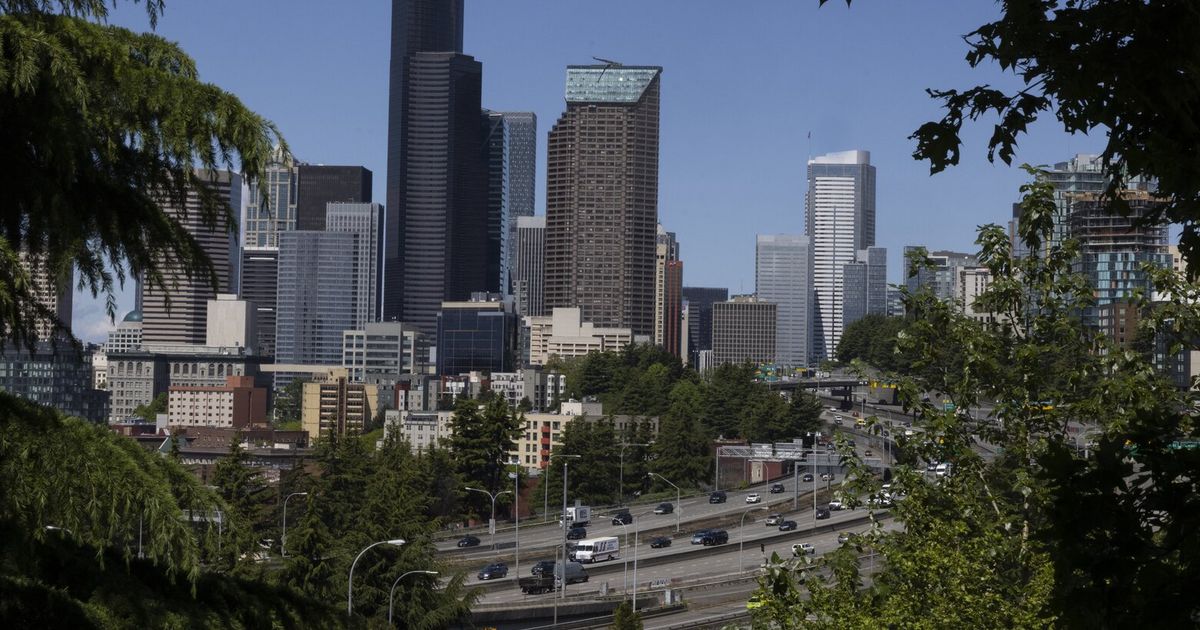
Small brick-and-mortar businesses in the Seattle area say they’re under more financial stress today than they were during the height of the COVID-19 pandemic, according to a new survey.
Squeezed between high operating costs and low revenue, businesses are taking on debt, putting off bill payments and laying off staff as they cast about for ways to stay afloat. Among survey respondents, just 12% reported that they’re earning enough to cover expenses.
The survey was conducted online between November and December by Intentionalist, a Seattle-based guide to small businesses. Respondents included 136 businesses across Seattle and other metropolitan areas in Washington.
“Small businesses are in a state of invisible crisis,” said Laura Clise, founder and CEO of Intentionalist. Over the past year, Clise heard anecdotally from business owners that they felt worried or overwhelmed about their finances. The survey was an effort to quantify those sentiments.
More than 67% of respondents said that they were under more financial stress now than in 2020 and 2021, the survey found.
“There’s a perception that things are better postpandemic,” said Efrem Fesaha, founder of Boon Boona, a coffee roaster and cafe with four locations in the Seattle area. “They’re not.”
Fesaha opened Boon Boona’s first brick-and-mortar store in 2019. The pandemic hit one year later.
In 2020, businesses were able to secure generous subsidies, such as low-interest, forgivable loans through the federal Paycheck Protection Program, enabling them to absorb the shock of lost revenue.
After those programs expired, businesses continued to grapple with high inflation and slow-to-recover consumer spending.
For instance, last year President Donald Trump imposed a minimum 10% tariff on most imports. For Boon Boona, that meant pricier beans. The U.S. isn’t a major producer of coffee, so Fesaha sources ingredients from abroad.
Over the course of 2025, Fesaha had to raise prices across the board by about 15%. But there’s only so much customers can take, he said. “How much can we really offset these costs?”
In November, the White House removed tariffs on imported coffee. But by then it was too late for Fesaha, who had already paid the duties on a 42,240-pound order of green coffee beans from Ethiopia two months prior.
Meanwhile, on the demand side, many small businesses say that they’re seeing dwindling sales.
January is historically a slow month in Seattle. But this particular January so far has been bleak, said Geo Quibuyen, co-owner of Hood Famous, a bakery in the Chinatown International District.
Quibuyen is regularly in touch with other business owners in the neighborhood. Their anecdotal consensus is that foot traffic in 2026 is lower than it was for the same period in 2025.
“Things aren’t improving,” he said. In September, Hood Famous pared back its menu, eliminating savory options and cutting staff. The idea was that a nimbler operation would be more profitable. But based on preliminary sales data, the bakery performed worse in December compared to the same time in 2024 and 2023.
“I’d be lying if I said I have no regrets,” said Quibuyen, referring to the decision to remain open after pandemic-support programs dried up. To stay afloat, Quibuyen and his partner have worked unpaid hours and taken on loans from family.
Similar stories are playing out across the country, said Michael Verchot, director of the Consulting and Business Development Center at the University of Washington, which provides guidance to small businesses.
For many, costs like rent, fuel and food are rising faster than spending among low- and middle-income consumers. That puts businesses in a tight spot. “When I look at macroeconomic trends, that’s what businesses are seeing,” he said.
Becky Bacsik-Booker and Alyssa Kaliszewski founded Doll Parts Collective, a vintage clothing store, in West Seattle at the end of 2020. Since then, costs for rent, business insurance and inventory have climbed while net profits have stagnated or fallen.
“We’ve seen dramatic shifts in the ability of people to spend,” said Kaliszewski. The store has dedicated customers, but many shoppers are facing financial challenges of their own.
“How far do we have to go to make things affordable while still being able to afford things ourselves?” Bacsik-Booker said. The pair estimate they’ll eke out a profit of around $23,000 for 2025, split two ways, compared to $24,100 in 2024.
Generally, small businesses have a harder time absorbing costs, Verchot said. They have less money on hand and fewer customers across whom they can spread price increases.
Municipal governments can make efforts to provide relief for small businesses a number of ways, he added. For instance, reducing fees and other costs related to building permitting and construction could help lower commercial rents.
Survey respondents said that other forms of support could help improve their bottom lines, including more corporate and institutional spending, increased access to low-interest working capital and tax relief.
Bacsik-Booker and Kaliszewski would like to see rent stabilization or caps. Otherwise, the cost of having a brick-and-mortar store might not make sense a few years down the line.
“So many businesses never recovered,” said Clise, the Intentionalist CEO. “Many are just hanging on.”