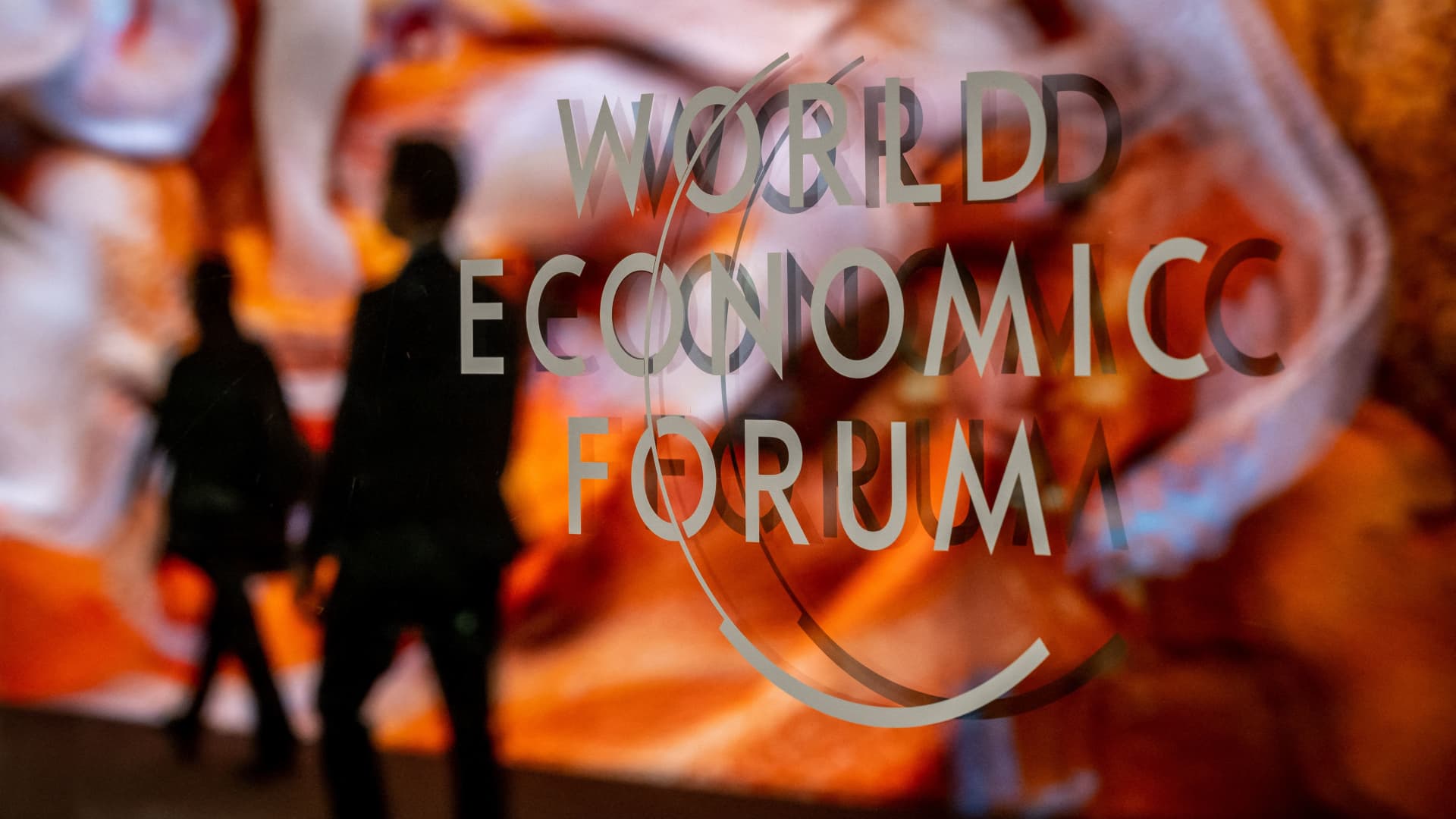
A photograph shows a sign at the Congress Centre on the opening day of the World Economic Forum annual meeting in Davos, Switzerland, Jan. 16, 2023.
Fabrice Coffrini | AFP | Getty Images
Global power rivalries and strategic standoffs top the list of most severe near-term risks heading into 2026, according to the World Economic Forum’s Global Risks Report released Wednesday.
Half of the business executives and other leaders surveyed said they expect turbulent times over the next two years, and only 1% said they expect calm, according to the report. The resulting picture is one of the world sitting on the precipice.
The report captures a shifting landscape where geoeconomic confrontation leaps to the top spot on the list of business worries over the next two years — fueled by increasing competition and weaponizing economic tools like tariffs, regulations, supply chains and capital constraints. The report warns it could lead to a substantial contraction in global trade.
“Concerns growing over an economic downturn, rising inflation and potential asset bubbles as countries face high debt burdens and volatile markets,” writes economist Saadia Zahidi, managing director of the World Economic Forum, which publishes the Global Risks Report annually.
The world’s largest insurance brokerage, Marsh — which rebranded Wednesday from Marsh McLennan — partners with the WEF on global risks.
“Today is not a moment of a big global crisis, it’s a moment of poly-crises,” Marsh CEO John Doyle told CNBC in an exclusive interview.
Doyle listed trade wars, culture wars, rapid technological revolution and the impact of extreme weather as among the current hurdles for business.
“It’s a lot for businesses to confront and to manage,” he said.
Misinformation and disinformation rank second on the WEF’s list of short-term risks, followed by societal polarization — or widening gaps between sharply opposed groups of people. Inequality is identified as the topmost interconnected risk over the next 10 years.
All of it creates impediments to the kind of cooperation necessary to address economic shocks, the report concludes.
The issue that has soared higher and faster than any other in the survey is the potential for adverse outcomes of artificial intelligence, moving from 30th place among short-term risks as of last year to fifth place among long-term risks in the most recent rankings.
Labor displacement, for instance, could lead to massive increases in income inequality, greater societal divides, contraction in consumer spending and vicious cycles of economic contraction and social discontent against a backdrop of massive productivity gains, according to the WEF report.
Machine learning and quantum computing are converging, and their development is accelerating, the report notes, warning of a supercharged landscape which “may lead to situations in which humans lose control.”
Still, extreme weather remains the top concern among surveyed leaders for the next decade. Global insured losses from natural catastrophes are estimated to reach $107 billion in 2025, topping $100 billion for the sixth consecutive year, a steep increase from even the early 2000s.

Marsh CEO Doyle said the wildfires in California in early 2025 illustrate the need for regulation that would allow insurance rates to accurately reflect the underlying risk in order to attract more capital to the insurance marketplace.
“There are risk takers. There are investors and insurance companies that are willing to finance these risks,” Doyle said. “It’s also making sure that building codes are appropriate, that we learn from prior events and that the technologies are deployed so that the risk can be managed effectively.”
The report warns, “Extreme heat, drought, wildfires and other extreme weather events are likely to become more intense and frequent.”
Yet environmental risks such as “critical changes to Earth systems” … “biodiversity loss and ecosystem collapse” and pollution have moved significantly lower on the risk list — reflecting a change in what worries leaders most.
The report concludes “coalitions of the willing” are crucial, that collaborations among governments, academic institutions, business and private citizens are essential to fostering resilience and creating workable solutions to the greatest global challenges.