The current transaction is expected to close in the first quarter of 2026, subject to regulatory clearances.
Perella Weinberg Partners are the financial advisor to ESTEVE on this transaction, and Arnold & Porter are serving as legal counsel. Leerink Partners acted as the lead financial advisor to TerSera, and Kirkland & Ellis LLP is serving as legal counsel.
About PRIALT® (Ziconotide Intrathecal Infusion)
PRIALT is a non-opioid intrathecal analgesic indicated for the management of severe chronic pain in patients for whom intrathecal therapy is warranted and who are intolerant of or refractory to other treatments. Derived from a marine snail peptide, ziconotide acts as a selective N-type calcium channel blocker, interrupting pain signal transmission in the spinal cord. Ziconotide is administered via continuous intrathecal infusion and is not associated with the risk of addiction or respiratory depression commonly seen with opioid therapies.1
IMPORTANT SAFETY INFORMATION
|
WARNING: NEUROPSYCHIATRIC ADVERSE REACTIONS
PRIALT is contraindicated in patients with a preexisting history of psychosis. Severe psychiatric symptoms and neurological impairment may occur during treatment with PRIALT. Monitor all patients frequently for evidence of cognitive impairment, hallucinations, or changes in mood or consciousness. Discontinue PRIALT therapy in the event of serious neurological or psychiatric signs or symptoms.
|
Contraindications
PRIALT is contraindicated in patients with:
-
A known hypersensitivity to ziconotide or any of its formulation components.
-
Any other concomitant treatment or medical condition that would render intrathecal administration hazardous, such as the presence of infection at the microinfusion injection site, uncontrolled bleeding diathesis, and spinal canal obstruction that impairs circulation of cerebrospinal fluid (CSF).
-
A pre-existing history of psychosis.
Warnings and Precautions
Cognitive and Neuropsychiatric Adverse Reactions
Severe psychiatric symptoms and neurological impairment may occur during treatment. Monitor all patients frequently for cognitive impairment, hallucinations, or changes in mood or consciousness. PRIALT may cause or worsen depression, with the risk of suicide in susceptible patients.
In clinical trials, 12% of patients reported hallucinations; other acute psychiatric events included paranoid reactions (3%), hostility (2%), delirium (2%), psychosis (1%), and manic reactions (0.4%).
Patients with pretreatment psychiatric disorders may be at increased risk. Management of psychiatric complications may need to include discontinuation of PRIALT, treatment with psychotherapeutic agents and/or short-term hospitalization.
In clinical trials, cognitive adverse reactions included confusion (33%), memory impairment (22%), speech disorder (14%), aphasia (12%), thinking abnormal (8%), and amnesia (1%). Cognitive impairment may appear gradually after several weeks of treatment. Reduce the dose of PRIALT or discontinue the use of PRIALT if signs or symptoms of cognitive impairment develop, but other contributing causes must also be considered. The cognitive effects of PRIALT are generally reversible within 2 weeks after drug discontinuation. The elderly (≥65 years) are at higher risk for confusion. Concomitant use of central nervous system (CNS) depressants with PRIALT may have additive effects.
Meningitis and Other Infections
Meningitis can occur due to inadvertent contamination of the microinfusion device and other means. In clinical trials, the rate of meningitis was 3% (40 cases) in the PRIALT group using either internal or external microinfusion devices and 1% (1 case) with placebo. In patients with external microinfusion devices and catheters, meningitis occurred in 38 out of 41 patients (93%), 37 of whom received PRIALT and one who received placebo. Patients, caregivers, and healthcare providers must be particularly vigilant for the signs and symptoms of meningitis including, but not limited to, fever, headache, stiff neck, altered mental status (e.g., lethargy, confusion, disorientation), nausea or vomiting, and occasionally seizures.
Strict aseptic procedures must be used during the preparation of the PRIALT solution and refilling of the microinfusion device.
Reduced Level of Consciousness
In clinical trials, 2% of PRIALT-treated patients became unresponsive or stuporous. If reduced levels of consciousness occur, discontinue PRIALT until the event resolves, and other etiologies (e.g., meningitis) must be considered.
Elevation of Creatine Kinase
In clinical trials, serum creatine kinase (CK) levels above the upper limit of normal (ULN) were reported in 40% of patients, with 11% of patients having CK levels >3 times ULN. Incidences were higher during the first 2 months of treatment. Serum CK should be monitored periodically. In the setting of new neuromuscular symptoms, evaluate patients, obtain CK measurements, and if symptoms continue and CK levels remain elevated or continue to rise, reduce the dose or discontinue the use of PRIALT.
Withdrawal From Opiates
PRIALT is not an opiate and cannot prevent or relieve the symptoms associated with the withdrawal of opiates. To avoid withdrawal syndrome when opiate withdrawal is necessary, do not abruptly reduce or withdraw opioid medications.
Driving and Operating Machinery
Use of PRIALT has been associated with cognitive impairment and decreased alertness/unresponsiveness. Caution patients against engaging in hazardous activities that require complete mental alertness or motor coordination.
Most Common Adverse Reactions
The most frequently reported adverse reactions (≥25%) in clinical trials (n=1254 PRIALT-treated patients) were dizziness, nausea, confusional state, and nystagmus. Slower titration of PRIALT may result in fewer serious adverse reactions and discontinuations for adverse reactions.
Indication
PRIALT® (ziconotide) solution, intrathecal infusion is indicated for the management of severe chronic pain in adult patients for whom intrathecal (IT) therapy is warranted, and who are intolerant of or refractory to other treatment, such as systemic analgesics, adjunctive therapies, or IT morphine.
To report suspected adverse reactions, contact the FDA at 1-800-FDA-1088 or www.FDA.gov/medwatch. You may also contact TerSera Therapeutics at 1-844-334-4035 or medicalinformation@tersera.com.
Please see PRIALT Full Prescribing Information, including BOXED Warning.
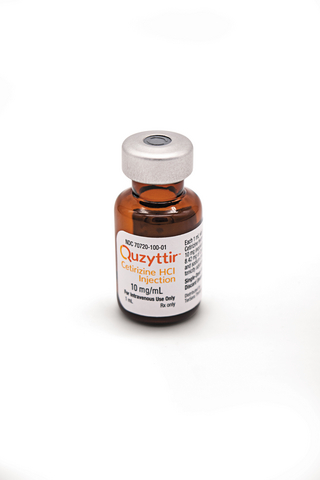
About QUZYTTIR® (Cetirizine Hydrochloride Injection)
QUZYTTIR is a second-generation intravenous antihistamine indicated for the treatment of acute urticaria in adults and children six months of age and older. As a selective H1 receptor antagonist, cetirizine works by blocking histamine activity, helping to rapidly relieve symptoms of allergic reactions. QUZYTTIR is administered via intravenous infusion and offers fast onset of action with less sedation compared to first-generation antihistamines.2
IMPORTANT SAFETY INFORMATION
Contraindications
Known hypersensitivity to QUZYTTIR or any of its ingredients, to levocetirizine, or hydroxyzine.
Warnings and Precautions
The occurrence of somnolence/sedation has been reported in some patients. Advise patients to exercise due caution when driving or operating potentially dangerous machinery. Avoid concurrent use of QUZYTTIR with alcohol or other CNS depressants because additional reduction in alertness and additional impairment of CNS performance may occur.
Adverse Reactions
The most common adverse reactions (incidence <1%) with QUZYTTIR are dysgeusia, headache, paresthesia, presyncope, dyspepsia, feeling hot, and hyperhidrosis.
The most common adverse reactions (incidence ≥2%) with chronic dosing of oral cetirizine hydrochloride in adults are somnolence, fatigue, dry mouth, pharyngitis and dizziness. Adverse reactions observed in pediatric patients with chronic use of oral cetirizine hydrochloride are headache, pharyngitis, abdominal pain, coughing, somnolence, diarrhea, epistaxis, bronchospasm, nausea, and vomiting.
Indication and Usage
QUZYTTIR is indicated for the treatment of acute urticaria in adults and children 6 months of age and older.
Limitations of Use: QUZYTTIR is not recommended in pediatric patients <6 years of age with impaired renal or hepatic function.
To report suspected adverse reactions, contact the FDA at 1-800-FDA-1088 or www.fda.gov/medwatch. You may also contact TerSera Therapeutics at 1-844-334-4035 or medicalinformation@tersera.com.
Please see QUZYTTIR Full Prescribing Information.
About ESTEVE
ESTEVE (esteve.com) is a global pharmaceutical company with a clear purpose: to improve people’s lives. Founded in 1929 and headquartered in Barcelona, ESTEVE has a strong international presence with pharmaceutical affiliates in Spain, Portugal, Italy, Germany, France, the UK, and the USA.
ESTEVE is focused on delivering highly specialized treatments that address significant unmet medical needs in several therapeutic areas. In addition to our innovative pharma business, we offer comprehensive Contract Manufacturing and Development services (CDMO), specializing in the production of Active Pharmaceutical Ingredients (APIs) through world-class facilities in Spain, Mexico, China and the USA.
ESTEVE’s strong commitment to its core values—people matter, transparency, and accountability—remains at the heart of everything it does.
About TerSera Therapeutics
TerSera Therapeutics is a biopharmaceutical company with a focus in oncology and rare disease. Founded in 2016, TerSera is building new cornerstones of care through its portfolio of unique therapeutics, amplifying their ability to deliver meaningful outcomes for patients. TerSera has been recognized as a 2025 Top Workplace. For additional information, please visit TerSera.com and follow us on LinkedIn.
References
-
PRIALT® (ziconotide). Prescribing information. TerSera Therapeutics LLC. www.accessdata.fda.gov/drugsatfda_docs/label/2023/021060s012lbl.pdf
-
Prialt®– www.ema.europa.eu/en/medicines/human/EPAR/prialt
-
QUZYTTIR® (cetirizine hydrochloride injection). Prescribing Information. TerSera Therapeutics LLC. www.accessdata.fda.gov/drugsatfda_docs/label/2025/211415s008lbl.pdf
-
Increlex – www.ema.europa.eu/en/medicines/human/EPAR/increlex
-
Mepact – www.ema.europa.eu/en/medicines/human/EPAR/mepact
-
Caprelsa – www.ema.europa.eu/en/medicines/human/EPAR/caprelsa
PRIALT, QUZYTTIR, TERSERA, and the TERSERA logo are registered trademarks of TerSera Therapeutics LLC or its affiliates.
View source version on businesswire.com: https://www.businesswire.com/news/home/20260113327900/en/
Contacts
For more information:
Esteve:
Irene Simón
Head of Global External Communications & ESG
+34 934 466 000
isimon@esteve.com
TerSera Therapeutics:
Mark Leonard
847-651-9682
mleonard@tersera.com