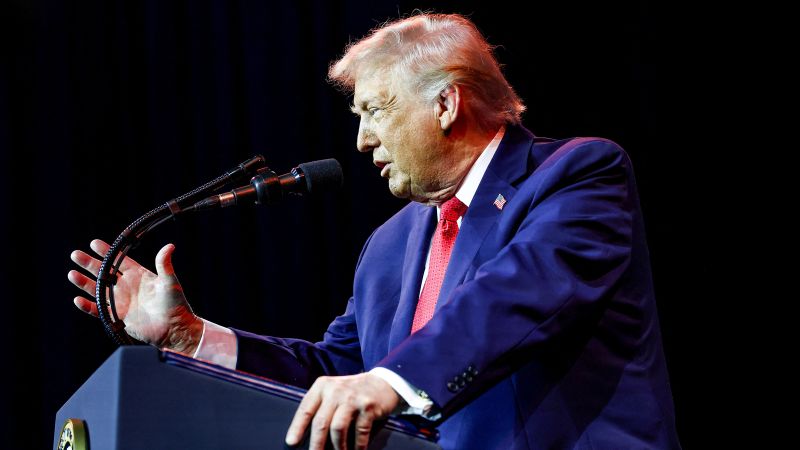
President Donald Trump made two extraordinarily unusual policy statements in rapid succession Wednesday that sent stocks sinking and raised serious questions about the limits of presidential power in a free-market economy.
First, Trump posted on Truth Social that large institutional investors should be barred from buying single-family homes.
Then, he said until defense companies can improve deliveries to the US military, his administration would block their contracts unless they pay their executives a maximum of $5 million and stop issuing dividends and stock buybacks.
The two proposals would seem more at home coming from Democratic Socialist New York Mayor Zohran Mamdani or progressive senators like Elizabeth Warren or Bernie Sanders. The scattershot nature of the announcements, however, is quintessential Trump.
Certainly, Trump is no typical Republican president. He’s no typical president, period. Trump’s historic on-again, off-again tariff policy has no parallel in modern history, and he has levied high import taxes on American businesses to incentivize them to onshore their manufacturing – only to frequently pare back his steepest tariffs when under fire for rising prices.
But Trump ran as a pro-business candidate with a populist economic agenda aimed at reducing the cost of living.
Even with tariffs, his interference in corporate boardrooms has been mostly limited. He has made a few boundary-pushing policies that have interfered with business decisions – threatening companies with strong diversity, equity and inclusion policies and suing media companies are a couple examples.
Otherwise, most of Trump’s business agenda has been about deregulation, lower taxes and a (mostly) light antitrust touch – typical Republican stuff.
But Trump’s proposals on Wednesday break the mold.
Trump’s housing plan is aimed at affordability, his biggest political vulnerability as he kicks off a midterm election year. The significant shortfall in homes for sale, combined with high mortgage rates and historic prices, remains a key factor in Americans’ frustrations with this economy – and a hopelessness many now feel about achieving the American Dream.
Trump’s proposal to boot out institutional investors from the single-family home market already has one prominent proponent: Senator Warren, who noted in a statement that she had been advocating for years to “limit Wall Street from buying up America’s homes.”
But it won’t solve housing’s core problem: a severe supply shortage. It may even backfire, argued TD Cowen analyst Jaret Seiberg, who noted institutional investments in the housing market are growing but remain quite limited compared to the overall market. And though it might boost some home sales, it could elevate risk, leading to higher prices. It might also reduce the number of homes for rent.
Housing stocks fell and Blackstone, one of the largest institutional investors in America’s housing market, tumbled 5.6% Wednesday.
Similarly, Trump on Wednesday made the progressive argument that defense contractors are making enormous profits off their largest customer, the US government, and they’re using that money to directly reward shareholders and executives rather than Americans. Trump, in an executive action, demanded improvements to products that he griped are too slow to ship and operations he called too poorly maintained.
Trump’s insistence that defense contractors stop issuing dividends or buybacks and reduce executive pay is right out of Warren’s playbook – she has been fighting against those kinds of financial maneuvers since before she was a senator. Defense stocks fell sharply Wednesday.
CEOs have become used to waking up to haphazardly announced, sweeping presidential decrees via Truth Social. It’s the reality of doing business during the Trump administration.
But the surprising and sudden shift in tone unsettled investors and rattled entire industries Wednesday. Stocks, which had been on their best pace to start any year since 2003, fell for the first time in 2026.
The question that could keep boards and executives up tonight: What’s next?