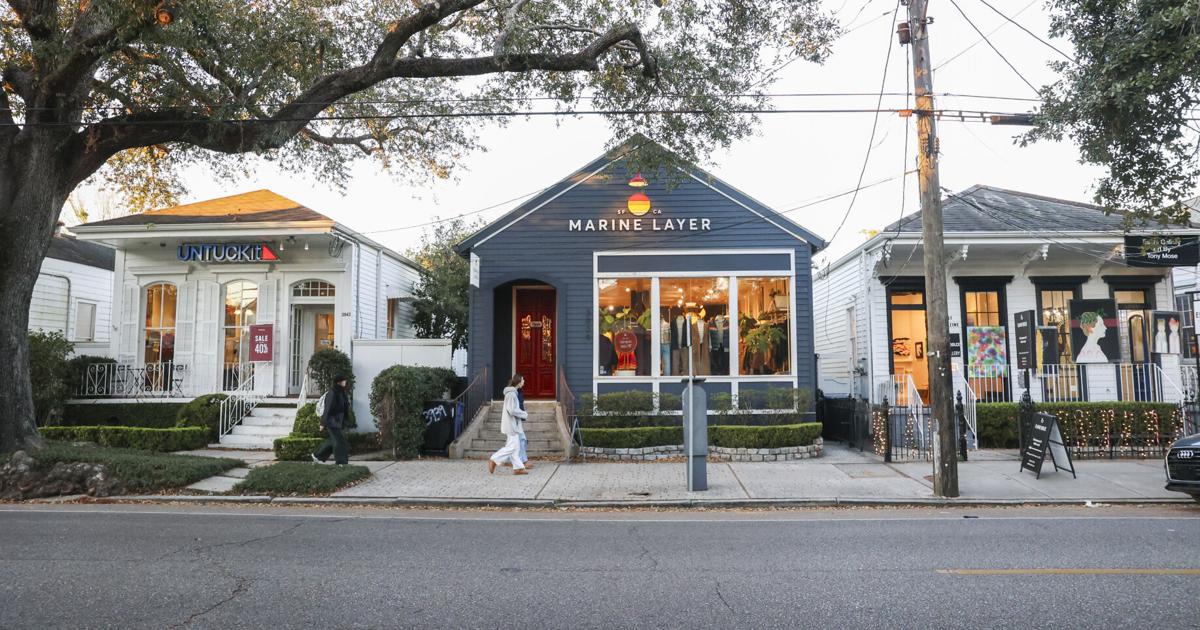
With its historic architecture and mix of trendy shops, galleries and restaurants, Magazine Street has long been a popular pedestrian promenade attracting residents and visitors alike.
For much of its century-and-a-half history as a commercial corridor, the street tended to attract small, locally owned boutiques and antique stores to the 19th-century cottages and shotguns that line the thoroughfare, which extends for 6 miles along a natural ridgeline from Audubon Park to Canal Street downtown.
Over the past decade, that has begun to change, with more national brands taking notice and moving in.
Among the post-pandemic national newcomers to the busy Uptown stretch of Magazine between Louisiana and Napoleon avenues — one of four swanky commercial clusters on the street — are Reformation, Gorjana, Greyson Clothiers, The Shade Store and Visual Comfort.
Pedestrians pass the Free People store in the 3900 block of Magazine Street in New Orleans, Tuesday, Dec. 30, 2025. (Photo by Sophia Germer, The Times-Picayune)
They join a handful of other national chains, all in the 3900 block, that began populating the street about a decade ago. They include Warby Parker, Marine Layer, Indochino, Free People and UnTuckit. And at least two more are planned for 2026.
“That is the main hub, the main center point for nationals when they come here,” said Casey Burka, principal of commercial real estate firm Ben and Burka. “And when you talk about retailers who can pay real rents, it’s usually nationals.”
Real estate brokers and some retail tenants on the strip see the influx of national investment as a rising tide that lifts all boats. Not everyone agrees. Demand for space from deep-pocketed national retailers has driven up lease rates, in some cases to more than $50 per square foot, pricing some store owners out.

The former Izzo’s Illegal Burrito at 4041 Magazine St., which is being renovated into retail and office space, photographed Tuesday, Dec. 30, 2025, in New Orleans. (Photo by Sophia Germer, The Times-Picayune)
At least two local investors are trying to counter the recent trend. Sud antique store owners Richard Dragisic and William Brockschmidt have acquired four properties in the 4000 block of Magazine — including a former Izzo’s Illegal Burrito location and the former SnoWizard SnoBall Shoppe — with the goal of keeping space available for local businesses.
“We want to make sure there’s a reason for people to come to Magazine that’s different than any other place,” Dragisic said.
Origin of a corridor
Magazine Street was first called “Calle de Almazen” after a Spanish warehouse near what is now the U.S. Customs House, with French-speaking locals later referring to it as “Rue de Magasins” after the powder magazines stored there, according to Tulane University geographer Richard Campanella.
As Magazine grew throughout the 19th century, Campanella said clusters of commerce formed around its public food markets — located near its intersections with St. Mary, Ninth, Napoleon and Ewing streets — evenly spread a mile apart to avoid cannibalizing one another’s business.
Pedestrians walk in the 4000 block of Magazine Street in New Orleans, Tuesday, Dec. 30, 2025. (Photo by Sophia Germer, The Times-Picayune)
Veteran real estate brokers say the street’s charm and popularity endure because it has the mix of elements that make New Orleans so unique — historic architecture, top-rated restaurants, artistic charm, funky bars and coffee shops — with a well-kept, walkable layout.
“There’s a lot going on there in one retail strip that you don’t see in other parts (of the city),” said Rich Stone, senior sales and leasing associate at NAI Rampart. While not immune from the same headwinds that have hindered retail in general, Magazine Street still has “some advantages in this current market over the French Quarter,” he said.
In recent years, the Napoleon-to-Louisiana strip has been particularly attractive, due, at least in part, to a wave of gentrification in nearby neighborhoods like the Irish Channel. Experts also point to the steady stream of visitors touring historic Garden District homes that bring shoppers to the street.
“It’s a natural landing point for retailers or restaurants when they want to open in the market. There’s not a lot of alternatives to it,” said developer Joe Mann of Verdad Real Estate.
The former Harry’s Ace Hardware at 3535 Magazine St. was renovated into a new mixed-use development that now houses home furnishing showrooms and offices.
Verdad is among those who has bet big on Magazine Street in recent years. In 2021, he bought and renovated the former Harry’s Ace Hardware at the corner of Magazine and Foucher streets. In September, he relocated his company’s New Orleans offices from the Warehouse District to the century-old brick building. Two national retailers — Shade Store and Visual Comfort — have since moved in and are his ground-floor tenants.
Gale Singer, founder of Visual Comfort’s direct division, said the Houston-based company was attracted to Magazine Street because of its “creative community.”
“New Orleans has a strong design identity, shaped by history, culture and craftsmanship,” Singer said in a statement about the company’s decision to open a Magazine Street location.
An evolving epicenter
The interest from national retailers is creating something of a snowball effect, attracting the attention of investors, who are buying clusters of properties with the intent of attracting more high-end retailers.
Attorney Peter Wilson recently formed the boutique real estate development firm Oxlot Capital and purchased five properties on Magazine Street in 2025. He has a sixth under contract and has his eye out for more.
Pedestrians pass the new Reformation store in the 3900 block of Magazine Street in New Orleans, Tuesday, Dec. 30, 2025. (Photo by Sophia Germer, The Times-Picayune)
Four of the five buildings are in the 3900 block of Magazine, where Wilson leased out space to the recently opened Reformation store, a Los Angeles-based chain that sells women’s clothing and accessories.
Next door, Wilson has a deal with national fragrance company Le Labo, which will be joined by Esom Art, a local gallery that will relocate from another nearby Wilson-owned building that he intends to combine and expand before leasing out again.
And Western wear chain Tecovas has signed a lease to open up its second Louisiana location in the building at the corner of Magazine and General Taylor that has been leased for the past nine years by local clothing boutique Pilot and Powell. The Austin-based cowboy boot store, set to open in the fall, marks the fourth new lease and third new national brand that Wilson has already attracted to his recently acquired portfolio.
Wilson said he wants to strike a balance, preserving and recognizing the history of the buildings while also adapting them for “modern-day retailers and restaurants and other companies that might be wanting to use them.”
Some retailers see investments like Wilson’s as a positive that ultimately benefits all retailers on the street.
“Having the big people come in on Magazine, to me, is only a plus, not a detraction from the locals,” said Varsity Sports owner Jenni Peters, whose Baton Rouge-based running store spent 12 years in a leased space in the 3400 block of Magazine before relocating in 2023 to a building she purchased in the 5700 block.
“They’re going to attract a new set of people that are there looking for the national chains,” she said. “And it’s kind of the cumulative attraction of everybody.”
Others see the influx of national retailers as a threat to the street’s affordability and local character.
An architectural rendering shows plans for a George Bass store at 4041 Magazine St., the site of a former Popeyes Louisiana Kitchen and Izzo’s Illegal Burrito.
Dragisic, one of the antique store owners who has assembled properties on the other side of Constantinople Street from the epicenter of national retailers on Magazine, said his goal is to make space for local businesses so they don’t get priced out of the market. He has had mixed results so far. The former Izzo’s building, for instance, is being renovated to house local menswear store George Bass, which will open there later this year.
On the other hand, limiting his pool of potential tenants has made it hard to fill the vacant sno-ball stand on the corner.
“We turned down a lot of, whatever you call them, chain sort-of things,” he said. “National brands, or something like that.”
The former SnoWizard photographed in the 4000 block of Magazine Street in New Orleans, Tuesday, Dec. 30, 2025. (Photo by Sophia Germer, The Times-Picayune)
Degas Gallery owner Cybèle Gontar, whose business relocated from the building now occupied by Reformation to 3819 Magazine St., generally supports adding more national chains to the corridor’s retail mix, though she offers a caveat.
“We really want for Magazine Street to continue to thrive, but we need to be careful about preservation,” Gontar said. “The fabric of our city is our old buildings, so when we turn certain properties over to national chains, we want to be careful that they’re respectful of the architecture as much as they can be.”