When Bellingham’s minimum wage rose $1 above Washington’s in 2024, and then again by another dollar in May to $18.66 per hour, Bellingham Bar & Grill owner Mo Tsimouris said he had no choice but to raise menu prices and cut staff hours.
“Everyone has to work a lot harder now,” said Tsimouris, who employs more than 20 people at both his downtown restaurant and neighboring Bellingham Axe. “I work more hours myself on the floor. As an owner, you have to be present now in this type of business.”
More than half a year since a voter-approved referendum in Bellingham went into full effect, setting the minimum wage to $2 per hour higher than the state minimum wage, many small-business owners are frustrated by the rising cost of doing business. Others are finding it hard to reconcile personal support for higher wages with the need to streamline operations to stay afloat.
Revised annually by the Washington State Department of Labor & Industries for cost-of-living adjustments based on the federal Consumer Price Index, the state minimum wage will increase to $17.13 on Jan. 1; Bellingham’s will rise accordingly to $19.13 that same day.
“That’s kind of the dirty secret of the business — that in order to survive times like this, you have to accept lower profit margins,” Tsimouris said. “You can try and raise your prices to meet the new costs — and not just minimum wage but higher operating costs in general — but if you do that, you’re going to lose your customer base. So, for us, it’s all about weathering the storm.”
Other business owners, like Craig Jewell, who co-owns the downtown live music venue The Wild Buffalo, have adapted by choosing which days to stay open and which to close up shop.
“It’s like this bittersweet frustration of making sure that people are getting paid a fair wage for the cost of living in this area, but also it’s like, well, now we can’t do what we sought out to do, which was to have live music every single night,” said Jewell, who has also discontinued the less-profitable showcases of local musicians.
“We are professional gamblers — we’re taking risks on all our shows,” he added. “We’re not only risking enough money coming in to pay our staff; we’re risking enough money to come in to pay the artists. I have to make sure that we hit all of those marks before opening up now.”
His outlook for 2026: “Doing whatever we can to keep the lights on — and that’s one of the main reasons why we opened up The Den,” he said, referring to his new bar nearby. “We don’t have all of the other costs to incur to support the live music system, which has now become one of the most difficult things to keep sustainable due to staffing costs.”
Washington currently boasts the nation’s highest minimum wage at $16.66 per hour.
Some businesses that can shoulder the cost have chosen to also raise wages for workers higher up on the pay scale, in order to avoid or at least minimize wage compression, in which pay differentials flatten between junior and senior staff.
Erika Millage, owner of Third Planet Boutique in downtown Bellingham, increased all of her staff’s wages, though not uniformly, in advance of the city’s minimum wage increase. Millage supported the voter referendum that increased minimum wage.
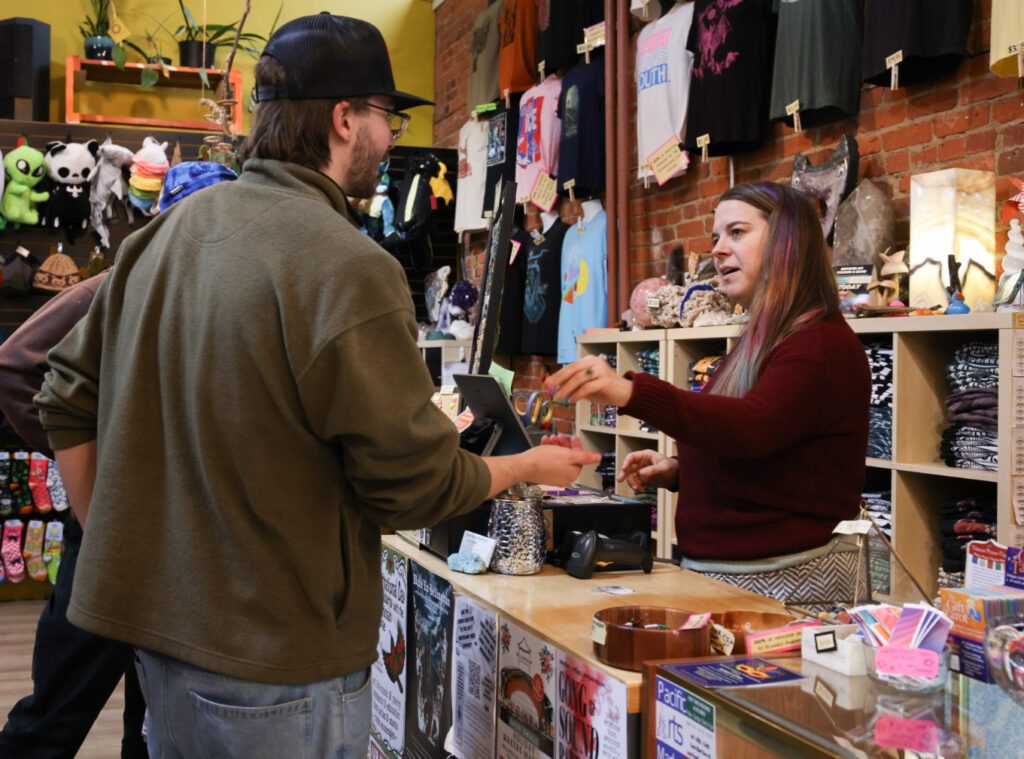
“Everybody deserves to earn a living wage, and I think that [the law] is forcing more of the big box stores to actually pay their employees more than they have been,” Millage said. “I also think there’s unfortunately a lot of businesses out there that do not think that they need to be regularly giving their staff more money to, at the very, very bare minimum, account for inflation.”
Village Books and Paper Dreams co-owner Paul Hanson likewise supported the referendum and has increased wages among all staff at both the flagship Fairhaven bookstore and the Lynden location, though not without headaches.
“Every time the minimum wage goes up, we have to ask ourselves whether or not we can apply that increase to the minimum wage across the board to all of our employees,” Hanson said. “We’re aware that if we don’t do that, then we start hitting compression where the minimum wage will start approaching our higher-paid positions. And that’s something that is not really sustainable.”
Book sales have not kept pace with payroll increases, he said, also owing in part to tariffs imposed by the Trump administration. Hanson and his team have had to get creative in finding new efficiencies, such as migrating to a new point-of-sale system last summer.
Although the minimum wage increase applies only to businesses operating within Bellingham city limits, in practice, it has exerted a ripple effect throughout much of Whatcom County, said Guy Occhiogrosso, the Bellingham Regional Chamber of Commerce president and CEO.
“We’re a very commuter-oriented community: there’s plenty of people that work in Bellingham but live in Ferndale or Lynden, or work in Ferndale but live in Bellingham or Sumas,” he said. “The need to travel for work is a known aspect.”
That mobility puts pressure on employers within commuting distance of Bellingham to raise their wages, Occhiogrosso said, or else risk losing workers and incurring the cost of turnover and retraining.
“I don’t think [Bellingham’s law] has given particularly the lowest-wage earners any more purchasing power because I think the cost of things have gone up,” he added.
Community First Whatcom chair Cleveland Harris II, whose group organized the 2023 voter referendum authorizing the $2 wage premium, said the measure is a decent starting point, but that more needs to be done.
“Unfortunately, our minimum wage, even with this increase, hasn’t caught up to the cost of living,” he said. “We have heard that it has helped fill gaps in basic needs and goods and helping with grocery prices, but tackling the affordable housing crisis — it’s not quite caught up.”
According to a recent analysis by the trade publication Construction Coverage, Bellingham has the nation’s highest home price-to-income ratio among small cities, defined as those with fewer than 150,000 residents.
Another wrinkle to the minimum wage debate: Washington is among a handful of states — including Oregon, California, Nevada, Montana, Minnesota and Alaska — that prohibit the use of tip credits, in which employers can pay certain workers less than the minimum wage, as long as their tips make up the difference.
For most retail establishments, where tips are few and far between, it doesn’t come into play, but at full-service restaurants like Bellingham Bar & Grill, the lack of a tip credit hurts the bottom line.
“A lot of business owners just scrape by, whereas they’d probably be better off just being a bartender or server themselves somewhere else,” Tsimouris said. “It will get to a point for me, probably five to 10 years from now, where I’ll have to really look in the mirror and say, ‘Do I want to continue to do this?’ Because, at a certain point, if it’s not worth it, you have to walk away.”
Benjamin Payne is a freelance journalist in Bellingham. He most recently served as the Savannah-based reporter for Georgia Public Broadcasting, a statewide NPR network.