
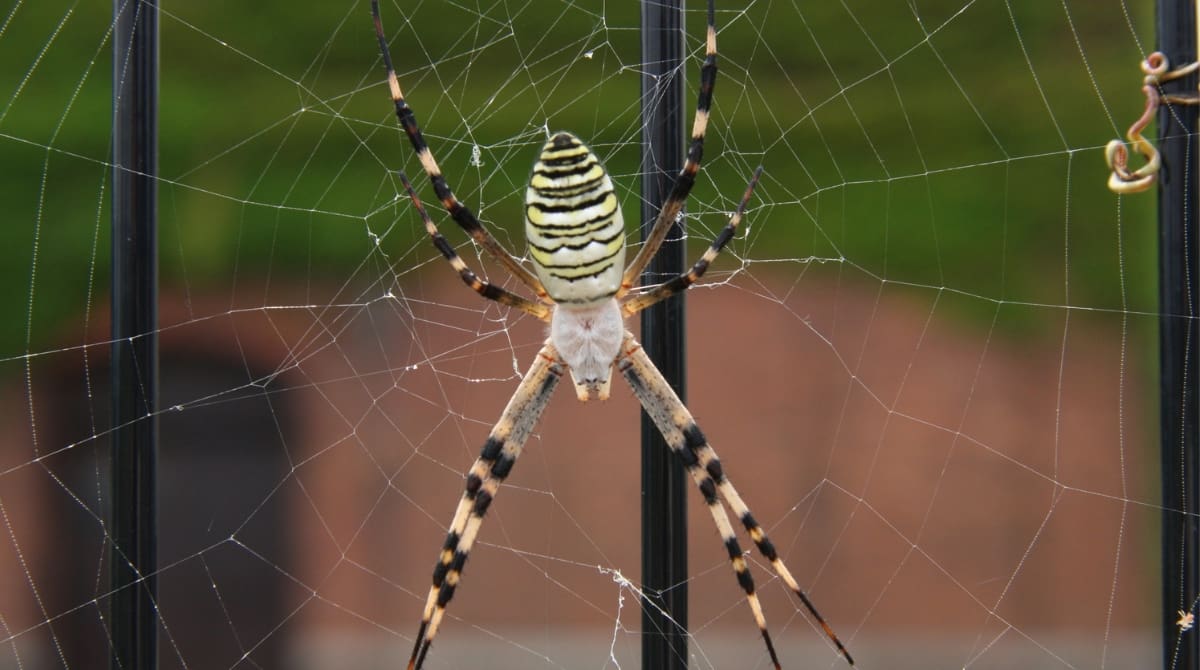
A potentially-invasive spider was spotted at a coastal business in Santa Barbara County this fall, the Santa Barbara Museum of Natural History said in a statement on its website.
The three-inch-long Joro Spider (Trichonephila clavata) was lurking in the manicured landscaping at the high-end business, the museum said on December 16, 2025. Evidence suggests that the Joro Spider can outcompete native orbweavers in southeastern North America, the museum said.
The spotting is the first confirmed Joro Spider seen west of the Great Plains, according to the museum.
An east Asia native, the Joro Spider’s web can be as wide as 10 feet. The species was first spotted in the U.S. in 2014, when it was observed around residences in Georgia, the museum said. Since then, the species has spread west as far as Oklahoma and north as far as Maryland.
Naturalist and birding instructor Sophie Cameron spotted the spider at the business, who recognized it as a female Joro Spider by its size and distinctive yellow, gray, and black coloration, the statement said.
The spider was immediately adjacent to an area where shipments of flowers and plants are received, which might be how it reached the spot, the museum said. No webs were found near the spider, which may have arrived alone inside some plants that were shipped from another part of the country.
She informed the Santa Barbara Museum of Natural History’s Schlinger Chair of Entomology Alex Harman, Ph.D., who reached the site. Once the spider’s identity was confirmed, it was captured.
Dr. Harman and Cameron have reported their discovery to the scientific journal ‘Southwestern Entomologist,’ to help other researchers track sightings of the species.
Cameron will be monitoring the site to ensure that the discovery does not reflect a more established presence by the spider in California, the museum said.
The Joro Spider is now preserved among thousands of insects and arachnids at the Museum’s Entomology Collection, according to the statement.
Joro Spiders are often referred to as “flying” spiders as their spiderlings, or baby spiders, can disperse by wind by a process called ‘ballooning,” the museum explained.
“Calling Joro Spiders ‘flying’ is ridiculous, as nearly all spiders disperse by wind,” Harman said in the statement.
The museum is not disclosing the name of the business where the spider was discovered as it is not about “shame or blame,” Director of Marketing & Communications Jonah Gabriel Haas said in the statement.
“It could happen anywhere, and that’s the point — we want to tell the story because it’s a great opportunity to raise everyone’s awareness of invasive species,” Haas said.
Due to its small size, insects and arachnids are small and easily overlooked and, therefore, are transported unintentionally, Harman said. It is not uncommon for wood-boring insects to be transported inside wooden pallets, he added.
“Just like specimens of all the other living organisms in museums, insect collections are a great source of data for seeing how ranges change over time,” Harman said.