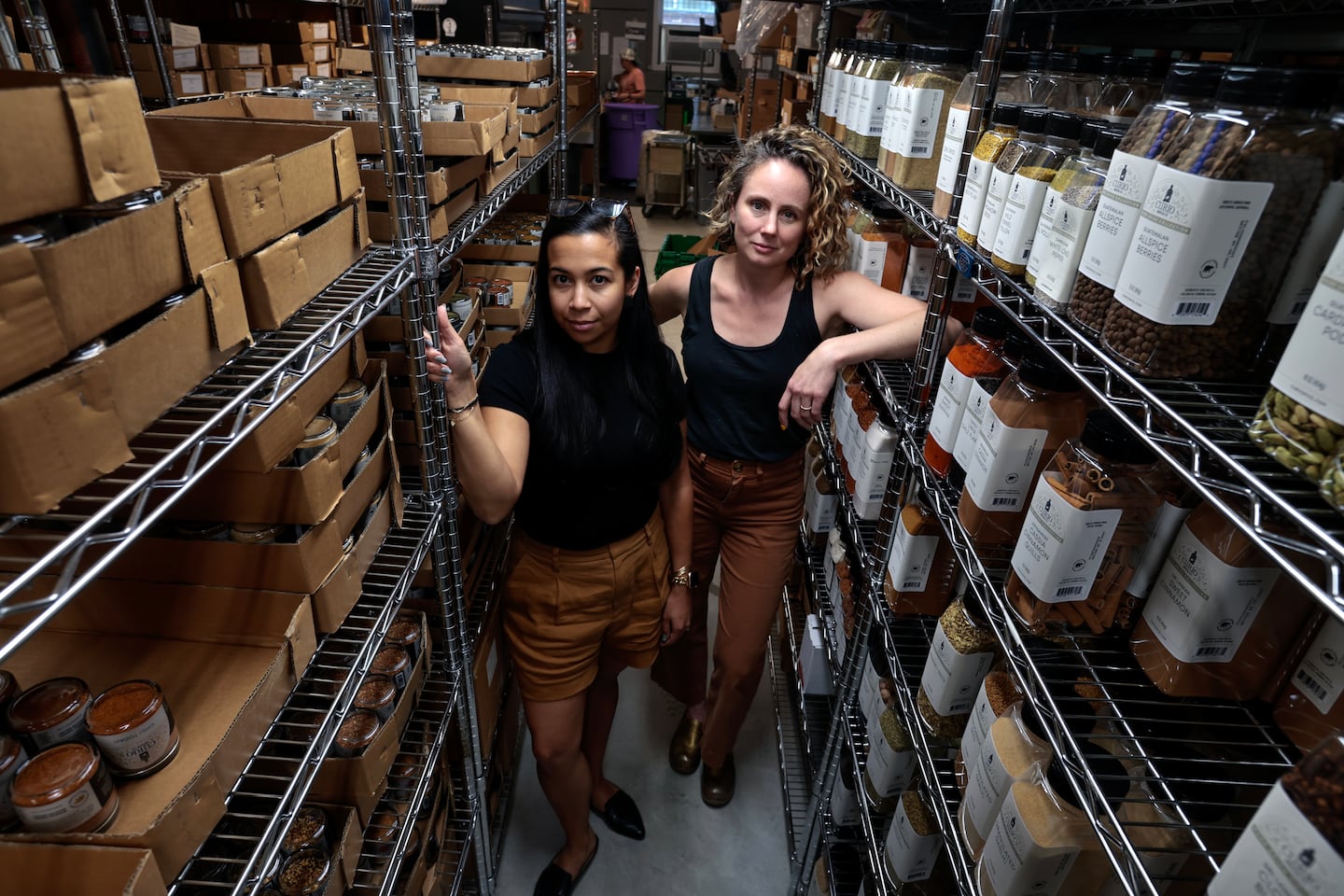
In early July, the Globe spoke with Cheney and other small business owners about the tariffs that were being rolled out and found the impact was just starting to be felt.
Six months later, the effects are clearer. And they’re anything but festive this holiday season arrives.
Curio Spice is one of many small businesses finishing a difficult year of dealing with Trump’s tariffs. Business owners interviewed by the Globe described an atmosphere of anxiety and uncertainty as they struggled to plan for on-again, off-again tariffs, wrestled with how much of the cost to pass on to customers, scrambled to find alternate suppliers, and scoured their operations for savings.
More uncertainty could be coming in early 2026 as the Supreme Court is expected to rule whether a large swath of the tariffs are illegal.
The C.M. Paula Company of Mason, Ohio, a family-owned holding company of manufacturing and retail businesses, is approaching $1 million in tariff costs this year, up from roughly $100,000 the year before, said chief executive George White. Cost reductions negotiated with suppliers helped offset a small amount of the tariffs, which are paid by US importers when the products arrive in this country.
But the company had to pass on most of the tariff expense to its customers, increasing prices between 10 percent and 30 percent, and was forced to lay off several of its 110 workers after two decades of steady growth.
“We’ve just had all of our holiday parties and my message to all the employees was, ‘It’s been a challenging year,’ “ White said.
C.M. Paula has four very different businesses, including ART Metals Group, a stamping factory that supplies the auto industry, as well as GeoCentral, which sells rocks and crystals. They’ve all been affected by the tariffs, White said.
Some of those tariffs he anticipated, like 30 percent on handmade, pop-up greeting cards that his Up With Paper business can only get from China.
Trump campaigned in 2024 on levying tariffs to reduce the US trade deficit with some nations, especially China.
But other tariffs took White completely by surprise.
GeoCentral gets its crystals, including high-end ones used for bookends and table top decorations, from Brazil. In 2024, the United States had a $30 billion trade surplus with Brazil so there was no expectation Trump would target that nation to reduce the trade deficit.
But in late July, the Trump administration hit Brazil’s products with a 40 percent tariff, on top of the 10 percent already in place, in an attempt to pressure the country’s leaders to drop charges against former president Jair Bolsonaro, a Trump ally. The morning of the announcement, the people who run GeoCentral came into White’s office to deliver the news.
“They just had this look of just total shock on their face, because they’re like, ‘We thought we were safe in Brazil, and now it’s a 50 percent tariff,’ ” he said. “It’s just crazy. That’s where we get our really high-end . . . crystals that you can’t get from the United States. The mines aren’t set up here.”
Facing rising grocery prices, Trump rolled back some of his tariffs in November, including the additional 40 percent levy on Brazilian food products such as beef, coffee, and various fruits and spices. But the total 50 percent tariff remains in place on crystals, White said.
Nationwide, small businesses paid $46.6 billion in tariffs from March through September, according to an analysis from Massachusetts Senator Ed Markey, the top Democrat on the Senate Small Business Committee. In Massachusetts, the total was $490 million.
“Small businesses operate on razor-thin margins, month-to-month, week-to-week, and even day-to-day, and the next day shouldn’t be harder than the last just to make ends meet for their employees and their families,” Markey said at a December news conference that included two small business owners.
One of them was Julie Robbins, chief executive of EarthQuaker Devices, an Akron, Ohio, company that makes guitar effects pedals. She said her costs have gone up 30 percent this year because the parts come from 15 countries and span 34 different tariff categories. She expects business to get worse in 2026, projecting her tariff bill will triple to $180,000. Her team has had to meet weekly this year to review the tariffs and their effects on the 35-employee company.
“From week to week, there’s always something that is changing,” she said. “All of that time and energy that we spend is taking away from things that would be actually productive for our business … like new products, customer relations, employee relations, all of those things.”
The fear and distraction caused by tariffs was a common theme among small business owners.
Business has been surprisingly good this holiday season at The Curious Bear Toy & Book Shop in the Tacoma suburb of Fircrest, Wash., despite tariff-related price increases, largely because it carries the viral, hard-to-find Jellycat stuffed animals, said owner Jenn Luna. Still, tariff concerns have kept her from hiring someone to handle shipping, leaving her to personally ship more than 3,000 online orders during the past month.
“We’ve needed somebody like that for an entire year, but I’m just trying my best to pick up where I can,” said Luna, who doesn’t want to expand beyond her 20 employees right now.
But tariffs have hurt her sister shop next door, Paper Luxe, because of increased costs of 15 percent to 30 percent to import popular Japanese stationery and pens. Luna has had to cut back on supply, and things got worse when she recently received a $2,200 order that was miscoded as containing steel products that have a 52 percent tariff. The package had to be sent back to Japan and reshipped at her expense.
“It’s keeping people, smaller businesses, like me, who don’t have brokers or anybody on our legal team from importing,” she said. “I’ve just pretty much stopped trying to import directly, which is frustrating.”
At Curio Spice, which sells online and from its stores in Cambridge and Boston, Cheney worried in July that the tariffs were going to be a hit to growth.
That turned out to be true. She expects revenue to only increase by 10 percent in 2025 — to about $1.9 million — down significantly from 28 percent growth the previous year. Cheney has resisted raising prices, fearful of driving away loyal customers, so she’s mostly absorbed the tariff costs while looking for alternate suppliers when necessary.
“With India, we just had to stop,” Cheney said after Trump imposed an additional 25 percent tariff on imports from there this summer, on top of a 25 percent levy earlier in 2025. “We’re going to run out of ginger, but we can’t buy it at a 50 percent tariff, that’s ridiculous.”
Like other businesses, she and her team also have been searching for any savings they can find in this time of high tariffs.
“Are we OK just using Google Meet instead of Zoom? Let’s cut our subscription to Zoom,” she said was one suggestion. “We’re just looking for money everywhere, because … that’s what we have to do.”
Jim Puzzanghera can be reached at jim.puzzanghera@globe.com. Follow him @JimPuzzanghera.