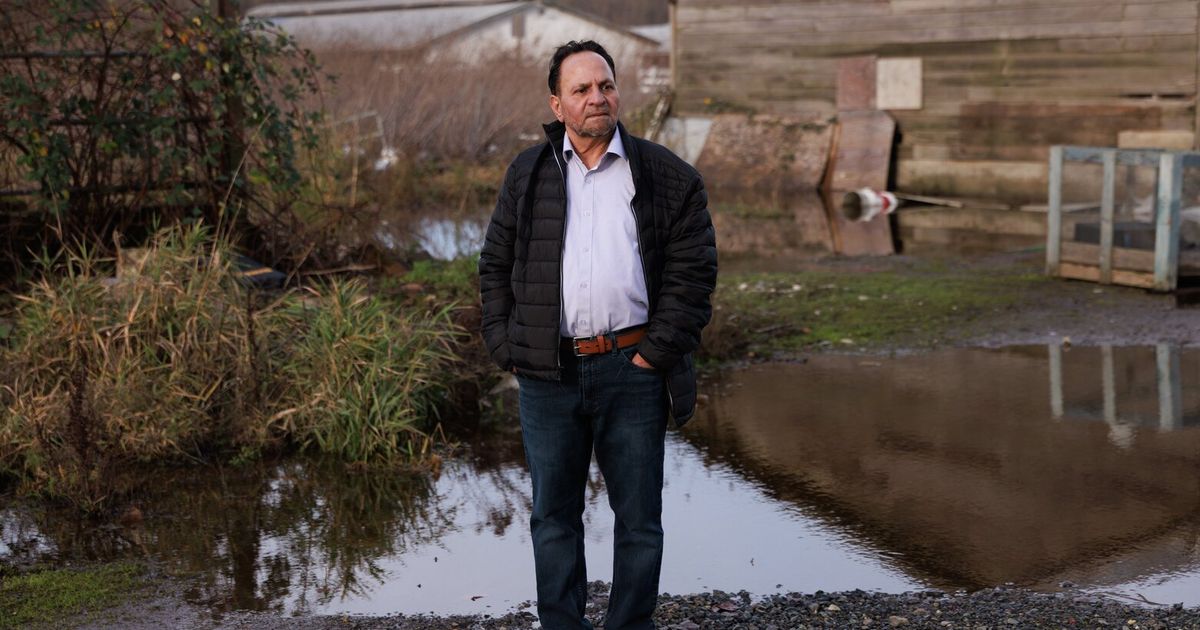
On Friday, Om Parkash, owner and manager of West Valley Nursery in Kent, drove down rain-slicked roads to check on what remained of his business.
Parkash has operated the 28-acre nursery for almost three years, selling a variety of flowers, plants and trees. He feared that relentless flooding in the region would soon wash it all away.
“It’s a disaster,” he said.
Parkash doesn’t have flood insurance, and he’s unsure whether there will be any government aid for him to access. More than three-quarters of the grounds were still under water Friday, the ninth day of flooding by Parkash’s count. Trees had been knocked down, gardening tools were missing and unidentifiable garbage bobbed about. He worried about the health of his plants.
“Some plants are damaged,” he said. “Others are dead or dying.”
Heavy precipitation and swollen rivers caused historic flooding across Western Washington this month, damaging buildings and forcing evacuations up and down the I-5 corridor. As floodwaters retreated late last week and over the weekend, hard-hit business owners are now taking stock of the damage they sustained.
Some losses were immediately apparent. Flooded businesses suffered costly damages to infrastructure and inventory, which could take weeks or longer to repair and recover. In addition, revenue cratered in areas where people were ordered to evacuate.
Sunny Singh is the owner of Quick Food Store, a convenience store and gas station on Highway 20 in Sedro-Woolley. Late in the evening on Dec. 11, floodwater from the Skagit River crossed over the highway and flooded his property.
It cut off power to all four of his gas pumps.
As a result of the flooding, he had to shut down business for three days. When he reopened early last week, he still couldn’t sell gas, which makes up 90% of his sales.
“I’m not feeling good,” he said over the phone Thursday.
By Monday, electricians had come by to work on repairs. Singh estimates that fixing the gas pumps will set him back by $20,000 to $30,000. His insurance doesn’t cover flooding, so those costs will have to come out of his pocket.
Making matters worse, repairs are estimated to take about a week, so Singh won’t be able to sell gas until early next week. That means that in addition to the cost of repairs, Singh can also expect to lose more than two weeks’ worth of income from gas sales. He declined to share an estimate of his predicted total revenue loss.
The economic impacts of extreme weather come in waves, according to Phillip Bruner, professor of sustainable finance at the UW Foster School of Business.
“Flood losses continue to unfold after waters recede through business interruption, insurance claims, and delayed reopening,” he wrote in an email.
Businesses are also wary, as another atmospheric river looms in the forecast for late December.
About a mile down the road from Quick Food Store, April Ellis was nervous about the future of her job.
For 15 years, Ellis has been the manager of Commuter Cars, a used-car dealership in Burlington. During this time, she’d never seen flooding on the property. That is, until two weeks ago, when Gages Slough, a nearby tributary of the Skagit River, spilled over.
The Commuter Cars lot sits on a slope. Vehicles at the top of the lot remained untouched, but those lower down were submerged in up to 3 feet of water. One car had water up to its hood. Another had water in its cupholders.
Reviewing security camera footage, Ellis saw that floodwater even entered the Commuter Cars office at one point.
Business had already been weak this year. Now, she estimates that the company will have to write off at least five cars, including one that had just been sold to a customer. The total retail value of the now-junked cars is an estimated $25,000.
“With us already being down in sales, I’m afraid we’re not going to make it out the other side,” she said. “This is a really big hit for us.”
Commuter Cars has flood insurance, but Ellis doesn’t know if it will cover destroyed inventory, or just damage to the buildings. Each car is also individually insured, but auto insurance explicitly excludes damages from flooding, she said.
Depending on how much insurance pays out, Ellis is worried that the company owner may decide to shutter the business.
“I’m super scared for my job,” she said.
Businesses that weren’t flooded also say that they’ve been hard hit.
For Summer Houlihan, 2025 was a make-or-break year for her store in downtown Mount Vernon, called Tri-Dee Arts.
Previously, Tri-Dee Arts was a retailer selling art supplies, toys and gifts. Since 2020, business has been in the red as competition from big-box stores and e-commerce eroded Houlihan’s sales. In February, she relaunched Tri-Dee Arts as a studio where people can paint their own pottery.
The window between Thanksgiving and Christmas is critical for Tri-Dee Arts, which has seen a surge in business as college kids come home for winter break and families do their holiday shopping.
But on Dec. 10, Houlihan closed up shop for almost a week as the Skagit River surged to record levels and thousands were ordered to evacuate.
Fortunately for Houlihan, the floodwalls in Mount Vernon held the river back, and businesses downtown were spared from flooding.
But she estimates that the closure still translates to a loss of about $6,000 in revenue. By comparison, her payroll costs over two weeks usually run about $3,800. The lost revenue impacts the amount of art supplies they can order right now and makes it harder for the business to break even by the end of the year.
“Any disruption to that revenue stream makes a difference,” she said.
Still, she’s cautiously optimistic that people will show up during the last few days of 2025 and help push business back into the black.
In addition to the immediate costs of recovery, flooded businesses and communities will have to grapple with intangible consequences for years to come, according to Bruner.
“The longer-term impacts are often more damaging,” he wrote. “Repeated flooding weakens customer loyalty, raises insurance and financing costs, and can permanently change how a business district is perceived.”
As of Monday, half of Parkash’s nursery was still covered in floodwater.
Parkash estimates that it’ll cost between $80,000 and $200,000 to clean up the property and replace plants. That’s money he doesn’t have.
He has liability insurance but not flood insurance. He simply “never, ever” expected flooding to occur. Parkash leases the land the nursery is built on, and his landlord also doesn’t have flood insurance.
Like many others, he’s hoping that either the federal or local government will offer emergency financial aid to flooded people and businesses. But details about potential assistance from government agencies have been slow to trickle out.
Otherwise, he said, “it’s almost like starting again.”
Winter is the offseason for the nursery, but March is when business picks back up again. He has his work cut out for him between now and then: He’ll have to lay fresh gravel, kill new weeds, clean up contamination and restock his plant inventory.
Recently, Parkash called his insurance broker. He didn’t expect to get coverage for the current floods. But could he at least proactively enroll in flood insurance now and protect himself in the future?
Parkash’s broker told him that there was a moratorium in place right now because of the recent floods, meaning his provider couldn’t offer any coverage.
“What I can do? Nothing.”