
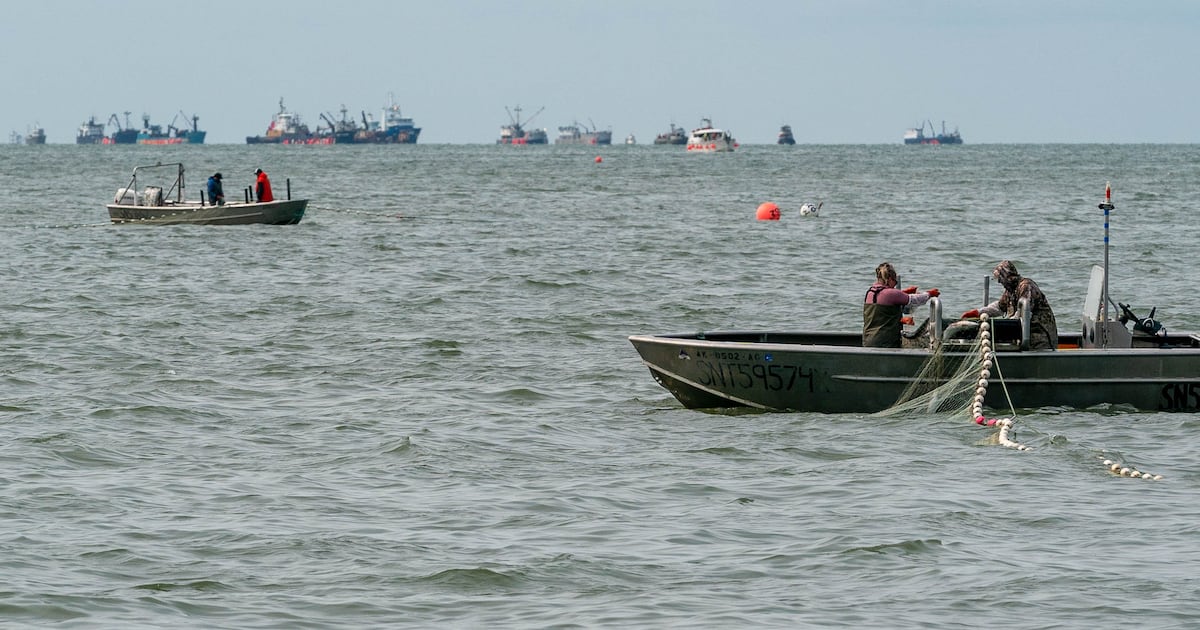
For more than 20 years, I have hosted visitors to Bristol Bay from Washington, D.C., from Juneau, from faraway places very different from my home. I share our boatyards, show them where my family picks fish from our nets, and I tell them what our people in Bristol Bay already know: that the proposed Pebble mine is a bad idea.
Last week, the U.S. Chamber of Commerce and National Mining Association — groups that call themselves “pro-business” — filed friend-of-the-court briefs in support of the proposed mine. To me, as a lifelong fisherman and as the founding chair of the Bristol Bay Economic Development Corporation, this is troubling. It shows how little they understand about the true wealth of our region and the salmon that sustains our economy, our communities and our traditional way of life.
We do not want this proposed mine. In fact, 85% of residents in the Bristol Bay region oppose the project. The proposed Pebble mine threatens our land, water and the greatest sockeye salmon runs left on Earth — which have supported thousands of years of tradition and an already-thriving salmon industry producing 15,000 jobs and $2.2 billion annually.
The Pebble Partnership and its allies have filed lawsuit after lawsuit, trying to force their project on the people of Bristol Bay. They seek to overturn the rigorous science undertaken by both Republican and Democrat administrations showing this ill-conceived mining proposal cannot move forward without risking undue harm to our waters and fisheries. And now, Outside groups that call themselves “pro-business” have joined. My question to them: Why risk our already-thriving fish economy and traditions by putting a foreign mining corporation over successful Alaskan businesses?
For 31 years, I was the founding chair of the Bristol Bay Economic Development Corp. I also served as the chief executive officer for 16 of those years. Our mission is to support economic growth for our people. The mission of the U.S. Chamber is to support economic growth for the American people. So why side with a Canadian company whose project endangers the livelihoods of thousands of Alaska fishing families and the way of life of the people of Bristol Bay?
If these groups took a closer look at the economy of our region, they would see that salmon, not mining, is best for business. The proposed Pebble mine might create 1,500- to 2,000 short-term jobs for Alaskans, but it would risk the 15,000 long-term jobs already provided by our fishery. The mining company claims a $2.3 billion net present value for its 20-year mine plan, but our fishery already provides $2.2 billion in economic activity — every year. My grandfather founded the first cannery for Bristol Bay’s commercial fishery, which is coming up on its 150th anniversary as our fishery continues to break records. The numbers are clear: Bristol Bay’s fishery is too important to risk. That is why leaders in Alaska’s State House recently introduced H.B. 233, a bill that protects our fishery from damaging large-scale mines like Pebble.
I invite these “pro-business groups” to visit us in Bristol Bay. Talk to the fish processors, the hunting and fishing lodges, small-business owners, the family-owned commercial fishing boat operators, and the men and women who depend on this fishery and make the Bristol Bay business community as successful as it is today. Rather than propping up a foreign mining corporation whose profits would largely flow out of Alaska and the United States, we should be looking after the fishing businesses that already anchor our communities, put food on our tables, and that have supported our traditions and economies for thousands of years.
H. Robin Samuelsen Jr. is the founding chairman of the Bristol Bay Economic Development Corp. and current board member of the Bristol Bay Native Corp. He is a lifelong commercial and subsistence fisherman from Dillingham.
• • •
The Anchorage Daily News welcomes a broad range of viewpoints. To submit a piece for consideration, email commentary(at)adn.com. Send submissions shorter than 200 words to letters@adn.com or click here to submit via any web browser. Read our full guidelines for letters and commentaries here.