Key events
Smiths sells airport security scanner to private equity for £2bn
The British engineering conglomerate Smiths Group has agreed to sell its airport security scanner unit to private equity firm CVC Capital Partners for £2bn.
The FTSE 100 group said it expects to receive £1.85bn in net cash by selling its Smiths Detection business, which develops tech to screen security threats at ports, borders and other travel hubs.
The company is one of the few remaining large industrial conglomerates in the UK. It started slimming down in 2021, when it offloaded its medical devices business. The group, which first listed on the stock market in 1914, has been restructuring to focus on its John Crane and Flex-Tex businesses, which supply industrial seals and pipes for industries such as oil and gas, pharmaceuticals and construction.
In October it agreed to sell Smiths Interconnect, which manufactures cable and wiring, at a valuation of £1.3bn.
Chief executive Roland Carter said:
Today we have reached another significant milestone for Smiths, with the agreement to sell Smiths Detection to CVC for an enterprise value of £2.0bn. This builds on our recently announced sale of Smiths Interconnect and demonstrates strong execution against the strategic actions we set out in January centred on value creation.
We are focusing Smiths as a premium industrial engineering company specialising in flow management and thermal solutions, and today’s announcement positions us strongly to deliver enhanced growth and returns.
We thank our Smiths Detection colleagues for their significant contribution to Smiths and their help in reaching this milestone.”
Its shares are up about 1.7% this morning and are up by 42.8% so far this year.
Jaguar Land Rover design boss ‘escorted out of office’ – reports
Gerry McGovern, the designer behind Jaguar’s divisive ad campaign last year, has been dismissed from the carmaker, just weeks after the arrival of the company’s new chief executive.
McGovern was told he was being dismissed with immediate effect on Monday, according to Autocar. It reported that McGovern was “escorted out of the office”, citing an unnamed source.
It comes after PB Balaji, the former boss of Tata Motors, succeeded Adrian Mardell as chief executive.
McGovern had been at JLR for more than two decades, where he led a revamp of Land Rover’s Defender model.
He also led the polarising rebrand of Jaguar last year, with a 30-second clip on X featuring models in brightly coloured clothing set against equally vibrant backdrops, without a car or the company’s traditional cat logo.
The campaign was met with severe backlash, drawing criticism from the likes of Nigel Farage and Donald Trump.
Mardell, who oversaw the rebrand, announced his retirement in August before leaving his job in November.
JLR declined to comment.
HSBC makes surprise chair appointment
HSBC has unexpectedly appointed Brendan Nelson as its next chair, after a long search to replace Sir Mark Tucker.
Nelson, who has been acting as interim chair since October this year, has been on HSBC’s board since 2023. He will replace Tucker, who stepped down from the role in September to take up the same post at the Hong-Kong based insurer AIA.
Nelson, 76, is a former KPMG executive and has previously been on the boards of BP and NatWest. His appointment will come as a surprise to some, given that his career has been largely focused in the UK and HSBC makes the majority of its profits in Hong Kong and China.
HSBC’s chief executive Georges Elhedery also said at the Financial Times Global Banking Summit yesterday that Nelson did not want to serve a full term of six to nine years.
Before the announcement, Elhedery said on Tuesday that Nelson would stay in the role “for as long as it takes until the board and the nomination committee identify the right chair”.
HSBC said the decision to appoint Nelson was made after a “robust process” that looked at internal and external candidates. Recent reports suggested that HSBC was also considering former chancellor George Osborne and Goldman Sachs banker Kevin Sneader for the job.
Airbus cuts delivery target after more issues with A320 jet
Elsewhere this morning, Airbus lowered its delivery target for commercial aircraft from 820 to about 790 this year, after it confirmed it had discovered a supplier quality issue on fuselage panels on its A320 family of jets.
Airbus engineers found defects on a wider set of A320 fuselage panels, according to Reuters, with around 40% of the affected jets still in assembly lines. The affected parts have the wrong thickness, Reuters reported.
The panel problem comes less than a week after Airbus warned thousands of its A320 jets needed an immediate software fix due to possible corruption from solar radiation. Most of the 6,000 planes affected by the problem received the software update over the weekend.
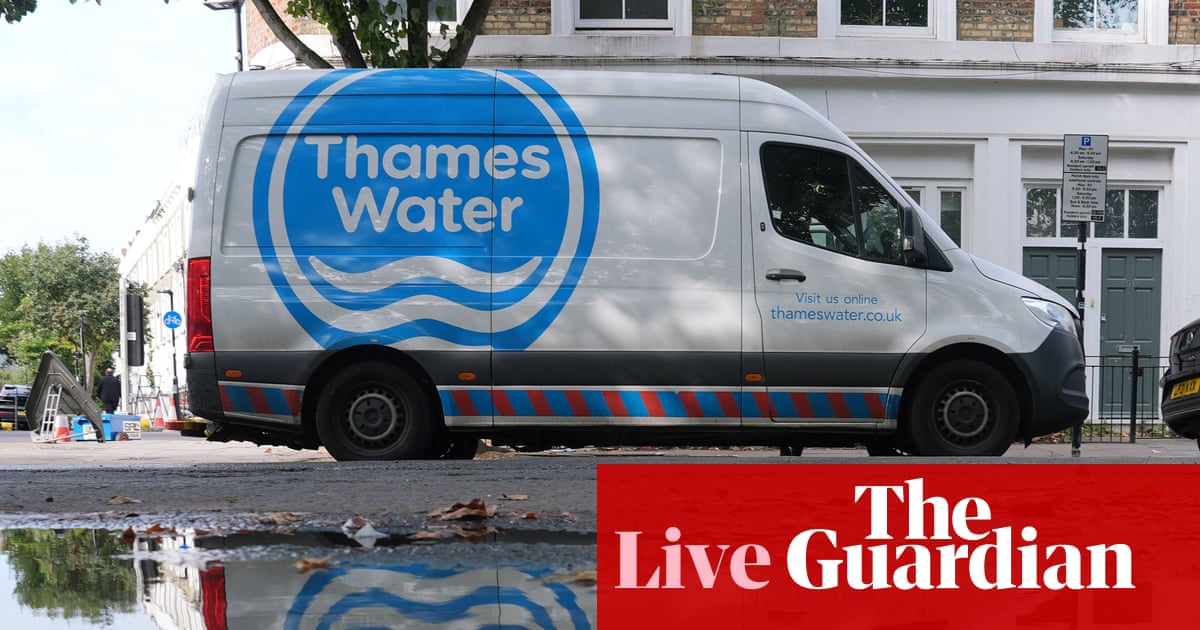
Thames Water has also warned there was “material uncertainty which may cast significant doubt” on its status as a going concern.
A collapse into government control under a special administration regime (SAR) – a form of temporary nationalisation – “could occur in the very near term” if it is unable to agree the terms of a formal takeover by its controlling lenders.
The supplier, which serves 16 million customers in south-east England, has been on the brink of collapse for years and has been dogged by poor environmental performance, with sewage leaks provoking public and political outrage and adding huge costs in the form of fines.
You can find my colleague Jasper Jolly’s full take on the story here:
Introduction: Thames Water profits surge on the back of higher bills
Good morning, and welcome to our rolling coverage of business, the financial markets and the world economy.
Thames Water has reported a leap in half-year pre-tax profit to £386m, even as it warned that it faced huge uncertainties over funding that could see it collapse rapidly into government control.
Britain’s biggest water company on Wednesday said it had swung into profit for the six months to September, after losing £230m in the same period in 2024.
Yet despite the reported profits, the company warned there was “material uncertainty which may cast significant doubt” on its status as a going concern. A collapse into government control under a special administration regime “could occur in the very near term” if it is unable to agree the terms of a formal takeover by its controlling lenders.
Thames Water has been on the brink of collapse for more than a year as it has struggled under the weight of £17bn of net debt, built up over decades since privatisation.
Chief executive Chris Weston said:
The first half of this year has been shaped by good progress across all areas of our operational transformation. We saw a 20% drop in pollutions and leakage performance is holding steady despite the extremely dry summer.
Financial performance has improved with strong revenue growth, driven by the regulated price rise, good operational expenditure control, resulting in material Ebitda growth.
We know our infrastructure requires significant investment, and that is why we have launched our biggest upgrade in over 150 years to improve our assets and consequently service to our customers and the environment.
In the first six months of this financial year, we have increased capital investment by 22% to £1.3 billion compared with the same period last year.
This investment has been funded by higher customer bills, which in turn have led to a rise in customer complaints. In response, we have increased the number of households on our social tariffs to 515,348 and launched a successful pilot that automatically enrols customers in London in financial difficulty for assistance they are entitled to, even if they are unaware of their eligibility.
This progress has all been achieved as we also manage the recapitalisation of the business. We continue to work closely with stakeholders to secure a market-led solution that we believe is in the best interests of our customers and the environment.
This in turn will allow the transformation of Thames to continue, a programme that will take at least a decade to complete and will restore the infrastructure and operations of the company.”
Elsewhere, Prada has now completed its acquisition of Versace, bringing the two major Italian luxury fashion houses under one roof.
The deal, which is worth about $1.4bn (£1bn), will build the Prada group of brands, which includes Miu Miu and Church’s, as it seeks to rival larger European luxury conglomerates such as the French LVMH.
Versace’s latest price tag is well below what its former parent company Capri Holdings paid for the brand in 2018, when it was valued at about $2bn. Designer Donatella Versace stepped down as its creative chief in March after almost three decades at the fashion company.
The agenda
9am GMT: Eurozone services PMI
9.30am GMT: UK services PMI
2.15pm GMT: Treasury Committee hearing on the budget with leading economists
4:30pm GMT: FTSE reshuffle announced